
24/7 Customer Support

Free returns

Same-day & Next-day Delivery

Quality Guaranteed

Unlock Your Welcome Offers: FREE Delivery | Up to 80% OFF | Free 30-day JoyPlus trial
Download the APP
A 4K mirror dash cam can combine forward recording, rear visibility and parking assistance in one upgrade. However, impressive resolution figures do not automatically mean a suitable system for your car. UK drivers also need to consider installation, screen reflections, memory storage, night performance and whether parking features require additional wiring.
This guide highlights common buying traps, explains the specifications that matter and matches several options to different driving needs.
Many front and rear dash cam systems advertise 4K, but the stated resolution may apply only to the front camera. A rear camera may record in 1080P, 2K or another resolution. This is not necessarily a problem: 1080P can provide useful rear footage, but buyers should understand the specification before purchasing.
Check both figures separately, particularly if you drive a long vehicle, tow a trailer or want clearer number plate footage behind you.
A parking monitor may need a separate hardwire kit connected to the fuse box. Using the 12V socket alone may not support continuous recording after the ignition is switched off. Incorrect installation can also create battery-drain or cable-routing concerns.
If you want 24-hour parking monitoring, check whether the hardwire kit is included and consider professional installation. Cables should be routed safely around trim and away from airbags and driving controls.
A rear-view mirror dash cam normally mounts over the original mirror with adjustable straps, but mirror dimensions vary. Some models specify a maximum mirror height, while larger screens may be less suitable for compact mirror housings.
The rear camera may be installed inside the rear window or externally near the number plate. External mounting can improve positioning but requires a secure, waterproof connection and careful cable routing. Always check that the image remains unobstructed.
A front 4K camera records at approximately 3840 × 2160 pixels, while a 1080P rear camera records at 1920 × 1080 pixels. Higher resolution can retain more detail when footage is viewed on a larger screen, although results also depend on lighting, lens quality, exposure and windscreen cleanliness.
For UK roads, a wide field of view can help capture surrounding traffic. The WOLFBOX M40lite, for example, specifies a 170° front viewing angle.
A 10-inch mirror dash cam usually offers a practical balance between display area and space around the original mirror. A 12-inch mirror dash cam provides a larger image, which may be useful in vans, SUVs and trucks, but buyers should confirm that it will not obscure important visibility.
A touchscreen dash cam makes it easier to adjust camera views, brightness and recording settings. Nevertheless, the display should not distract you while driving. If the unit replaces the reflective view, check the product instructions and your vehicle requirements. The G930 guidance states that the reflective display should still allow a clear rear view when the screen is off and refers to ECE R46 compliance for replacement mirrors; confirm suitability for your specific vehicle before installation.
Most systems use loop recording, which automatically overwrites older unlocked clips when the card is full. A G-sensor can detect a collision and lock relevant footage against automatic overwriting.
Check the supported card type and capacity. The M40lite supports a Class 10/U3 microSD card up to 256GB, with the card sold separately. Other options include a 32GB or 64GB card. Format the card in the device before recording and replace it if recording errors or corrupted files become frequent.
Additional features such as GPS, Wi-Fi, night vision, ADAS and BSD should be treated as practical functions rather than substitutes for attentive driving. GPS may record location and speed data, while Wi-Fi can simplify file transfer to a compatible app. ADAS and BSD alerts may vary with road conditions, camera position and settings.
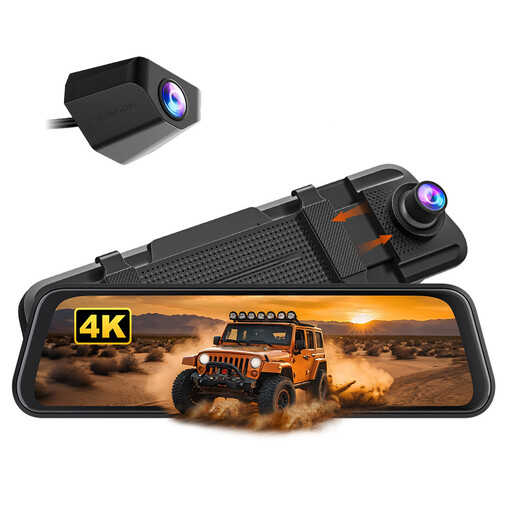
Why This Fits Their Persona: A straightforward option for drivers upgrading from a basic single-camera recorder, including commuters and everyday car owners.
The front and rear resolutions are stated separately, and the 10-inch format avoids assuming that a larger screen suits every vehicle.
4K front recording, 1080P rear camera, 10-inch IPS touchscreen, loop recording and G-sensor.
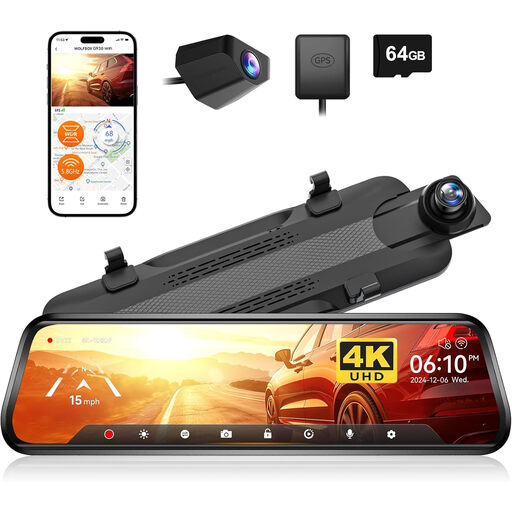
Why This Fits Their Persona: Suitable for motorists wanting app connectivity, location logging and a supplied memory card in one package.
The listing identifies the 64GB card, GPS logger and 5.8GHz Wi-Fi, while clearly noting that parking monitoring needs a separate hardwire kit.
4K front camera, 1080P/2K rear camera with WDR, GPS, Wi-Fi, parking monitor and dynamic reverse guidelines.
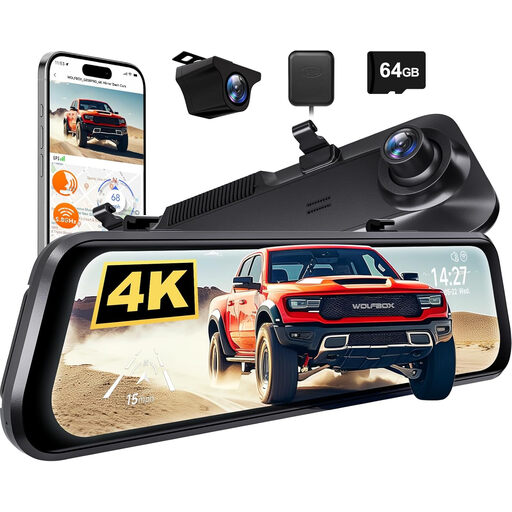
Why This Fits Their Persona: The 12-inch format and feature set may suit larger cars, vans, pickups and drivers who regularly travel long distances.
Its 12-inch screen is clearly specified, and the installation notes identify the mirror height limit, GPS placement and reversing-light connection requirements.
4K front and 1080P rear recording, ADAS, BSD, voice control, GPS, dual-band Wi-Fi and included 64GB card.
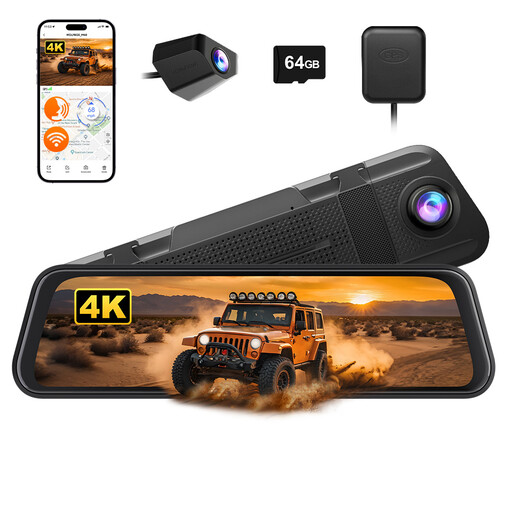
Why This Fits Their Persona: A useful match for drivers of cars, SUVs or trucks who want broad compatibility and configurable rear-camera placement.
It supports 12V–24V systems and explains that the rear camera can be fitted internally or externally. Parking monitoring still requires a separate hardwire kit.
4K and 1080P dual-camera recording, ADAS/BSD, voice control, GPS, Wi-Fi and adjustable viewing angle.
Before ordering, confirm the following:
For a cleaner finish, cables can be tucked along the headliner and trim, but avoid interfering with airbags. A hardwire installation should be completed carefully, particularly when parking monitor mode is enabled.
We have compiled a complete, real-time list of products that fully satisfy these strict selection criteria and UK safety regulations.
It can be useful if you want front and rear recording, a larger rear display and parking or reversing assistance in one unit. The main trade-offs are more involved installation, greater storage use and the need to check mirror fitment carefully.
Not for ordinary driving recordings when the device is powered through the supplied 12V car charger. A hardwire kit is commonly required for continuous parking monitoring, and installation should account for battery protection and safe fuse-box connections.
4K footage uses more space than 1080P footage. Choose the card capacity supported by the product, use the stated speed class and rely on loop recording to manage storage. Lock important clips after an incident and format the card within the camera according to the instructions.