Print-bound album designers
If you approve spreads for printing, prioritise a defined colour target and a workflow you can recalibrate over time. Maximum screen brightness alone cannot tell you how a printed image will look.


For print-bound album spreads, choose a colour-managed 4K monitor with reflection control and a calibration workflow suited to the intended output. If you mainly review layouts on screen, an anti-reflective 4K desk monitor with the connections you need may be sufficient, but neither route removes the need to manage window reflections and changing room light.
If you approve spreads for printing, prioritise a defined colour target and a workflow you can recalibrate over time. Maximum screen brightness alone cannot tell you how a printed image will look.
If you review images beside a window, tackle visible reflections before judging shadow detail or the balance across a spread. Screen treatment, placement and control of incoming light all matter.
If the monitor is part of a laptop desk, check both the viewing position and the connection. A single-cable setup depends on the laptop, monitor configuration and cable supporting the required video and charging functions.
For album spreads beside a bright window, decide which issue would most affect your approval decision: reflections, print colour, viewing space or the laptop setup. Then check the exact monitor against that priority.
| Concern | What to check | Who this matters to |
|---|---|---|
| Window reflections | Check the screen's anti-reflective treatment and whether a compatible hood is included; plan where the panel will face. | If reflected window light obscures shadows or distracts from the spread, I need to control it before approving images. Around 36% of consumers would put reflection control first. |
| Print colour | Check the gamut modes, calibration method and uniformity controls against your intended print workflow. | When a spread is headed for print, I need repeatable colour rather than a vivid-looking screen alone. Print-colour confidence would be the primary concern for around 29% of consumers. |
| Spread viewing space | Confirm 3840 × 2160 resolution, screen size and whether the monitor fits your desk and viewing distance. | If I regularly assess a full two-page layout, I need enough physical space to see its composition as well as pixels for close inspection. Around 21% of consumers would make viewing space their first priority. |
| Laptop setup | Match the laptop's video output and charging needs to the monitor's ports, power delivery and cable requirements. | For a desk shared with a laptop, I want the display positioned comfortably without discovering that my planned connection cannot carry video or charge the computer. Connectivity and adjustment would come first for around 14% of consumers. |
A 4K pixel grid helps with detail, but it does not keep a display's white point or luminance stable over time. EIZO recommends periodic calibration for monitors used in graphics work.
For print approval, check the available calibration method and colour target as well as the resolution.
The workflow may also require a compatible calibration device and time to recalibrate.
ASUS specifies 1,200 nits as peak HDR brightness for the ProArt PA32UCX-K. EIZO gives 100 cd/m² as a printing preset example; the figures describe different uses, not interchangeable settings.
Control reflections to make the screen viewable, then calibrate it to the target appropriate for the intended output and viewing conditions.
BenQ lists 90 W USB-C power delivery and DisplayPort Alt Mode for the SW272U; Dell lists power-delivery options up to 140 W for the U2725QE. The laptop, chosen monitor configuration and cable still have to work together.
Check the laptop's video-output mode and charging requirement against the exact monitor and cable before relying on one connection.
A suitable cable, dock or separate charger may be needed.
These product lines illustrate different priorities: print-oriented controls, a laptop desk setup and specialist HDR work. Check the exact model rather than assuming every monitor from a brand has the same features.
BenQ UK positions the 27-inch 4K SW272U for photographic work and specifies a 400-nit typical brightness, wide-gamut modes, hardware calibration, uniformity technology and a shading hood.
Dell UK lists the 27-inch 4K UltraSharp U2725QE with an anti-glare, anti-reflective surface, height adjustment, ambient-light sensor and Thunderbolt hub functionality.
ASUS describes the 32-inch 4K ProArt PA32UCX-K as a mini-LED HDR display with 1,200-nit peak brightness and support for multiple professional colour spaces.
These 4K monitors offer different starting points for spread review, from colour-focused displays to larger desk screens. For use beside a bright window, check reflection control and the intended colour workflow for each exact model before choosing.
 No image available
Consider this 32-inch display if you review album spreads alongside HDR work and have room to position a larger screen away from direct reflections.
The product title identifies an IPS mini-LED panel, 120 Hz refresh rate, hardware calibration and Thunderbolt 3. Confirm the exact peak-brightness specification and whether a compatible shading hood is included; peak HDR brightness is not a print-calibration target.
 No image available
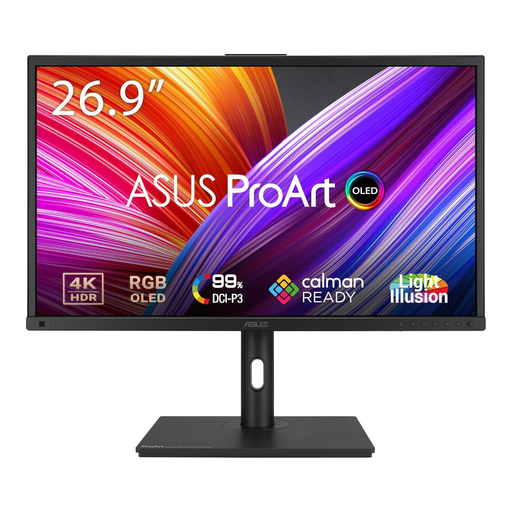
This 4K OLED model is a colour-focused option to assess if album-spread work is headed for print.
Check its typical brightness, screen reflections and whether a shading hood is included for your window-side position. Confirm the calibration method and target required by your print workflow rather than relying on factory calibration alone.
 No image available
Consider the larger screen if physical viewing space matters to you, while checking whether a curved panel suits the way you assess two-page layouts.
The product name specifies 3840 × 2160 resolution, 99% DCI-P3 coverage and USB-C with 65 W power delivery. Confirm its screen-surface treatment and calibration method before relying on it for bright-window or print-critical review.
 No image available
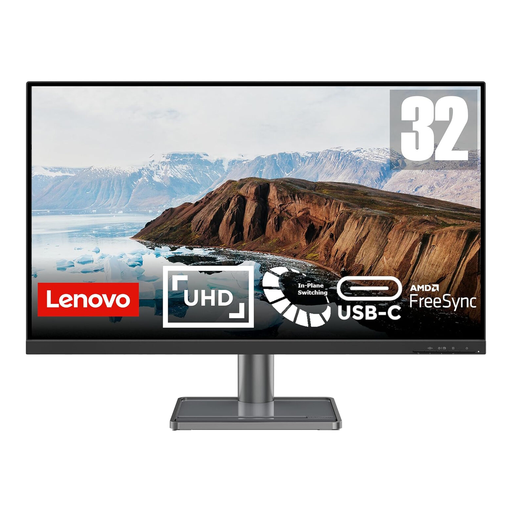
The 31.5-inch format is worth considering if you want a physically larger canvas for full-spread layout review and can accommodate it on your desk.
The product name specifies a 4K IPS display and USB-C connection. Check the screen's reflection treatment and calibration options for window-side print work, and confirm USB-C video and charging compatibility with your laptop.
 No image available
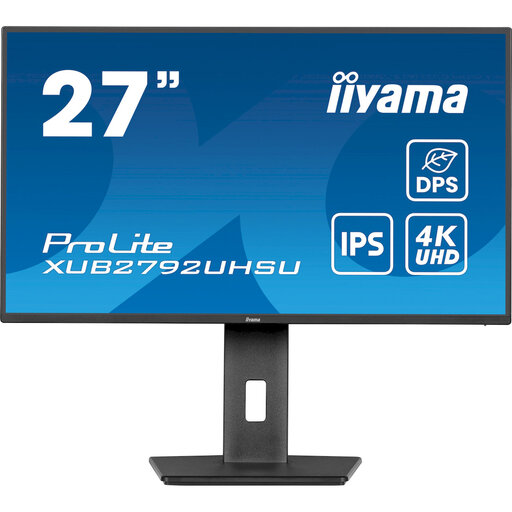
This 27-inch 4K model is an option to assess for layout detail where a smaller desk footprint matters.
Check the screen's actual reflection treatment before placing it beside a bright window: the product name's matte-black description refers to its finish, not necessarily the display surface. For print approval, also confirm the colour modes and calibration workflow you need.
Not on brightness alone. BenQ UK specifies 400 nits typical brightness for the SW272U, but direct window reflections can still interfere with viewing; check the screen treatment, position the panel to avoid reflected light and use a hood or blind where needed.
Yes, if you need dependable colour over time, plan for periodic calibration to a target suited to your output. EIZO notes that a monitor's white point and brightness change with use and recommends calibrating a graphics monitor at least every 200–300 hours; its printing preset of 100 cd/m² and 5500 K is an example, not a universal target for every printer, paper and room.
No. Choose a monitor mode and colour-managed application workflow that match the intended output. BenQ UK lists several colour modes for the SW272U, but a wide-gamut setting by itself does not establish that a spread preview will match a print.
Not necessarily: GOV.UK guidance dated 31 March 2026 says Great Britain continues to recognise CE marking alongside or instead of UKCA marking where the applicable product regulations allow it. Check the rules for the exact product and its destination; Northern Ireland has separate arrangements. The marking does not replace checks on the supplied plug, documentation and seller support.