Colour-conscious vector-art students
If you review logos, illustrations, icons or layouts for digital submission, stated sRGB coverage and calibration information for the exact monitor model give you more to assess than resolution alone.


For digital vector-art review, start with a 4K monitor whose exact model has stated sRGB coverage and calibration information, then check whether its stand fits your student-room desk. A 27-inch model is a useful starting point, not a requirement; if you use a laptop, confirm USB-C video support and charging wattage separately. Colour specifications alone cannot guarantee that artwork will match a print or another screen.
If you review logos, illustrations, icons or layouts for digital submission, stated sRGB coverage and calibration information for the exact monitor model give you more to assess than resolution alone.
If one laptop is your main computer, consider how the monitor will connect and whether its stand and cables will fit the space available.
If you spend long sessions reviewing work, measure desk depth and consider screen height, adjustment and glare alongside display specifications.
For vector artwork reviewed mainly on screen, assess the exact model's colour specifications first, then make sure the display fits your desk and connects to your laptop as intended.
| Concern | What to check | Who this matters to |
|---|---|---|
| Colour confidence | Check the exact model's stated sRGB or Rec.709 coverage and its calibration information. Coverage does not guarantee print matching. | If my vectors are submitted or shared digitally, I want to judge fills and colours using a stated standard-gamut specification rather than resolution alone. Around 42% of consumers put colour confidence first. |
| Desk fit and viewing position | Measure desk depth and cable clearance; compare stand dimensions and adjustment options, or check mount compatibility. | At a shallow student-room desk, I need room to position the screen comfortably without losing space for my work. Desk fit is the primary concern for around 33% of consumers. |
| Laptop connection | Confirm laptop video output over USB-C and compare the monitor's Power Delivery rating with the laptop's charging needs. | When I work from one laptop, I would rather avoid extra connections, but I need to know that video and charging will work with my machine. Around 25% of consumers put laptop connectivity first. |
Resolution describes pixel count, not sRGB coverage or calibration. Those specifications matter separately when you review vector colours on screen.
Compare the exact model's stated colour-space coverage, calibration information and available colour modes before choosing it for digital artwork.
A USB-C connection does not establish that your laptop can send video through it or that the monitor can supply enough power for your workload.
Check the laptop's display-output documentation and compare its charger rating with the monitor's Power Delivery specification.
You may still need the laptop's own charger or a separate display connection.
The Health and Safety Executive notes that overuse or a poorly arranged display-screen workstation can contribute to fatigue, eye strain and physical discomfort.
Measure the desk before ordering. If an arm would solve a positioning problem, check its mounting pattern and supported monitor weight.
Dell UK marks the UltraSharp U2723QE as unavailable on its product page, although its specifications remain useful for comparison.
If that model interests you, check current availability and the exact identity of any alternative before making your decision.
ASUS UK describes the ProArt PA279CV as a 27-inch 4K IPS monitor with stated 100% sRGB and 100% Rec.709 coverage, a Delta E below 2 colour-accuracy claim and 65W USB-C Power Delivery.
BenQ UK lists the PD2705U as a 27-inch 4K IPS model with stated 99% sRGB and 99% Rec.709 coverage, a factory calibration report, 65W USB-C Power Delivery and 100 × 100 mm VESA mounting.
Dell UK lists the 27-inch 4K U2723QE with stated 100% sRGB, 100% Rec.709 and 98% DCI-P3 coverage, plus USB-C Power Delivery of up to 90W.
These 4K monitors offer different screen sizes and display types for reviewing artwork at a student-room desk. Compare each exact model's colour specifications, physical fit and laptop connections against your own workflow.
 No image available
Consider the larger 32-inch screen if your desk has enough depth for it. The product name specifies an IPS Mini LED display, 120 Hz and Thunderbolt 3; check the exact colour-space modes and your laptop's video and charging compatibility before relying on it for your workflow.
 No image available
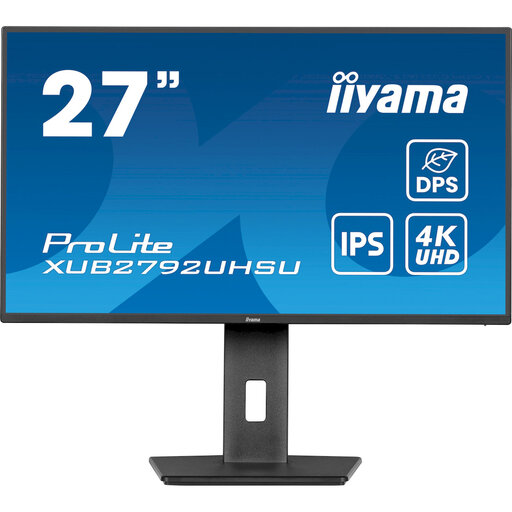
A 27-inch option to assess when desk space shapes your choice. Its product name specifies a 16:9 LED monitor; for colour-sensitive review or laptop charging, check the exact model's calibration, Rec.709 and USB-C specifications.
 No image available
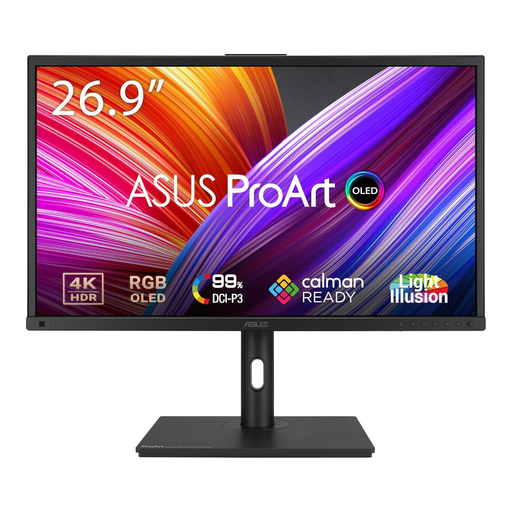
Consider this OLED model if you want to assess a 27-inch display for artwork review. Check its exact sRGB and Rec.709 specifications for standard digital work, as well as video output and charging compatibility with your laptop.
 No image available
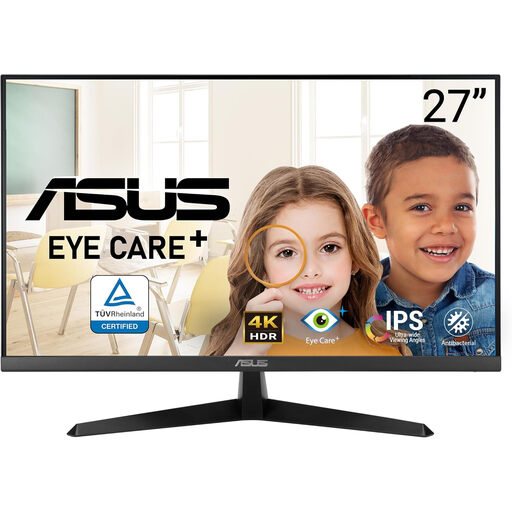
This 27-inch option is worth assessing if you review vectors on a compact desk. Its product name states a 60 Hz refresh rate, which does not establish colour accuracy; check calibration and colour-space information, along with the stand's dimensions and adjustment, before choosing it.
For artwork intended mainly for standard digital viewing, stated sRGB coverage is a useful specification to check, but a particular percentage alone does not guarantee accurate results. ASUS UK states 100% sRGB for the PA279CV, while BenQ UK states 99% for the PD2705U; check colour modes and calibration for the exact model you choose.
Only if your laptop supports video output through that connection and the monitor supplies suitable charging power. ASUS UK and BenQ UK list 65W Power Delivery for the PA279CV and PD2705U respectively, while Dell UK lists up to 90W for the U2723QE; compare the exact monitor with your laptop's documentation and charger rating.
Measure desk width, depth, cable clearance and the space available for screen height. Then compare the exact monitor-with-stand dimensions and adjustment range; if you plan to use an arm, check its mounting pattern and supported weight too.
Ask your retailer or local recycling service which electrical-equipment collection route is available to you rather than placing an old monitor in general waste. GOV.UK explains that UK waste electrical and electronic equipment measures are intended to reduce disposal through landfill and incineration.