Who these monitors suit

Dark-scene HDR players

If adventures take you through night scenes, caves or high-contrast environments, you may put black levels and HDR presentation ahead of the highest refresh-rate figure. Compare the exact model’s HDR characteristics rather than relying on an HDR label alone.

4K console-and-PC players

A conventional 16:9 screen may suit you if you want 4K detail on both a PC and a console. Check the resolution, HDR, variable refresh rate (VRR) and refresh-rate modes supported by your particular monitor and source device.

PC ultrawide explorers

A curved 21:9 screen may appeal if you mainly play PC adventures that support the wider format. It is a different choice from 16:9 4K: game support, native resolution and the space available on your desk all matter.

What matters when choosing

32-inch 4K OLED

Choose it when: You want a familiar 16:9 image for detailed PC play and a console setup.

Accept: Less horizontal screen space than a 21:9 ultrawide, and the need to follow the exact OLED model’s panel-care and warranty guidance.

Curved 21:9 OLED

Choose it when: You mainly play PC adventures that support ultrawide output and prefer a broader view to native 4K resolution.

Accept: More demanding desk fit and game-format checks; a 21:9 screen is not the straightforward default for console play.

ConcernWhat to checkWho this matters to
HDR and dark scenes Check the exact model’s VESA DisplayHDR or DisplayHDR True Black certification and panel type; an HDR label alone gives you less to compare. If dark environments and bright highlights shape how I experience a story, I want to assess contrast before chasing speed. Around 31% of consumers put HDR and dark-scene presentation first.
4K detail and format Confirm native 3840 × 2160 resolution, screen size and whether your PC can deliver the performance you expect at 4K. For detailed scenery and readable interface text, I would rather keep a standard 16:9 image than depend on ultrawide support. Roughly 31% of consumers make 4K detail their primary concern.
Ultrawide PC view Check your games’ 21:9 support, the monitor’s native resolution and its fit at your viewing distance. When exploring a game world on PC, I may value a wider supported view more than native 4K. Around 23% of consumers put ultrawide presentation first.
Console connections Match your console’s intended output mode to the monitor’s HDMI input and your cable; check VRR support separately. If I switch between a console and PC, I want to know which video modes will work through my connections before ordering. Approximately 15% of consumers prioritise that compatibility check.

Checks that are easy to miss

  • Taking an HDR label as a performance comparison

    An HDR label by itself does not tell you how two specific monitors handle contrast or colour. VESA’s DisplayHDR and DisplayHDR True Black certifications give you named criteria to check.

    Compare certification and stated HDR characteristics for the exact models on your shortlist; do not assume every monitor in a range shares the same certification.

  • Assuming a 120 Hz panel guarantees console 4K at 120 Hz

    Xbox Support specifies an Xbox Series X, an Ultra High Speed HDMI cable supporting HDMI 2.1 and an HDMI 2.1-capable display for Series X 4K gaming at 120 Hz. The panel’s refresh rate alone does not establish that the connection will provide this mode.

    Check your console model, the monitor’s exact HDMI capabilities and every connection between them, including any AV receiver.

    You may need a different Ultra High Speed HDMI cable for the intended Xbox connection.

  • Choosing an ultrawide without checking the setup

    A large curved 21:9 screen takes up considerable desk space, while games differ in how they handle ultrawide output. LG lists its 45GS96QB-B as a 44.5-inch, 3440 × 1440, 800R model.

    Measure your usable desk space and check the games you play most before committing to an ultrawide format.

  • Treating OLED-care features as a burn-in guarantee

    Panel-care and cooling measures described by Samsung and ASUS are risk-reduction features, not a promise that long periods of static imagery carry no risk.

    Read the warranty and care guidance for the exact model, particularly if you often leave a desktop or fixed game interface on screen.

Brands relevant to these formats

Samsung

The Odyssey OLED G8 G80SD is one 32-inch 4K QD-OLED option to examine for a conventional-format setup.

  • Samsung UK specifies a 4K QD-OLED display for the G80SD.
  • Check the exact model’s warranty and panel-care guidance rather than treating OLED protection features as eliminating burn-in risk.

LG UltraGear

LG’s 45GS96QB-B illustrates the large, curved ultrawide route for PC-first play.

  • LG UK specifies a 44.5-inch, 3440 × 1440, 21:9 OLED panel with an 800R curve and DisplayHDR True Black 400 for this model.
  • Its size and native resolution need to suit your desk, games and preference for ultrawide rather than 16:9 4K.

ASUS ROG

The ROG Swift OLED PG32UCDM is a 31.5-inch-class 4K QD-OLED example for buyers comparing PC-focused connections.

  • ASUS ROG specifies 3840 × 2160 resolution, a 240 Hz panel, HDMI 2.1 and USB-C with 90 W Power Delivery for this model.
  • ASUS describes its thermal design as reducing burn-in risk; check the model’s warranty and your static-screen habits rather than interpreting that claim as zero risk.

Joybuy monitors to consider

These choices span a dual-mode 4K OLED, curved ultrawide options and a smaller QHD OLED. Match the screen format to your games and desk first, then check the exact output modes you need for a console.

LG UltraGear 32GS95UV-B OLED gaming monitor

LG UltraGear 32GS95UV-B 32-inch OLED monitor

Consider this if cinematic 4K play is your priority but you also want a faster, lower-resolution mode for other games.

The listed dual modes are 4K at 240 Hz and Full HD at 480 Hz; the 480 Hz mode does not retain 4K detail. The title also specifies HDMI 2.1 and DisplayPort.

Check the console output modes you intend to use and the model-specific OLED warranty.

View on Joybuy

LG UltraGear 34GX900A-B OLED gaming monitor

LG UltraGear 34GX900A-B 34-inch OLED monitor

Consider this curved ultrawide option for PC adventures that support a wider view.

Its product title specifies WQHD resolution and a 240 Hz refresh rate. Check your games’ ultrawide support, desk fit and the model-specific OLED warranty.

View on Joybuy
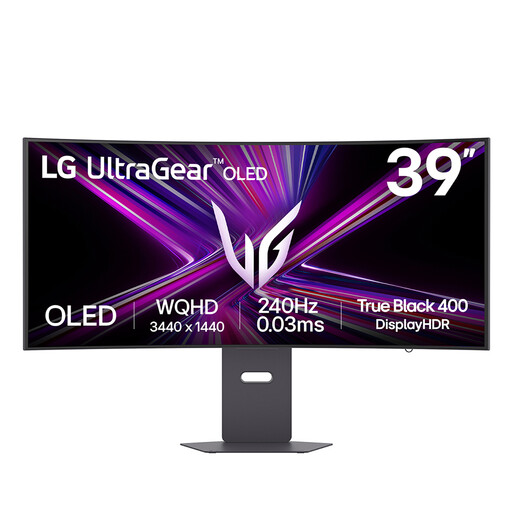
LG UltraGear 39GX900A-B OLED gaming monitor

LG UltraGear 39GX900A-B 39-inch OLED monitor

This larger curved ultrawide option is worth considering for PC adventures that support the format.

The product title specifies QHD and 240 Hz. Check the screen dimensions against your desk, confirm support in your games and read the model-specific OLED warranty.

View on Joybuy

Acer Predator X27U W3 QD-OLED gaming monitor

Acer Predator X27U W3 26.5-inch QD-OLED monitor

Consider this standard-format option if OLED gaming interests you but native 4K detail is not essential.

The title specifies 2560 × 1440 resolution, 240 Hz and HDR10; HDR10 alone is not a VESA DisplayHDR certification. Check your intended console modes and the model-specific OLED warranty.

View on Joybuy

Acer Predator X49X curved QD-OLED gaming monitor

Acer Predator X49X 49-inch curved QD-OLED monitor

Consider this exceptionally wide format only if your PC games support it and your desk can accommodate it.

The title specifies a 32:9 screen, 1800R curve, Double Quad HD resolution, 240 Hz and DisplayHDR 400 True Black. Confirm the exact port configuration and supported input modes before choosing it.

View on Joybuy

Common questions

Do cinematic adventure games need a 240 Hz monitor?

No: a 240 Hz panel is not a requirement for cinematic adventure games. Resolution, HDR characteristics, screen format and device compatibility may be more useful starting points; a high refresh rate remains worthwhile if your PC and games can make use of it.

How can I check the video modes available on my PS5 or Xbox?

Check the console’s output information alongside the monitor’s supported modes and the connection you plan to use. PlayStation UK describes PS5 video-output settings and a test for supported 1440p SDR or HDR, 60 or 120 Hz, and VRR modes. For Xbox Series X 4K gaming at 120 Hz, Xbox Support specifies a Series X, an Ultra High Speed HDMI cable supporting HDMI 2.1 and an HDMI 2.1-capable display.

What if a monitor arrives faulty or not as described?

GOV.UK guidance says a retailer must offer a full refund for goods that are faulty, not as described or do not do what they are supposed to do. Keep the order details and contact the retailer about the problem; a voluntary change-of-mind policy is separate from remedies for those faults.

Which electrical marking should I check on a monitor?

For electrical equipment, GOV.UK’s guidance dated 31 March 2026 lists UKCA or CE marking for Great Britain, and CE or UKNI together with CE for Northern Ireland. Check the marking applicable to where the monitor is supplied rather than assuming the same route applies in both places.