Daylight sandbox builders
You plan and navigate detailed worlds while the room is brightly lit. Reflections and readable building details matter more to you than the highest advertised refresh rate.


For building detailed sandbox worlds in a bright room, start with the screen’s reflection treatment and the resolution your device can run comfortably, rather than choosing by refresh rate alone. A 4K IPS model with a specified anti-glare surface is worth considering when fine detail comes first; QHD OLED and QD-OLED models offer fast-motion options, but their reflection treatment, typical brightness and screen-care guidance need checking model by model.
You plan and navigate detailed worlds while the room is brightly lit. Reflections and readable building details matter more to you than the highest advertised refresh rate.
You want to inspect terrain, structures and interface text closely, and can check whether your PC and connection support your preferred high-resolution mode.
You switch between building and faster games, so refresh rate and response time matter alongside daylight visibility. If you choose OLED, you also want to understand the exact model’s brightness specifications and screen-care guidance.
Choose a screen you can position and read comfortably in daylight, then decide how much you value 4K building detail against QHD high-refresh play. The model-specific specifications below illustrate three different routes, not interchangeable guarantees about every IPS or OLED monitor.
Consider it when: Fine building detail is your priority. Dell UK specifies an anti-glare IPS panel and 4K at 180Hz for the Alienware AW2725QF.
Trade-off: Check whether your device can run the 4K mode you want; the AW2725QF’s faster 360Hz option switches to FHD.
Consider it when: You also value fast motion and can place the screen away from direct sunlight. LG UK specifies QHD, 240Hz and an anti-glare, low-reflection surface for the 27GS93QE-B.
Trade-off: Its stated 275-nit typical brightness and 1,300-nit peak brightness describe different conditions; read the exact model’s screen-care guidance for persistent game interfaces.
Consider it when: Reflections concern you but QHD high-refresh play remains important. Samsung UK specifies QHD and 240Hz for the Odyssey OLED G6 G61SH and says its Glare Free treatment reduces external-light reflections.
Trade-off: That reflection statement is model-specific manufacturer information, not a reason to place the panel in direct sunlight.
| Concern | What to check | Who this matters to |
|---|---|---|
| Daylight visibility | Check the exact surface treatment and typical SDR brightness, then consider where windows and lights will reflect in your viewing position. | If reflections obscure dark areas or small interface elements while I build, I need a screen I can read in my room. Around 36% of consumers put daylight visibility first. |
| World detail | Check native resolution and the refresh rate available at that resolution with your device and connection. | When I inspect terrain, structures and menus, I would prioritise fine detail over a faster alternative mode. Roughly 29% of consumers make world detail their primary concern. |
| Motion and refresh | Confirm whether the desired mode is native or overclocked, and whether your device, port and cable support it. | I move between building and fast action, so responsiveness matters when the pace changes. Around 21% of consumers place motion performance first. |
| OLED ownership | Read typical brightness separately from HDR peak conditions, and check the exact OLED model’s screen-care and warranty guidance. | With maps or game interfaces on screen for long sessions, I want to understand the panel’s care requirements before choosing OLED. For roughly 14% of consumers, that ownership question comes first. |
Brightness figures can describe different test conditions. LG UK lists 275 nits typical and 1,300 nits peak for the 27GS93QE-B; its DisplayHDR True Black 400 statement is qualified at a 10% average picture level.
For a bright room, compare typical SDR brightness and reflection treatment separately from HDR peak figures, and consider whether direct light will strike the screen.
A faster mode may require specific hardware or settings. LG UK lists 180Hz native operation for the 27GS85Q-B and requires DisplayPort 1.4-capable graphics hardware and cable for its 200Hz overclocked mode.
Match your device’s ports and cable to the resolution and refresh mode you actually intend to use.
Persistent maps, menus and other game-interface elements make the exact model’s guidance relevant. LG UK describes Screen Move, Screen Saver and Image Cleaning for its 27GX790A-B, but those features should not be assumed for another model.
Read the candidate monitor’s user guidance and warranty terms, and use the protection features available on that model.
The AW2725QF is a reference point for combining a specified anti-glare IPS surface with a choice of detail-focused and faster-play modes.
LG UK documents both a QHD high-refresh IPS route and a QHD OLED route with anti-glare, low-reflection treatment.
The Odyssey OLED G6 G61SH is a QHD high-refresh option for shoppers examining manufacturer-stated glare reduction.
These monitors offer different ways to approach sandbox gaming, from a dual-mode 4K OLED to QHD OLED and IPS options. Compare the exact display mode and room-light requirements of each rather than treating them as equivalent bright-room choices.
 No image available
Consider this if detailed world-building and an alternative faster-play mode both matter to you. Its title specifies a 32-inch 4K OLED screen and Dual Mode with a maximum of 330Hz; confirm the resolution, device connection and cable required for the mode you want.
For a bright room, check typical SDR brightness and screen placement. Follow the model’s guidance on prolonged static images.
 No image available
Consider this QHD option if you want sandbox detail alongside fast-motion play and can assess how the screen will sit relative to room light. The product name specifies 2560 × 1440 resolution, 240Hz, 0.03ms response time and Adaptive-Sync.
Check whether your device supports the intended mode, and read the applicable panel warranty terms before choosing it for long sessions.
 No image available
Consider this model if QHD play and fast motion are priorities, while checking its suitability for your room’s lighting. Its title specifies a 27-inch QHD OLED display, 240Hz and 0.03ms response time.
Confirm typical brightness, reflection treatment and support for your chosen device connection; avoid direct sunlight on the panel.
 No image available
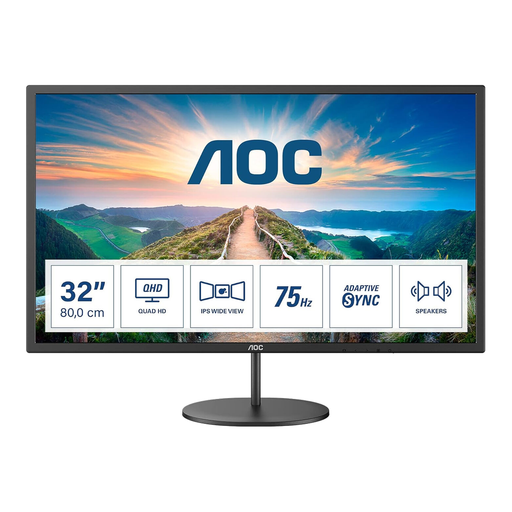
Consider this larger IPS option if screen space for building is more important to you than choosing an OLED model. Its title specifies a 31.5-inch IPS screen, 4ms response time, Adaptive-Sync and built-in speakers.
Check its native resolution, available refresh modes and brightness against your device and room before choosing it for fast games or daylight use.
Choose 4K when fine terrain, structures and interface detail matter most and your PC can run your preferred mode; choose QHD when you would rather prioritise a high-refresh option. Dell UK’s Alienware AW2725QF illustrates another choice: its specified modes are 4K at 180Hz and FHD at 360Hz, so switching modes also changes resolution.
An anti-glare label does not establish how a monitor will look with direct sunlight on its panel. Check the exact model’s surface treatment and typical SDR brightness, then consider whether you can position the screen away from direct light.
No; the available mode depends on the monitor, graphics hardware, port and cable. For LG UK’s 27GS85Q-B, the listed 200Hz overclocked mode requires DisplayPort 1.4-capable graphics hardware and a DisplayPort 1.4 cable, while its native listed refresh rate is 180Hz.
Read the exact OLED model’s screen-care instructions and warranty terms, rather than assuming all models have the same protections. LG UK describes Screen Move, Screen Saver and Image Cleaning for its 27GX790A-B; check which functions are available on the monitor you intend to buy.