Wholegrain-focused lunch planners
You want a wholewheat pasta base and are happy with its different flavour and texture. The NHS recommends choosing wholegrain starchy foods where possible; the rest of the lunch still matters.


For a 500g lunch pasta pack, wholewheat is a useful starting point if you can eat wheat: NHS guidance recommends choosing higher-fibre or wholegrain starchy foods where possible. Choose the shape for how you will serve it, use that pack’s dry-portion guidance, and plan vegetables, a protein food and any sauce as part of the meal. If you need to avoid gluten, choose a clearly labelled suitable alternative instead of ordinary wholewheat pasta.
You want a wholewheat pasta base and are happy with its different flavour and texture. The NHS recommends choosing wholegrain starchy foods where possible; the rest of the lunch still matters.
You want to divide a 500g pack between meals or serve pasta hot and cold. Shape and the chosen pack’s dry-portion guide help you plan what to cook.
You need a suitable alternative to wheat-based wholewheat pasta. Coeliac UK identifies wheat as a gluten-containing grain, so check each product’s ingredients, labelling and relevant cross-contact information.
Start with any dietary restriction, then consider how the pasta fits into the whole lunch and how you intend to portion and serve it.
| Concern | What to check | Who this matters to |
|---|---|---|
| Wholegrain and fibre | Check the ingredients for wholewheat and compare declared fibre using the same dry or cooked basis. Confirm wheat and gluten suitability. | I want wholegrain pasta to be the starting point for my lunch and can eat wheat. About 37% of consumers would put this need first. |
| The complete lunch | Plan vegetables and a protein food; check a prepared sauce’s serving size and nutrition separately. | Pasta is only one part of the meal I am putting together, and the additions matter to my choice. For about 27% of consumers, building the complete lunch would come first. |
| Portions and preparation | Follow the chosen pack’s dry-portion guide. Decide whether a short shape for a cold lunch or a long shape for a hot meal suits your plans. | I need to divide a 500g pack between lunches and choose a shape that works in the dish I am making. Roughly 18% of consumers would prioritise that planning. |
| Gluten and allergens | Read the current ingredients and allergen information, including any relevant precautionary statement; check the exact pack size of a suitable alternative. | Before considering shape or fibre, I need to know whether the pasta meets my dietary restriction. That would be the primary concern for about 18% of consumers. |
Wholewheat pasta is wheat-based and is not an ordinary gluten-free choice. Its fibre content does not resolve a need to avoid wheat or gluten.
Start with a clearly labelled alternative that meets your requirements, then read the individual pack’s ingredients, allergen information and relevant cross-contact advice.
A 500g pack does not specify one serving size. Tesco and Asda give 75g dry-pasta examples for their listed products, while Sainsbury’s gives 90g for its wholewheat spaghetti.
Use the guide on the pasta you choose and plan the other ingredients before deciding how many lunches to prepare.
The sauce and additions have their own nutrition profiles. NHS guidance considers starchy foods alongside other food groups and notes that added fats affect a meal’s energy content.
Choose your pasta, then consider vegetables, a protein food and the sauce portion as separate decisions.
Ingredients and allergen information can change, which matters particularly when you are avoiding a specific ingredient.
Check the current pack in hand before buying and using it.
These examples show different pasta shapes and, in Dolmio’s case, a sauce to consider separately. Compare the particular product and its label rather than treating a brand name as a dietary guarantee.
Barilla lists a 500g wholewheat spaghetti made with wholewheat semolina.
Tesco lists a 500g wholewheat fusilli made with durum wholewheat semolina.
Sainsbury’s lists 500g wholewheat spaghetti and penne made with durum wholewheat semolina.
Asda lists 500g wholewheat penne and spaghetti.
M&S Food lists 500g wholewheat penne and spaghetti with product nutrition information.
Dolmio is relevant here as a sauce option, not as a substitute for a 500g dried-pasta pack.
These Morrisons fusilli listings suit shoppers considering a wheat-based, short-shape wholewheat pasta for lunch. Check the bundle quantity carefully if you want more than one 500g pack.
 No image available
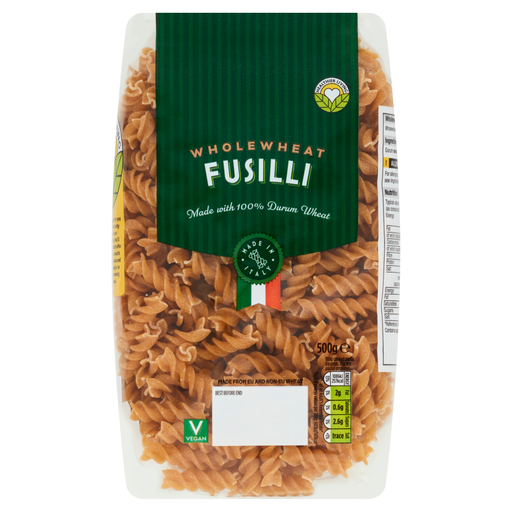
Consider this single 500g pack if you want wholewheat fusilli for a pasta salad or another short-pasta lunch. It contains wheat, so choose a suitable alternative if you need to avoid wheat or gluten; check the current pack’s allergen information.
 No image available
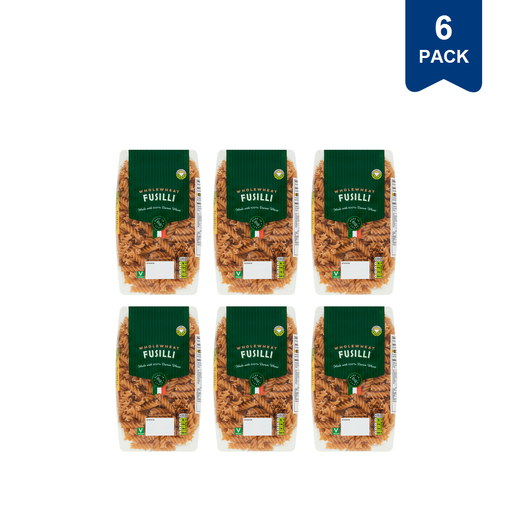
Consider this listing if you want multiple packs of wholewheat fusilli for repeated lunches. The title indicates six 500g packs, but another product-detail field gives 500g as the gross weight: confirm the total quantity supplied before ordering. The pasta contains wheat; check the current allergen information if you have a dietary restriction.
No. Wholewheat pasta can provide the starchy part of lunch, but NHS guidance considers the balance of food groups across eating overall. Plan vegetables and a protein food, and consider the sauce and added fats separately.
Use the chosen pack’s dry-portion guide rather than assuming one number for every pasta. Tesco and Asda give 75g dry-pasta examples for their listed products; Sainsbury’s gives 90g and approximately five servings for its wholewheat spaghetti. The rest of your meal also affects how much pasta you prepare.
Ordinary wheat-based wholewheat pasta is not suitable for a gluten-free diet: Coeliac UK identifies wheat as containing gluten. Choose a clearly labelled suitable alternative and check that individual product’s ingredients and relevant cross-contact information.
Yes. Wholewheat pasta contains wheat, and M&S states an additional egg-allergy limitation for its listed wholewheat products. Read the current pack’s ingredients and allergen information rather than assuming all plain pasta has the same suitability.
Choose a short shape such as fusilli or penne if it fits the cold salad or sauce-coated lunch you plan to pack; Tesco describes its wholewheat fusilli as suitable hot or cold. Spaghetti is another option when you prefer a hot pasta dish. Shape alone does not establish the meal’s nutritional balance.