
24/7 Customer Support

Free returns

Same-day & Next-day Delivery

Quality Guaranteed

Unlock Your Welcome Offers: FREE Delivery | Up to 80% OFF | Free 30-day JoyPlus trial
Download the APP
If you're tired of the dim, yellowish glow from your car's standard halogen bulbs, you are not alone. Many UK drivers are looking to modernise their vehicles with the crisp, bright illumination of LED technology. Upgrading to a 501 LED bulb is a popular and straightforward modification, but the market is filled with options that can be confusing. Key concerns often include finding the right fit, ensuring compatibility with your car's electronics and achieving that clean, modern look.
This guide is designed to help you navigate the choices. We will explain the essential features to look for, from fitment codes to Canbus compatibility, and provide our recommendations for 2026 to help you make a confident purchase for your car interior, side lights or number plate.
Before choosing a bulb, it helps to understand a few key technical points. This will ensure you get a product that fits correctly and performs as expected without causing any issues.
You will see many different codes used to describe these small wedge-type bulbs. It's simpler than it looks: 501, W5W and T10 LED bulb all refer to the same physical fitment. They are interchangeable. You may also see American-style codes like 194 LED replacement or 168 LED bulb, which also share this universal T10 wedge base. So, if a product is listed as a T10 or W5W, it will fit a 501 socket.
Many modern vehicles, particularly those from European manufacturers like Volkswagen, Audi and BMW, use a Controller Area Network (Canbus) system to monitor the car's functions, including the lighting. Standard LED bulbs draw much less power than old halogen bulbs. This low power draw can trick the Canbus system into thinking a bulb has failed, triggering a warning light on your dashboard.
To prevent this, look for bulbs specifically labelled as W5W LED canbus or error free LED car bulbs. These have built-in resistors that mimic the power consumption of a halogen bulb, satisfying the vehicle's monitoring system and preventing false warnings.
The colour of the light is measured in Kelvin (K). For that contemporary, high-end look, you should aim for a xenon white 501 bulb, which typically falls between 6000K and 6500K. This provides a pure, bright white light without any yellow or blue tint.
Brightness is measured in Lumens (LM). While more lumens mean a brighter light, the ideal brightness depends on the application. For car interior LED lights like map or dome lights, a moderate brightness is sufficient. For applications like reverse lights, a much higher lumen output can significantly improve visibility. All bulbs must be a 12v T10 LED as standard for car use, though some support a wider voltage range.
Here are our recommendations based on their features, user feedback and overall value.
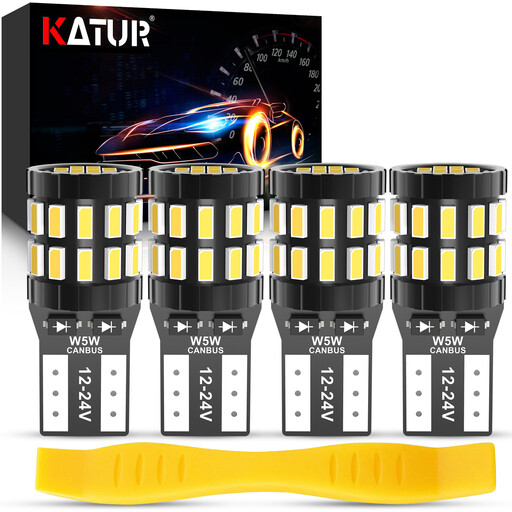
Why It Stands Out: This KATUR bulb is a versatile and powerful option. It is packed with 30 individual high-power 3014 SMD chipsets arranged for 360-degree illumination, which helps to eliminate the dark spots often seen with lesser LED bulbs. Its wide operating voltage of 12-24V makes it suitable for a range of vehicles, including some lorries and motorhomes.
Pros:
Who is it for? This is an excellent all-rounder for drivers wanting a noticeable brightness boost for their side lights, LED number plate bulbs or interior courtesy lights.
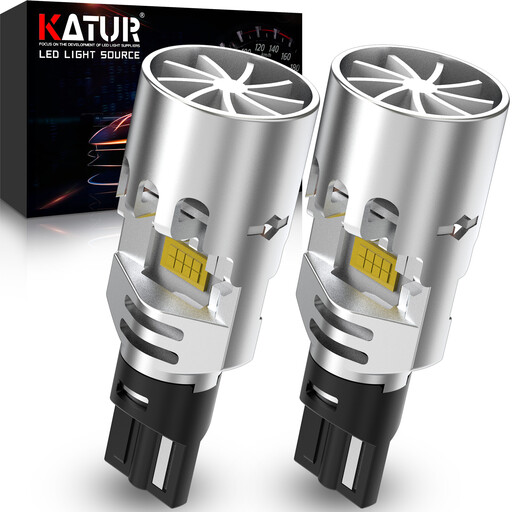
Why It Stands Out: While this is a T15/W16W fitment, it's a common upgrade for drivers looking for maximum performance from their reverse lights. Its standout feature is the extremely high light output, combined with an active cooling fan. This fan helps dissipate heat, which is crucial for maintaining performance and longevity in high-power LEDs.
Pros:
Who is it for? This is for the driver who prioritises safety and visibility when reversing. If you find your stock reverse lights dangerously dim, this high-output bulb is a purpose-built solution.
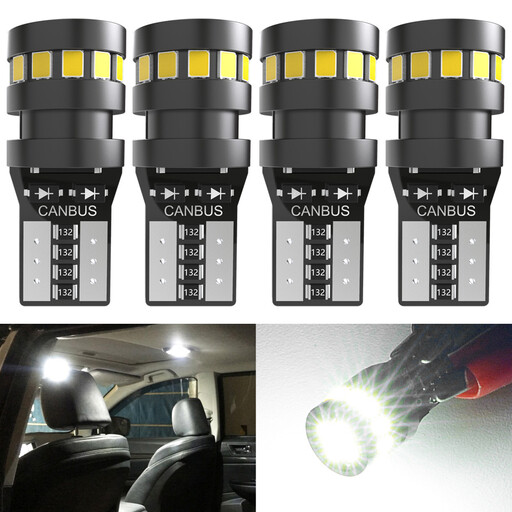
Why It Stands Out: The OUSHI T10 bulb offers a fantastic balance of performance, efficiency and reliability. It provides a significant brightness increase over halogen bulbs while consuming only a third of the power. The full aluminium body acts as an effective heat sink, promoting a long and stable operational life without the need for a fan.
Pros:
Who is it for? Ideal for the car owner looking for a dependable, plug-and-play upgrade for their car interior LED lights or number plate, who values efficiency and a clean look over maximum possible brightness.
The world of automotive lighting is vast, with bulbs suited for every possible application and vehicle. If our top recommendations don't quite match what you're looking for, or if you need a different fitment, feel free to explore our full range of LED T lights.
Yes. The terms 501, W5W and T10 all refer to the same small, wedge-based bulb fitment. They are completely interchangeable, along with other codes like 168 and 194.
It is highly recommended if your car was made after approximately 2005, especially if it is a European brand such as Audi, BMW, Mercedes-Benz, Volkswagen or Volvo. Using error free LED car bulbs will prevent the car's computer from showing a false "bulb out" warning on your dashboard.
Absolutely. The T10 LED bulb is one of the most common fitments for LED number plate bulbs. Just ensure the bulb provides a road-legal white light and is not so intensely bright that it causes glare for other drivers. The options listed above are excellent choices for this purpose.