
24/7 Customer Support

Free returns

Same-day & Next-day Delivery

Quality Guaranteed

Unlock Your Welcome Offers: FREE Delivery | Up to 80% OFF | Free 30-day JoyPlus trial
Download the APP
If you're tired of the dim, yellowish glow from your car's standard halogen bulbs, you are not alone. Many UK drivers are upgrading to LED technology for a brighter, more modern look and improved visibility. The 501 (also known as W5W or T10) is one of the most common bulbs used in vehicles for sidelights, interior lights and number plates.
Upgrading might seem as simple as swapping one bulb for another, but with modern vehicle electronics, it's important to choose the right product. This guide will help you understand the key features to look for and provide our recommendations for reliable 501 W5W LED bulbs that offer a straightforward, effective upgrade for your car.
Before you purchase, consider these three key factors to ensure you get the right bulbs for your vehicle and avoid common issues.
You will often see multiple codes listed for a single bulb, such as T10, 194, 168 and 2825 bulb replacement. While this can seem confusing, these codes all refer to the same 'wedge' style base. This means a bulb marketed as a 194 led bulb will fit perfectly in a socket designed for a 501 or W5W. The key is to confirm your car uses this T10 wedge-type bulb for the specific location you wish to upgrade, which can usually be found in your owner's manual.
Most vehicles manufactured in the last 15-20 years use a Controller Area Network (CAN bus) system to monitor the vehicle's functions, including the lighting. Standard halogen bulbs have a specific electrical resistance; low-power LEDs have a much lower resistance. This difference can trick the CAN bus system into thinking a bulb has failed, resulting in a warning light on your dashboard.
To prevent this, look for bulbs specifically labelled as T10 canbus led or error free led bulbs. These have built-in resistors or circuitry to mimic the load of a halogen bulb, ensuring seamless, plug-and-play operation without triggering any dashboard errors.
Two main specifications determine a bulb's appearance:
Here are our recommendations based on their features, construction and user-focused design.
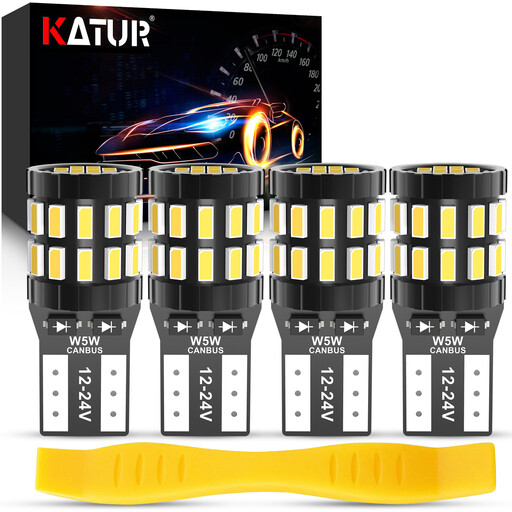
Why It Stands Out: These bulbs are designed for maximum light output. Each bulb is packed with 30 individual 3014 LED chipsets, providing intense, 360-degree illumination that eliminates the dark spots common with lesser bulbs.
Pros:
Who is it for?: Drivers who prioritise maximum brightness for applications like interior dome lights, boot lights, or even as brighter reversing light bulbs on some vehicles.
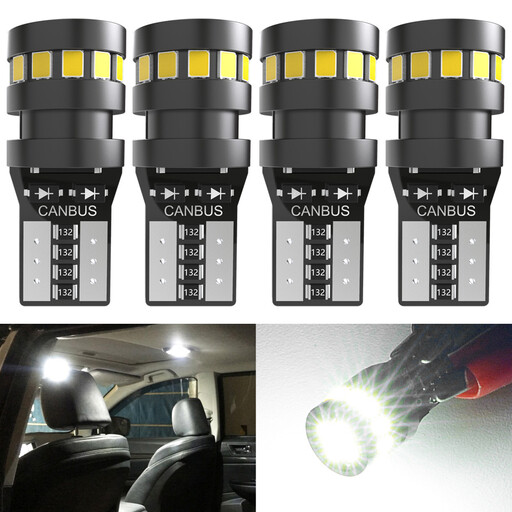
Why It Stands Out: This bulb offers a great balance of brightness, build quality and reliable Canbus performance. Its full aluminium body is designed for efficient heat dissipation, which is crucial for the longevity of the LED chips.
Pros:
Who is it for?: Car owners with sensitive CAN bus systems who want a dependable, error-free upgrade without compromising on brightness or build quality.
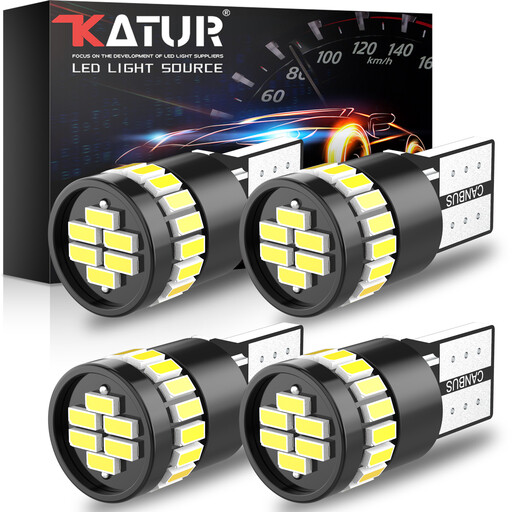
Why It Stands Out: The main advantage of this model is its compact, 1:1 mini design. It is sized to be a direct replacement for the original halogen bulb, ensuring it fits easily into tight light housings where larger, more complex LED bulbs might not.
Pros:
Who is it for?: The DIY enthusiast who needs a guaranteed fit for confined spaces like map lights, courtesy door lights, or certain number plate light fittings.
While these recommendations cover some of the most popular needs, the world of automotive lighting is vast. If you're looking for different brightness levels, colours, or bulbs for other parts of your vehicle, you can explore a wider selection.
Browse our full range of Carriage light bulbs to find the perfect fit for your car.
Yes. The terms 501, W5W and T10 all refer to the same type of small, wedge-base bulb commonly used in cars. You will also see them cross-referenced with American codes like 168 and 194. As long as the base is the T10 wedge type, they are interchangeable.
This is a classic symptom of an incompatibility with your car's CAN bus system. The system expects the higher power draw of a halogen bulb and interprets the low power draw of the LED as a fault. To fix this, you must use error free led bulbs that have the necessary built-in components to communicate correctly with your vehicle's computer.
According to UK law, number plate lights must illuminate the rear plate with white light. A bulb rated at xenon white 6000K produces a pure white light and is generally suitable. However, it is important to ensure the light is not excessively bright or tinted blue, as this could be a reason for an MOT failure. Always choose a bulb that provides clear, neutral white illumination.