
24/7 Customer Support

Free returns

Same-day & Next-day Delivery

Quality Guaranteed

Unlock Your Welcome Offers: FREE Delivery | Up to 80% OFF | Free 30-day JoyPlus trial
Download the APP
Finding a cooker that fits a compact kitchen can feel like a challenge. For many UK homes, flats and rental properties, a 50cm width is the standard, but choosing the right appliance involves more than just measuring the gap. All too often, buyers are caught out by misleading marketing claims or hidden design flaws that lead to disappointment and wasted money.
As the Joybuy Product Recommendation Officer, my role is to help you navigate these choices with clear, practical advice. Before you buy, be aware of these common pitfalls:
easy clean oven has specific design features, not just a smooth-sounding name. Without them, you are left with a weekly cleaning chore you were hoping to avoid.To make a smart purchase, focus on the core features that determine daily performance and longevity. Here are the non-negotiable factors to consider for a 50cm electric cooker.
The hob is your everyday workhorse. For a 50cm wide cooker, you will typically encounter two main types:
Even within the compact 50cm frame, you have options that significantly impact your cooking flexibility.
freestanding electric cooker of this size. This usually consists of a main oven (often fan-assisted) and a smaller top oven that doubles as a grill. This is ideal for cooking different dishes at separate temperatures simultaneously.With energy prices being a constant concern, an appliance's efficiency rating is more important than ever. An A rated electric cooker is designed to consume less electricity to reach and maintain its temperature compared to lower-rated models. While the initial purchase price might be slightly higher, the long-term savings on your utility bills can make it a more economical choice over the appliance's lifespan.
To help you find the right fit, we have matched a few standout models to common UK household profiles.
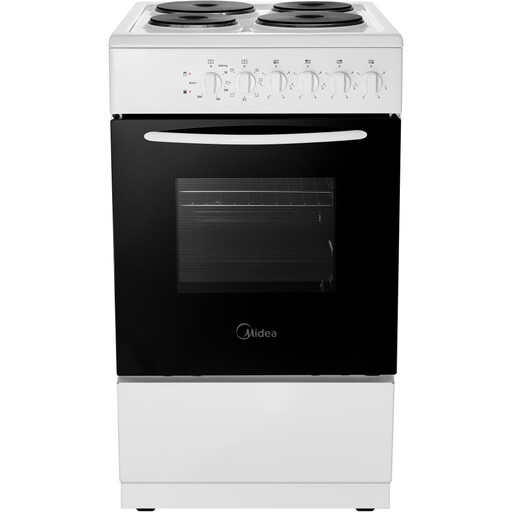
Why This Fits Their Persona: This is an ideal choice for landlords, tenants or first-time homeowners who need a dependable, affordable and straightforward appliance for daily meals. Its simple rotary controls and classic design prioritise function over fuss.
It avoids the "easy-clean" myth with a genuine easy-clean enamel interior and a removable inner door glass, making maintenance much simpler. It is an honest conventional oven, perfect for those who value traditional cooking methods.
Its key strengths are its simplicity and A-rated energy efficiency. The durable 4-zone solid plate hob is built to last, offering excellent value and reliability.
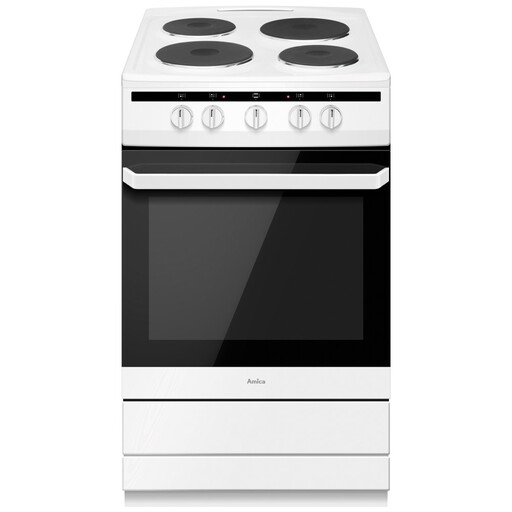
Why This Fits Their Persona: For the home cook who loves to bake or entertain but is constrained by a small kitchen. This model provides the flexibility of a double oven, allowing you to grill fish in the top while roasting vegetables in the main oven below.
It directly solves the "conventional oven surprise" by offering both. The main 62L oven is fan-assisted for even heat, while the top 35L cavity is a conventional oven and grill, giving you complete control and versatility.
The primary advantage is true double oven functionality in a compact 50cm footprint. It also includes a digital programmer for precise timing and easy-clean enamel in both cavities.
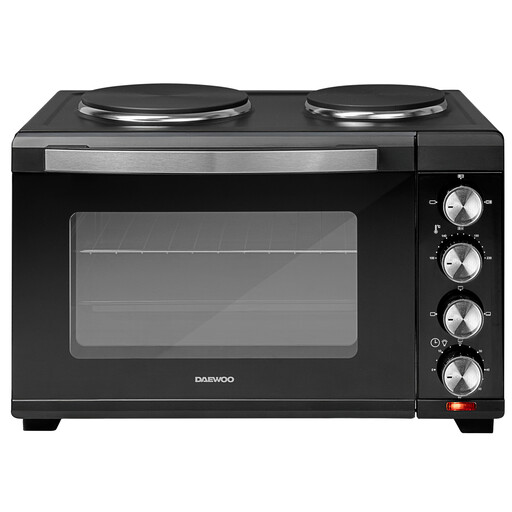
Why This Fits Their Persona: This is the perfect `electric cooker for a small kitchen` where a permanent installation isn't an option. It's ideal for student accommodation, studio flats, annexes or as a stop-gap during a kitchen renovation.
It completely bypasses the hardwiring pitfall. As a countertop appliance, it plugs directly into a standard 13-amp wall socket, requiring no professional installation and offering immediate, hassle-free cooking capabilities.
Its greatest strength is its plug-and-play flexibility. The combination of a 32L oven and two independent hotplates provides a complete, portable cooking station without any permanent commitment.
Once you have chosen your cooker, you will need the right bakeware to get started. We have compiled a complete list of high-quality oven dishes that satisfy strict selection criteria.
In most cases, yes. A freestanding single oven electric cooker or double oven model typically has a total power rating well above 3kW. UK regulations require any appliance over this rating to be professionally installed on its own dedicated circuit, usually a 32-amp fuse, by a qualified electrician. The main exception is countertop mini-ovens, which are designed to plug into a standard 13-amp socket.
A conventional oven (also called static) uses two heating elements, one at the top and one at the bottom. This creates heat zones, with the top of the oven being hottest. It is excellent for traditional recipes like cakes that require a crisp base and a well-risen top. A fan oven uses an element at the back with a fan to circulate hot air, creating an even temperature throughout the entire cavity. This is faster, more energy-efficient and ideal for batch baking on multiple shelves at once.
Look for specific, verifiable features rather than marketing slogans. A true easy clean oven will often have a special enamel lining that is smooth and non-porous, preventing grease from baking on. The single most useful feature is a removable inner glass door. This allows you to take the glass out completely and clean it in the sink, which is far more effective than trying to clean it in place.