
24/7 Customer Support

Free returns

Same-day & Next-day Delivery

Quality Guaranteed

Unlock Your Welcome Offers: FREE Delivery | Up to 80% OFF | Free 30-day JoyPlus trial
Download the APP
A 58-piece magnetic building blocks set can offer an appealing introduction to construction play, but the piece count alone does not tell you whether it will suit your child. Some sets look substantial in marketing images yet contain mostly small accessories. Others use weak connections, lack practical storage or provide little scope for building beyond one or two designs.
For UK parents, grandparents and gift buyers, three common purchasing traps deserve attention:
The right choice depends on the tile design, materials, age guidance and the type of play your child enjoys.
Look for clearly stated materials such as ABS plastic, which is commonly used for durable construction toys. Smooth edges and well-sealed seams are practical features for children handling pieces repeatedly.
Magnetic tiles should have magnets enclosed inside the plastic rather than exposed or easily accessible. Before each play session, check for cracks, splits, loose panels or unusual rattling. If a tile is damaged, remove it immediately. Swallowed magnets can present a serious risk, so young children should play with magnetic building tiles under suitable adult supervision.
Product listings may refer to reinforced magnets, ultrasonic welding or secure construction. Treat these as design information rather than a substitute for inspection. Also check whether the set provides a stated age range and safety information relevant to the UK market, including CE marking where applicable and references to toy safety requirements such as EN 71.
The most useful magnetic building blocks usually include repeatable shapes—such as squares, triangles or diamond forms—that can be joined in several directions. A diamond magnetic building blocks design can create textured surfaces and unusual patterns, while standard geometric tiles may be easier for beginners to arrange.
Consider the actual tile dimensions as well as the number of pieces. Larger parts may be easier for preschoolers to handle, but they also take up more storage space. A reliable connection should hold simple structures together without requiring excessive force. However, no magnetic tile set should be treated as a climbing or load-bearing toy.
A magnetic tiles with storage pouch option can be more practical than a larger set with no dedicated organisation. A pouch helps keep parts together in a playroom, grandparents’ house or holiday accommodation.
For regular maintenance, follow the product instructions. The Qiyuan set, for example, advises wiping pieces with a damp cloth, drying them thoroughly and storing them in its included pouch. Avoid soaking magnetic tiles unless the manufacturer specifically confirms that this is suitable.
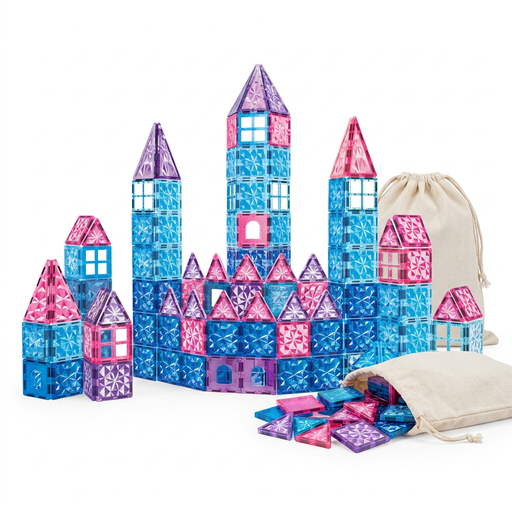
Why This Fits Their Persona: A 58-piece starter collection is a manageable entry point for families wanting creative construction play without immediately buying a very large set. The included pouch also suits visits between UK homes.
The listing specifies 58 diamond-surface magnetic tiles, rather than presenting only a broad piece count, and includes a storage pouch for keeping the collection organised.
Made from stated non-toxic ABS material with smooth edges; diamond-shaped surfaces encourage pattern-making and basic geometric construction.
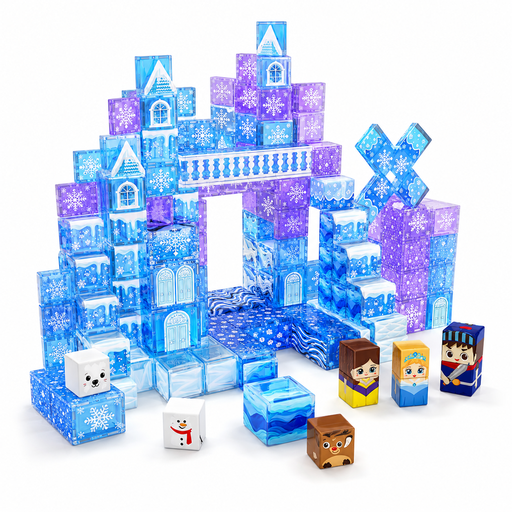
Why This Fits Their Persona: This option suits households prioritising visual design and open-ended building, particularly when children enjoy observing colours, patterns and light through transparent pieces.
The transparent snow-ice styling provides a clear visual identity, helping buyers distinguish decorative design from a generic mixed-shape listing.
Transparent construction pieces; product listing states suitability from age 3 years, allowing buyers to compare it with other magnetic tiles for children.
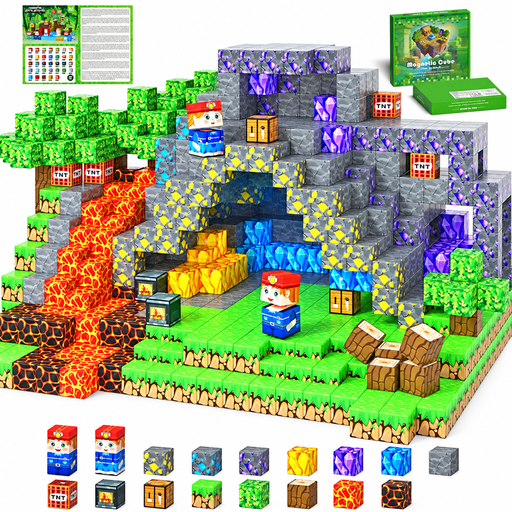
Why This Fits Their Persona: Larger households or children who regularly build broad layouts may prefer a 150-piece collection, particularly when one starter set feels limiting for shared play.
The higher piece count is clearly stated, making it easier to assess whether the set offers enough components for larger or collaborative builds.
150 pieces provide more scope for expansion; the listing identifies ABS plastic and a nature-themed design.
A 58-piece collection is often easier to sort, carry and introduce gradually. It can work well for independent play at a small table or for taking to a relative’s home. A larger STEM construction toy may be more suitable when siblings build together or when children already understand basic balancing and shape formation.
Do not assume that a larger set is automatically more educational. The learning value comes from how children use the pieces: creating structures, testing stability, recognising shapes, comparing sizes and explaining their ideas. Adult prompts such as “What could make the tower wider?” can extend play without turning it into a lesson.
We have compiled a complete, real-time list of products that fully satisfy these strict selection criteria and UK safety regulations.
Some products are listed as suitable from age 3, but age guidance is only one part of the decision. Check the manufacturer’s warnings, supervise play and inspect every tile regularly. Children who still mouth objects may need a different type of toy until they can use magnetic pieces responsibly.
Lifespan depends on frequency of use, storage and handling. Keep tiles dry, wipe them as instructed and remove damaged pieces. A pouch or box can reduce lost parts and help prevent tiles from being stepped on or crushed.
Standard magnetic tiles generally connect without batteries. Always check the product listing, as themed construction toys may include lights or sounds. A battery-free set can be convenient for travel, quiet play and households seeking a simple screen-free activity.