Runners who missed breakfast
One portable snack may appeal before a light jog or parkrun when a meal is not practical. The UK Sports Institute says many athletes eat one to three hours before running, but timing varies between individuals.


A bar is not automatically needed for a short 5K: the UK Sports Institute advises against fuelling for a parkrun as though it were a marathon. If you missed breakfast or want a familiar small snack, compare carbohydrate per bar and choose something you have tolerated in training; a protein-focused bar serves a different preference and may contain substantial fibre or polyols.
One portable snack may appeal before a light jog or parkrun when a meal is not practical. The UK Sports Institute says many athletes eat one to three hours before running, but timing varies between individuals.
Check carbohydrate for one bar, not just the pack size or a per-100 g figure. The Tesco-listed Mallow & Marsh bar has 27.1 g carbohydrate per 35 g bar, while its Kellogg's Rice Krispies Squares listing gives 21 g per 28 g bar.
Gelatine sources and declarations for milk, cereals and other allergens differ between these products. Fibre and polyols also matter when deciding whether a particular bar is familiar enough to eat close to a run.
Start with whether you want a snack at all, then compare one bar's label and consider when you would eat it.
| Priority | What to check | Your needs |
|---|---|---|
| Whether to take a bar | Consider your preceding meal and when you plan to run. The UK Sports Institute says a short run does not call for marathon-style fuelling. | If I have already eaten breakfast, I may not want another snack. If I missed it, one familiar portion may be more practical than a full meal. |
| Carbohydrate per bar | Compare the individual serving and pack format. Tesco Groceries lists 27.1 g carbohydrate per 35 g Mallow & Marsh bar and 21 g per 28 g Kellogg's bar; ASDA Groceries lists 17 g per 22 g Rice Snaps bar. | I want to know what is in the portion I would carry, rather than choose by the words ‘marshmallow’ or ‘protein’ on the front. |
| Timing and ingredients | Try the chosen portion in training. The UK Sports Institute says many athletes eat one to three hours before running; ASDA Groceries lists 12 g fibre and 9 g polyols in the 65 g Optimum Nutrition bar, whose label warns about excessive consumption. | A familiar bar and a timing that works for me matter more than trying an unfamiliar snack on event day. |
| Dietary suitability | Read the current pack for allergens, precautionary statements and gelatine. Tesco Groceries lists beef gelatine in the Mallow & Marsh and Kellogg's products; ASDA Groceries lists pork gelatine in Rice Snaps. | I need the actual recipe and allergen declarations to fit my dietary requirements, not just the flavour name. |
A bar may be unnecessary if you have already eaten. The UK Sports Institute advises that a parkrun does not require marathon-style fuelling.
Consider your earlier meal and whether you actually want a snack; test any bar during training rather than introducing it on event day.
ASDA Groceries lists 20 g protein but 17 g carbohydrate, 12 g fibre and 9 g polyols per Optimum Nutrition Marshmallow Crunch bar. Its label warns that excessive consumption may cause laxative effects.
If your aim is to compare carbohydrate portions, read the per-bar carbohydrate figure first and consider whether you have tolerated the ingredients near a run.
Marshmallow-style bars can use different gelatine sources and have different allergen declarations, so a familiar product name does not establish dietary suitability.
Check the current pack, including ‘may contain’ information, for the exact product and flavour you intend to eat.
Its Vanilla & Milk Chocolate product is a chocolate-coated marshmallow bar sold as a 35 g portion.
The Marshmallow cereal square is a 28 g bar available in multipacks.
Marshmallow Crunch is a 65 g protein bar that the manufacturer positions for use after training.
Crispy Square Marshmallow is a 30 g protein snack bar.
This eight-bar pack provides individually portioned cereal-and-marshmallow squares to consider if you want to try the same 28 g portion during training. It is not a single-bar retail pack.
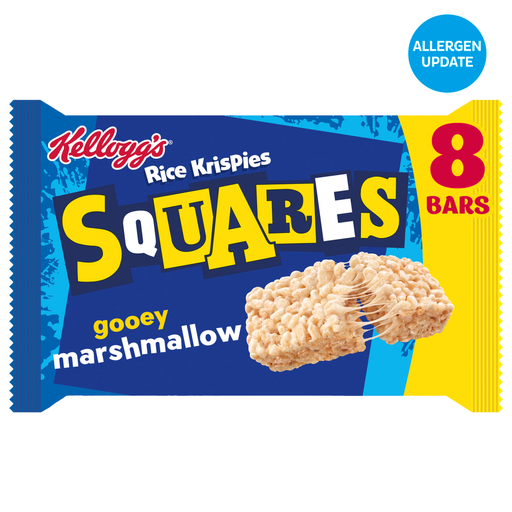 Image unavailable
The individually portioned bars let you try a consistent serving during training before deciding whether to eat one near a 5K. Each 28 g bar lists 21 g carbohydrate. Contains barley, wheat and milk; may contain cereals containing gluten and soya. Check the current pack against your dietary requirements.
No bar is automatically needed. The UK Sports Institute says runners need not fuel for a parkrun as though it were a marathon; whether you want a small snack depends on your earlier meal, hunger and experience with eating before running.
Try it in ordinary training, not for the first time on event day. The UK Sports Institute says many athletes eat one to three hours before running, while individual timing varies.
No. Tesco Groceries lists beef gelatine in the Mallow & Marsh and Kellogg's bars, while ASDA Groceries lists pork gelatine in Rice Snaps. Allergen declarations also differ, so read the current pack for the exact product.
Compare its full per-bar label rather than protein alone. ASDA Groceries lists 20 g protein, 17 g carbohydrate, 12 g fibre and 9 g polyols in the 65 g Optimum Nutrition Marshmallow Crunch bar; the manufacturer positions it for after training, and the label warns about excessive consumption.