
24/7 Customer Support

Free returns

Same-day & Next-day Delivery

Quality Guaranteed

Unlock Your Welcome Offers: FREE Delivery | Up to 80% OFF | Free 30-day JoyPlus trial
Download the APP
By Joybuy Product Recommendation Officer
Choosing a new stand mixer can feel overwhelming. You are ready to upgrade from a hand mixer and tackle more ambitious bakes, but the market is flooded with models boasting impressive-sounding features. For many UK home bakers, a 6.5 qt stand mixer hits the sweet spot—large enough for batch baking but still manageable in a domestic kitchen.
However, navigating the specifications can lead to costly mistakes. Before you invest, it is crucial to understand the common pitfalls that marketing language often hides.
To make a smart purchase, focus on the functional design rather than just the marketing claims. Here are the key parameters to analyse for any electric stand mixer.
Instead of focusing solely on watts, look for information about the motor type. Models with pure copper motors or DC motors tend to be more efficient, durable and quieter. Also, verify that the mixer uses planetary mixing action. This is a non-negotiable feature where the attachment spins on its own axis while also sweeping around the entire bowl, ensuring no ingredients are left unmixed at the sides or bottom.
A reliable food mixer for baking needs a solid, heavy base to anchor it. Look for models that explicitly mention anti-slip suction feet and check the total weight of the unit. A heavier machine is generally more stable. The most common design for home use is the tilt-head kitchen mixer, which allows for easy access to the bowl and attachments. Ensure the locking mechanism for the tilt-head is robust and clicks securely into place.
A 6.5-quart (approximately 6.2-litre) bowl is ideal for making larger quantities, such as two loaves of bread, a large celebration cake or several dozen cookies. Ensure the bowl is made from food-grade stainless steel for durability and hygiene. A standard set of attachments should always include:
We have analysed models to find options that address the common pitfalls while delivering on the core features that matter for UK home bakers.
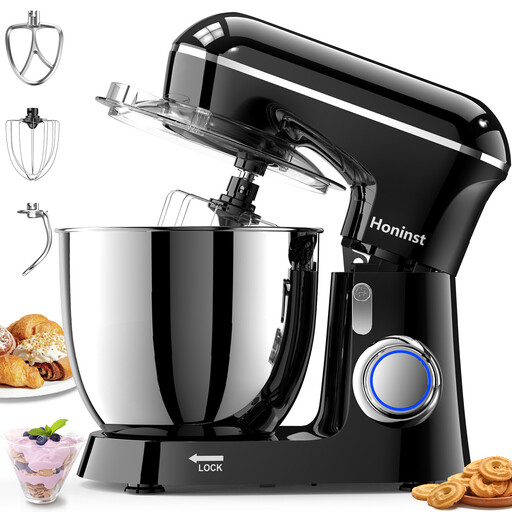
Why This Fits Their Persona: This is an excellent all-rounder for the home cook who is moving beyond simple recipes. The 6.5-quart capacity is perfect for batch baking for family events or weekly meal prep and the 10-speed control offers the precision needed for everything from delicate meringues to heavy sourdough.
It directly counters the common pitfalls with a powerful pure copper motor for efficiency, anti-slip suction feet for stability and a design that aims for low-noise operation (under 60 dB according to the manufacturer's information).
It includes the three essential attachments (dough hook, whisk, beater) and a splash guard. The combination of a large bowl, planetary mixing and multiple speeds provides great versatility for the price point.
We have compiled a complete, real-time list of products that fully satisfy these strict selection criteria and UK safety regulations.
A 6.5-quart (approx. 6.2-litre) capacity is a versatile size for those who bake regularly or in batches. While it has a larger footprint than a 4-quart model, many modern tilt-head kitchen mixer designs are surprisingly compact. Before buying, always measure the height of your counter space, especially underneath cabinets and compare it to the product's dimensions to ensure a good fit.
The term "quiet" is subjective, but a good benchmark is to look for models rated below 70 decibels (dB). For context, a normal conversation is around 60 dB and a vacuum cleaner is typically 75-80 dB. Mixers with high-quality pure copper or DC motors are generally engineered to produce less noise and vibration than their less efficient counterparts.
Planetary mixing action is a crucial feature for thorough mixing. It means the beater, whisk or dough hook not only spins on its own axis but also travels in an orbital path around the bowl. This dual motion ensures that the attachment reaches all areas of the bowl—sides, bottom and centre—incorporating all ingredients evenly without you needing to constantly stop and scrape down the sides.