24/7 Customer Support

Free returns

Same-day & Next-day Delivery

Quality Guaranteed

Unlock Your Welcome Offers: FREE Delivery | Up to 80% OFF | Free 30-day JoyPlus trial
Download the APP
There is a particular quality to the air during Britain’s transitional seasons. It is the cool dampness of a spring morning that carries the scent of wet earth and new growth, or the crisp edge to an early autumn evening that signals a shift in the light. These are the in-between moments, when the climate is neither one thing nor the other. Our homes, and our routines within them, must adapt. We shed the heavy layers of winter but are not yet ready for the stark lightness of summer. This search for balance is felt most keenly at night, in the quiet hours when our bodies seek a state of equilibrium.
The challenge is to find a covering that offers comfort without constraint, warmth without weight. It is a question of thermal harmony, a state often disrupted by a duvet that is too heavy for a mild night or too slight for a sudden cool spell. This is where a considered approach to our bedding becomes less about decoration and more about thoughtful living.
Understanding how we achieve this balance begins with a simple, practical metric: the tog rating. A measure of thermal insulance, the tog scale provides a quiet language for warmth. A high tog promises deep winter insulation, while a low tog offers a barely-there covering for summer heat. The space between these two extremes is where true versatility lies. A mid-range rating, such as a 6.7 tog double duvet, is calibrated specifically for the nuanced temperatures of spring and autumn. It is an acknowledgement that comfort is not a fixed state, but a gentle negotiation with our environment.
This philosophy extends to materiality. While tradition has long favoured natural fillings, modern material science offers compelling alternatives, particularly for those who sleep warm or are prone to allergies. A well-constructed microfibre duvet provides a solution that is both practical and sensorial. The fine, synthetic fibres can be engineered to create a lofty, cloud-like structure that traps air for insulation while remaining remarkably breathable. This focus on a temperature-regulating duvet helps to manage the microclimate beneath the covers, wicking away moisture and preventing the overheating that so often fragments sleep.
Furthermore, the choice of a lightweight double quilt speaks to a desire for freedom of movement. It should drape and contour rather than press down, a subtle distinction that has a profound impact on our quality of rest. For the modern home, practicality is also paramount. The ability to refresh our bedding with ease is a quiet luxury, and a machine washable duvet simplifies this essential ritual, ensuring our sleep sanctuary remains clean and hygienic.
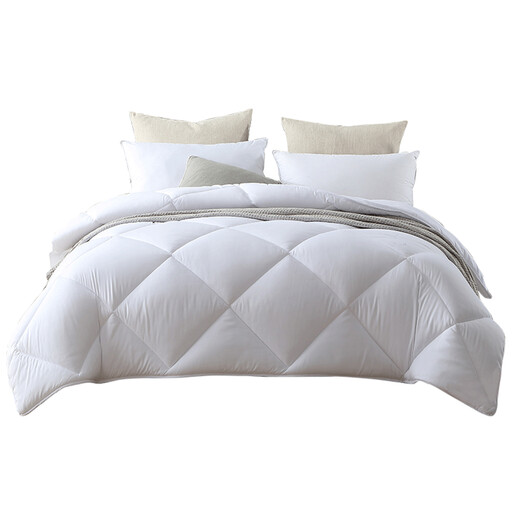
Curating a restful bedroom is an exercise in intention. Each object should serve a purpose, contributing to an atmosphere of calm and order. The bedding we choose is central to this. A considered spring autumn double duvet, for instance, can be the anchor of the room’s function. The design of the Emma Duvet Spring & Autumn 6.7 TOG Double is a study in this principle. Its use of soft, brushed microfibre in both the filling and the cover creates a unified, tactile experience. It is a piece designed not to dominate, but to perform its function with quiet competence, providing just the right level of warmth for the UK’s milder seasons.
A truly restorative sleep environment, however, is a system of harmonising parts. The comfort provided by a duvet is amplified or diminished by the support of a pillow. The search for spinal alignment and pressure relief has led to more adaptable designs. Pillows such as the Emma Pillow Adapt Cooling ThermoSync & Memory Foam feature removable layers, allowing one to tailor the height and firmness to their specific posture, whether sleeping on their side, back or stomach. This level of personalisation ensures the head and neck are correctly supported, completing the foundation for deep rest that the duvet begins.
This movement towards responsive, adaptable textiles is a defining feature of contemporary design. We see it in innovations like dual-sided fabrics, where each surface offers a different tactile or thermal property. A piece like the LEBONSOIR 1pc Dual-Sided Summer Quilt, with its cool-touch and soft-touch sides, demonstrates a sophisticated understanding of personal comfort. While intended for summer, the principle of choice and adaptability it embodies is relevant year-round. It reflects a deeper desire for objects that respond to our needs, allowing us to curate our own comfort from one night to the next.
For those seeking to explore a wider curation of objects designed with these material standards, the complete cooling quilt registry offers further inspiration.