
24/7 Customer Support

Free returns

Same-day & Next-day Delivery

Quality Guaranteed

Unlock Your Welcome Offers: FREE Delivery | Up to 80% OFF | Free 30-day JoyPlus trial
Download the APP
A 6-in-1 kids tricycle can cover several stages between early walks and independent pedalling. However, the number of configurations does not always tell you how practical the trike will be after the first few months. Parents in the UK also need to consider pavements, uneven parks, compact car boots, changing weather and how much control the adult has during everyday outings.
Before buying a baby trike with push handle, watch for these common pitfalls.
“6-in-1” may refer to several small changes, such as removing a footrest, canopy or safety bar. Check what each stage actually provides:
A convertible stroller tricycle should offer a useful progression from supervised rides to child-led movement, rather than simply adding accessories to a standard frame.
A tricycle can appear compact in product photographs but still be difficult to store in a hallway or car boot. Look for the full folded dimensions, not just statements such as “easy to fold”.
An adjustable parent handle is also important for adults of different heights. A handle that is too low may be uncomfortable during longer walks, while a fixed handle can make steering awkward for taller carers.
A canopy, harness and braking system can support a more controlled ride, but they do not remove the need for adult supervision. Check the recommended age, maximum load, seat fit and instructions before use. For toddlers, a 5-point harness trike may offer more restraint than a simple waist belt, but it still needs to be adjusted correctly over the child’s shoulders and hips.
A tricycle for ages 1-5 should provide a clearly stated recommended age range and maximum load. These figures are not interchangeable: a child may be within the age range but exceed the weight limit, or may be too small for the harness and footrest arrangement.
A high backrest, padded seat and removable safety bar can make push-trike mode more comfortable. Reclining or rotating seats may also be useful for younger children who need closer supervision, although parents should follow the supplied instructions for every position.
EVA wheels are commonly used on toddler tricycles because they do not require inflation and can provide a quieter ride on many hard surfaces. Wheel diameter also affects how the trike handles kerbs, paving changes and compacted paths. Larger front wheels may help with general manoeuvrability, but no children’s tricycle should be treated as suitable for fast riding or rough terrain without checking the manufacturer’s guidance.
A long push handle, linked steering system or parent-control bar can make a noticeable difference on busy pavements. Test whether the adult can keep the front wheel aligned while walking at a comfortable pace.
Check the product listing and manual for:
A tricycle with canopy may be useful for sunny park visits, but it should not be treated as weatherproof protection. Likewise, a kids trike with storage basket can carry snacks or small toys, but avoid overloading it or placing heavy items where they could affect balance.
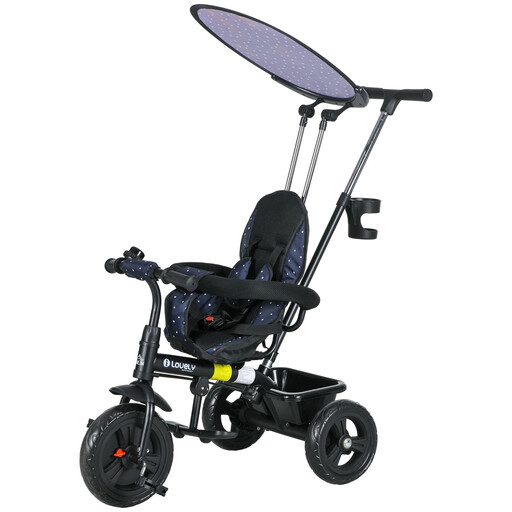
Why This Fits Their Persona: A straightforward option for families wanting parent steering, a canopy and storage in one adaptable trike for everyday walks, without prioritising advanced folding features.
Its listing states six riding stages, a detachable push handle, 5-point harness, canopy and basket, so the main features are clearly identified rather than implied by the product title alone.
Metal frame, EVA wheels, 25kg maximum load, storage basket and stated EN71-1-2-3 qualification reference.
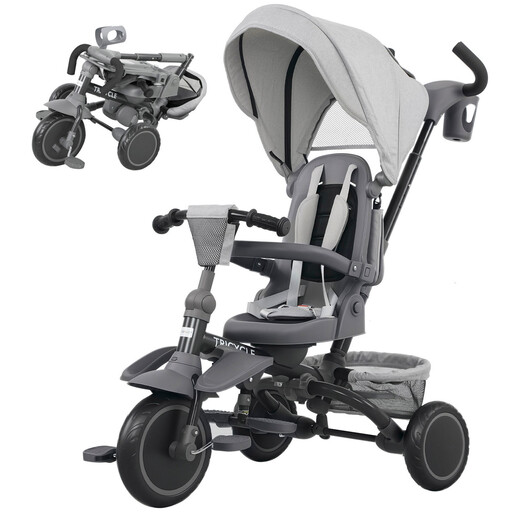
Why This Fits Their Persona: Suits parents who regularly travel by car or want more adjustment options for different adults and changing stages of use.
The folded dimensions are stated as 76L × 58.5W × 58Hcm with the push bar removed. Its three-position telescopic handle is also listed at 89, 86 and 83cm.
Rotating seat, four-position reclining backrest, 5-point harness, canopy, basket, parent bag and 25kg maximum load.
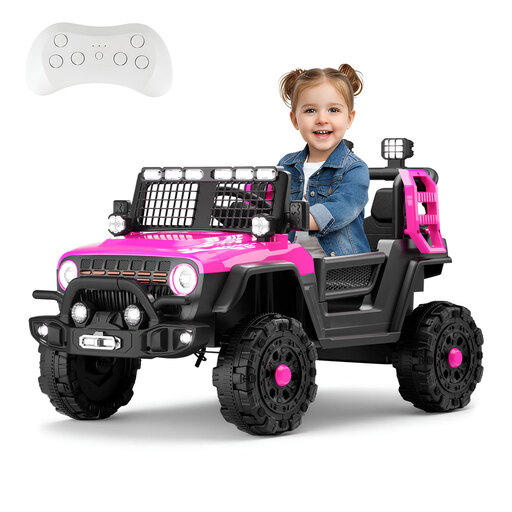
Why This Fits Their Persona: This is an alternative for families specifically seeking powered ride-on play rather than a pedal tricycle for walks and developing independent pedalling.
It is clearly described as a 12V electric vehicle toy, so buyers are less likely to confuse a powered ride-on car with a 6-in-1 push trike.
Parent remote control, seat harness, locking doors, spring suspension, Bluetooth and a stated 66lb weight capacity.
We have compiled a complete, real-time list of products that fully satisfy these strict selection criteria and UK safety regulations.
Once your trike arrives, allow time for assembly and adjustment before the first outing. Check that:
For UK pavement use, plan routes around kerbs, narrow gates and crowded areas. A storage basket is convenient, but keep heavier items low and avoid hanging bags from the steering handle.
Some models list a recommended range beginning at 12 months, but suitability depends on the child’s size, posture and ability to sit securely. Follow the manufacturer’s recommended age, weight limit and assembly instructions. A younger child should use the parent-controlled configuration rather than the independent pedalling stage.
A model rated for 12-60 months may remain useful through several stages, provided the child stays within the stated load limit and the frame and components remain in good condition. Actual use depends on growth, frequency of outings and storage conditions. Inspect wheels, harnesses, fasteners and steering parts regularly.
No. Compare the stated folding dimensions with your boot opening and available depth. Some models only reach their smallest size after removing the push handle, canopy or another accessory. Measure before ordering, particularly if the trike will also share space with a pushchair or shopping.