
24/7 Customer Support

Free returns

Same-day & Next-day Delivery

Quality Guaranteed

Unlock Your Welcome Offers: FREE Delivery | Up to 80% OFF | Free 30-day JoyPlus trial
Download the APP
A 60cm cooker hood is designed to suit many standard UK hobs, but width alone does not tell you whether a model will work well in your kitchen. The wrong installation type, unsuitable ducting or costly filter replacements can turn an apparently affordable purchase into an inconvenient upgrade.
This guide explains the practical specifications to check before buying, from a slimline cooker hood for a rental property to a powerful wall-mounted model for frequent frying.
Manufacturers may highlight the highest extraction figure, but this is not always the rate used during normal cooking. Check the airflow at each fan speed where available, and compare it with the noise level. A model offering several speeds gives you more control for simmering, boiling and frying.
Also remember that duct length, bends and restricted outlets can reduce real-world extraction. A well-installed ducted cooker hood may perform differently from the same unit operating in recirculation mode.
A 60cm product may measure slightly under or over 600mm. Check the actual width, depth and height, as well as the available cabinet opening. Integrated and built-in cooker hoods often need a custom cabinet front or suitable internal clearance.
Telescopic and under-cabinet designs can be useful in compact kitchens, but their extended depth may affect cupboard storage or nearby doors.
A hood advertised as suitable for ducted and recirculating use may require additional parts for one of those modes. Carbon filters are commonly needed for recirculation and may need periodic replacement. In contrast, a washable grease filter can be removed and cleaned regularly.
Before ordering, confirm whether the product includes carbon filters, ducting, adapters, brackets and a template. Electrical connection and installation should follow the manufacturer’s instructions and applicable UK requirements; use a suitably qualified installer where necessary.
Choose the format that matches your kitchen layout:
For ventilation, ducted and recirculating cooker hood operation offers flexibility. Ducting sends air outdoors, while recirculation passes air through grease and carbon filtration before returning it to the room. Ducted installation generally depends on having a suitable external route, while recirculation can be more practical in flats, rented homes or kitchens without an outside wall.
Airflow is usually measured in m³/h. A larger open-plan kitchen or a household that frequently fries, grills or stir-fries may benefit from a higher stated maximum airflow. For light cooking, a lower-capacity model may be sufficient.
Noise is measured in decibels (dB). Compare the quoted maximum rather than relying only on descriptions such as “quiet cooker hood”. For reference, the products below list maximum noise levels between 60dB and 64dB, although installation and ducting can affect perceived sound.
Look for removable metal or aluminium grease filters, preferably dishwasher-safe where the manufacturer permits it. Clean filters regularly, commonly every two to four weeks depending on cooking frequency, to help maintain airflow and reduce grease build-up.
An LED cooker hood provides task lighting over the hob and typically uses less electricity than traditional bulbs. Check the energy label and annual consumption rather than relying on a general “energy-efficient cooker hood” description.
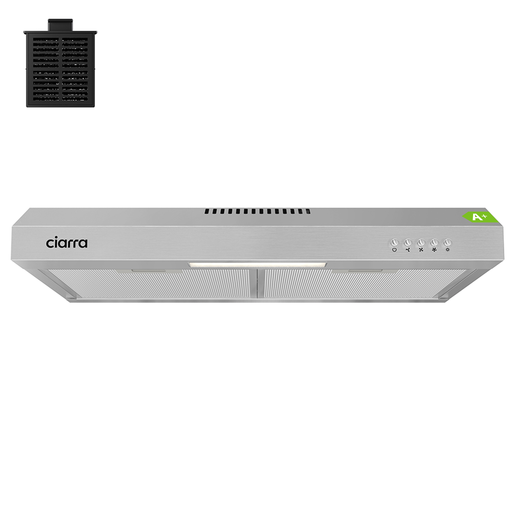
Why This Fits Their Persona: Its 596mm-wide, 85mm-high profile suits compact kitchens, rental properties and low-cabinet installations where space and simple controls matter.
It states three airflow levels, a maximum of 184m³/h and a 61dB maximum noise level rather than relying only on broad marketing language.
A+ energy class, two washable aluminium filters, push-button controls and ducted or recirculating operation.

Why This Fits Their Persona: This concealed black built-in design suits kitchen renovations where uninterrupted cabinetry and higher extraction capacity are priorities.
The specification separates speed levels, listing airflow from 373m³/h to 640m³/h, and identifies carbon filters for recirculation.
A+++ energy class, 599mm width, washable aluminium filter and dual ventilation modes.
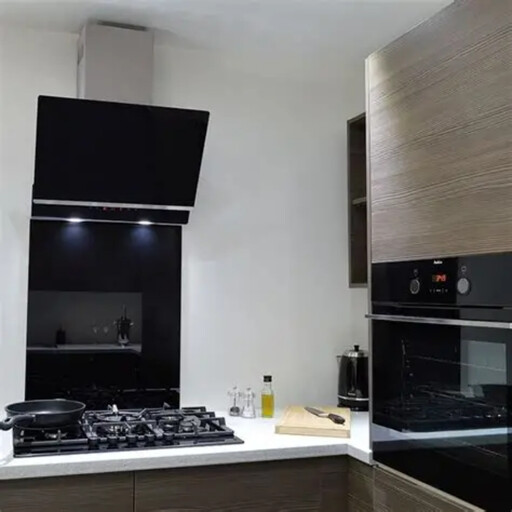
Why This Fits Their Persona: The angled wall-mounted format provides three speeds and a boost setting for households regularly cooking with high heat, frying or multiple pans.
Its listed 615m³/h maximum airflow is paired with a stated 66dB maximum noise level, making the performance and acoustic trade-off clearer.
Two LED lamps, two dishwasher-safe aluminium filters and ducted or recirculating installation.
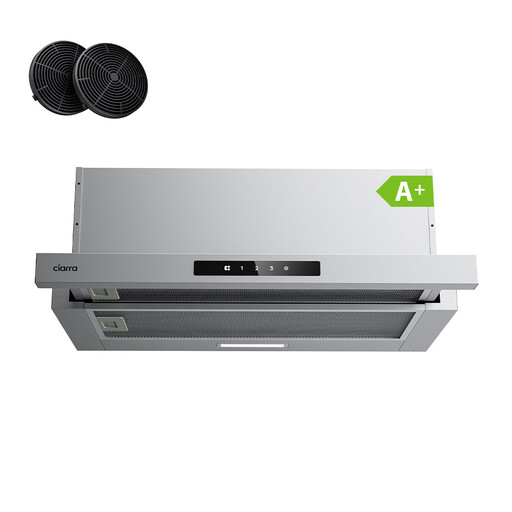
Why This Fits Their Persona: The pull-out format gives compact kitchens a wider capture area when cooking while remaining discreet when closed.
The retracted and extended depths are listed as 298–453mm, helping buyers check cabinet clearance before ordering.
Up to 551m³/h airflow, A+ energy class, three touch-controlled speeds and two washable aluminium filters.
We have compiled a complete, real-time list of products that fully satisfy these strict selection criteria and UK safety regulations.
A 60cm hood is commonly matched with a 60cm hob, but check the appliance dimensions and installation guidance. The hood should cover the main cooking area, and the manufacturer’s minimum clearance above a gas or electric hob must be followed.
They serve different installation needs. Ducted extraction sends air outdoors, while recirculation is useful where external ducting is unavailable. Recirculating models require suitable carbon filters, and these need cleaning or replacement according to the product instructions.
A washable grease filter is commonly cleaned every two to four weeks, depending on how often you cook and whether you fry regularly. Always disconnect the appliance before maintenance, allow components to cool and follow the supplied instructions.