
24/7 Customer Support

Free returns

Same-day & Next-day Delivery

Quality Guaranteed

Unlock Your Welcome Offers: FREE Delivery | Up to 80% OFF | Free 30-day JoyPlus trial
Download the APP
A 60cm cooker hood can fit neatly above a standard hob, but choosing the wrong model may leave you with excessive noise, poor odour control or an installation that does not suit your kitchen. The width alone does not tell you whether a hood will work well in a flat, rental property, open-plan kitchen or full renovation.
Joybuy Product Recommendation Officer’s approach is simple: look beyond promotional phrases and compare the installation format, airflow figures, filter arrangement, noise rating and running costs.
A product described as a 60cm cooker hood may measure 595mm, 596mm, 598mm, 599mm or 600mm. That difference can matter when fitting a built-in cooker hood inside existing cabinetry. Depth and height are equally important, particularly where a low cupboard sits above the hob.
Check:
Installation must follow the manufacturer’s instructions and relevant UK electrical and building requirements. Gas hob clearances can differ from electric hob clearances, so confirm the required distance before drilling or ordering.
A high airflow figure can look attractive, but the maximum setting may also be the loudest. A hood rated at 61–66dB may be suitable for many kitchens, yet sound can feel more noticeable in an open-plan living space or small flat.
Look for airflow figures at each speed where available. For example, some compact models provide lower settings around 138–221m³/h and rise to approximately 367–370m³/h at maximum. Larger wall-mounted or angled designs can reach approximately 580–650m³/h, but they may require more space and a larger duct route.
A ducted hood sends cooking air outside through a suitable duct. A recirculating hood passes air through a grease filter and carbon filter before returning it to the room. Recirculation is useful where an external vent is impractical, but carbon filters normally need periodic replacement.
Before purchasing a ducted and recirculating cooker hood, check:
A built-in cooker hood or under-cabinet cooker hood is suited to kitchens where the appliance needs to sit inside or beneath a wall unit. A telescopic cooker hood can be pulled out during cooking and pushed back when not required, which helps preserve cupboard space.
A wall-mounted cooker hood, chimney cooker hood or angled cooker hood normally offers a more visible design feature. These options may provide a larger capture area and higher extraction figures, but require secure wall fixing and adequate clearance.
For homes without an outside duct, recirculation can be practical. For ducted installation, keep the route as short and straight as possible, and confirm the outlet diameter in the manual. Poorly planned ducting can reduce real-world airflow and increase noise.
Airflow is measured in cubic metres per hour, shown as m³/h. It indicates the volume of air the hood can move, but does not alone guarantee effective extraction. The hood’s width, capture area, duct route, filter condition and distance from the hob all influence performance.
For light simmering and everyday cooking, a compact hood with a maximum airflow around 184–370m³/h may be adequate. Frequent frying, wok cooking or multi-pan meals may justify a model rated around 580–650m³/h, particularly in a larger or open-plan kitchen.
A washable grease filter helps trap airborne grease before it reaches the motor and ducting. Aluminium filters can usually be removed and washed; follow the care instructions and clean them every two to four weeks depending on use.
LED lighting is useful where the hood shades the hob or the kitchen has limited task lighting. For running costs, compare the stated energy efficiency cooker hood rating and annual consumption. The products below list annual consumption from 9kWh/a to 16kWh/a in their specifications, although actual use depends on speed, lighting and cooking frequency.
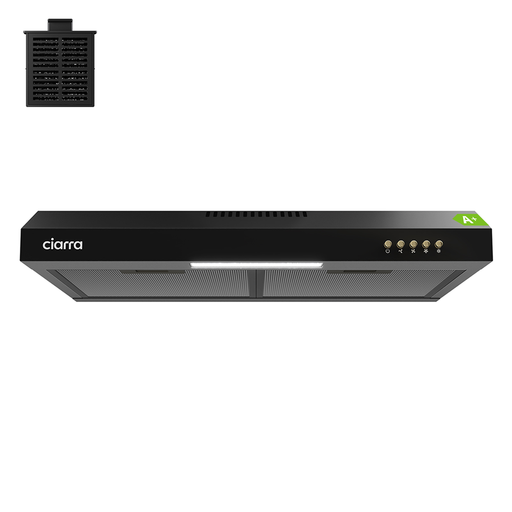
Why This Fits Their Persona: Its compact 596mm-wide format suits smaller kitchens, rental homes and low-cabinet layouts. Push-button controls keep operation straightforward.
The listing states both ducted and recirculating operation, with two washable aluminium filters. This helps buyers check the ventilation plan before ordering.
A+ rating, 11kWh/a stated annual consumption, integrated light and maximum noise rating of 61dB.

Why This Fits Their Persona: The recessed design is intended for integrated kitchens where visual continuity and cabinet installation are priorities.
Its stated dimensions are 599mm wide by 309mm deep, allowing cabinet measurements to be checked before purchase rather than relying on the 60cm label.
A+++ rating, 9kWh/a stated annual consumption, dual ventilation and airflow listed up to 640m³/h.
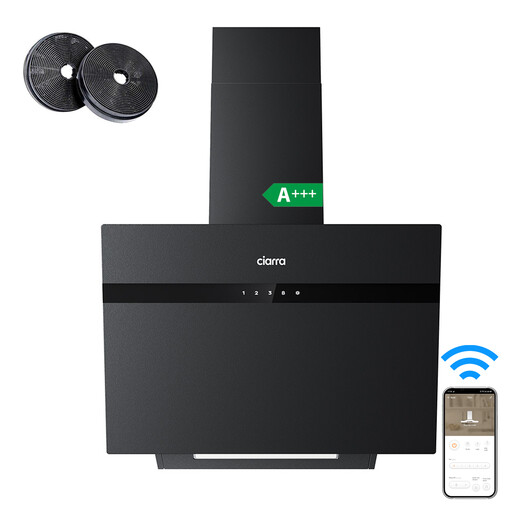
Why This Fits Their Persona: The angled wall-mounted profile leaves more headroom, while 650m³/h maximum airflow suits frequent frying and high-heat cooking.
The product specification provides both maximum airflow and a maximum noise figure of 58dB, so performance can be weighed against sound rather than judged by power alone.
A+++ rating, two-level LED lighting, touch and app control, washable aluminium filter and ducted or recirculating installation.
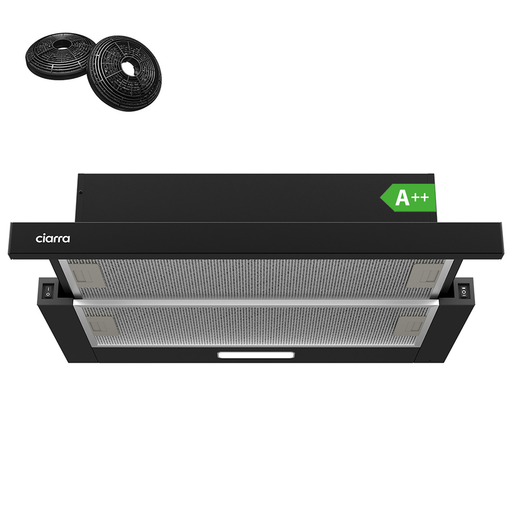
Why This Fits Their Persona: The sliding panel can be hidden when not in use, making it practical for compact UK kitchens and cabinet-led renovations.
The specification states a 599mm width, 370m³/h airflow and both ducted and recirculating modes, with filters included for the latter.
A++ rating, 10kWh/a stated annual consumption, integrated LED lighting and two washable aluminium filters.
We have compiled a complete, real-time list of products that fully satisfy these strict selection criteria and UK safety regulations.
Many 60cm cooker hoods are designed for standard 60cm cooking zones, but check the exact hood width and capture area. A wider hob may require a wider hood, while the installation height must match the manufacturer’s guidance for gas or electric cooking.
Running costs depend on the motor, lighting and usage rather than ventilation mode alone. Ducted extraction avoids regular carbon-filter replacement, while recirculation can reduce installation work where an external outlet is unavailable. Compare annual energy consumption and include replacement filter costs.
Service life depends on build quality, installation, cooking frequency and maintenance. Regularly cleaning washable filters, keeping vents clear and replacing carbon filters when required can help maintain airflow. Always follow the product warranty and care instructions for model-specific guidance.