
24/7 Customer Support

Free returns

Same-day & Next-day Delivery

Quality Guaranteed

Unlock Your Welcome Offers: FREE Delivery | Up to 80% OFF | Free 30-day JoyPlus trial
Download the APP
As a Joybuy Product Recommendation Officer, my role is to help you navigate the crowded market of kitchen appliances. A 60cm telescopic cooker hood is a popular choice for modern UK kitchens, offering a sleek, space-saving design. However, not all models are created equal. Many homeowners find themselves disappointed by underperforming units that fail to deliver on their promises.
Before you invest, it's crucial to be aware of a few common pitfalls. Many buyers are swayed by impressive-looking specifications without understanding what they mean, leading to noisy, ineffective extractors. The three most frequent issues we see are:
This guide will help you look past the marketing hype and focus on the features that truly matter, ensuring you select a reliable and effective pull-out kitchen extractor hood.
To avoid the pitfalls, you need to understand a few core parameters. These figures determine how well the appliance will perform in your specific kitchen environment.
The extraction rate, measured in cubic metres per hour (m?/h), tells you how much air the hood can process. A higher number generally means more power. However, the right number for you depends on your kitchen size.
To calculate a suitable rate, multiply your kitchen's volume (length x width x height in metres) by 10. For example, a 4m x 3m kitchen with a 2.5m ceiling has a volume of 30m?. It would require a hood with an extraction rate of at least 300m?/h. For those who frequently fry or cook aromatic foods, aiming for a higher rate, such as 500-600m?/h, provides the necessary power to keep the air fresh.
The noise level, measured in decibels (dB), is often overlooked but is critical for a comfortable kitchen. A conversation is typically around 60 dB. A cooker hood running at 65 dB or lower on its maximum setting is generally considered acceptable. Anything higher can become intrusive. Look for models that provide noise levels for each fan speed, allowing you to balance extraction power with kitchen acoustics.
A 60cm built-in extractor fan can operate in two ways:
Choosing an integrated cooker hood that supports both modes offers the greatest flexibility for any home layout.
Instead of a generic list, we match products to specific user needs. Below are our recommendations based on common UK buyer profiles.
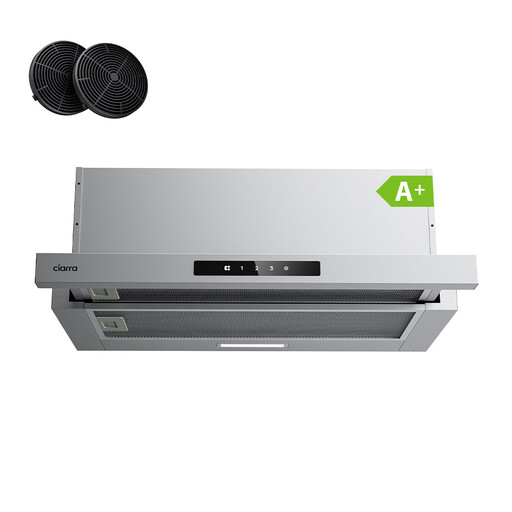
Why This Fits Their Persona: This user prioritises aesthetics and a seamless look. The sleek silver extractor hood design and touch controls integrate perfectly into contemporary cabinetry, while the telescopic function keeps it hidden when not in use.
Its sturdy construction and smooth pull-out mechanism directly counter the "Flimsy Slide-Out" pitfall, ensuring long-term reliability and maintaining the kitchen's clean lines.
Intuitive touch controls and bright cooker hood with LED lights enhance the user experience, combining modern functionality with a minimalist aesthetic.
Why This Fits Their Persona: This user cooks regularly and needs performance they can count on. The high extraction rate and A+ energy rating mean it can handle heavy-duty cooking without driving up electricity bills.
With a clearly stated maximum extraction rate of 600m?/h, it avoids the "Powerful but Weak" trap by providing verifiable performance capable of clearing a typical UK kitchen quickly.
Features washable aluminium grease filters, which are easy to clean and maintain, saving money on disposable parts over the appliance's lifetime.
Why This Fits Their Persona: Kitchen fitters and DIYers need versatile solutions. This model's ability to be configured for both ducted and recirculating ventilation makes it a reliable choice for various property types and layouts.
By providing clear noise level specifications (up to 64dB), it avoids the "Jet Engine" trap, allowing fitters to manage client expectations about sound output accurately.
The dual ventilation system offers maximum installation flexibility, making it a dependable stock item for professionals who encounter different building requirements.
We have compiled a complete, real-time list of products that fully satisfy these strict selection criteria and UK safety regulations.
For optimal performance, aluminium grease filters should be cleaned every 2 to 4 weeks, depending on your cooking habits. Most are dishwasher-safe, but always check the manufacturer's instructions. If you are using a recirculating setup, the carbon filters are not washable and typically need to be replaced every 3 to 6 months.
These hoods are designed to be integrated into a standard 60cm-wide overhead kitchen cabinet. However, you must ensure the cabinet's internal depth and height can accommodate the main body of the unit. Always check the product's specific dimensions against your cabinet's internal measurements before purchasing.
A ducted extractor is more effective at removing moisture and all airborne particles because it vents them outside. A recirculating hood is an excellent alternative when ducting is not feasible. It is very effective at removing smoke and odours, provided the carbon filters are clean and replaced regularly. However, it does not remove moisture from the kitchen.