
24/7 Customer Support

Free returns

Same-day & Next-day Delivery

Quality Guaranteed

Unlock Your Welcome Offers: FREE Delivery | Up to 80% OFF | Free 30-day JoyPlus trial
Download the APP
A 60cm cooker hood can make a noticeable difference to steam, grease and cooking odours, particularly in compact UK kitchens, flats and open-plan living spaces. However, the headline airflow figure or stylish black finish does not tell you everything you need to know.
Several common buying traps can lead to an appliance that is difficult to install, noisy during everyday cooking or expensive to maintain. The practical approach is to match the hood’s extraction method, dimensions and controls to your kitchen rather than choosing by appearance alone.
A high maximum extraction figure can look impressive, but it may only apply to the highest or boost setting. Check the airflow at each speed, as well as the stated noise level. A cooker hood used frequently on a moderate setting may be more suitable than one that is loud whenever it is switched on.
For example, the CIARRA telescopic model lists airflow steps of 337m³/h, 441m³/h and 551m³/h, with noise levels from 54dB to 64dB. This provides more useful context than a single maximum number.
A ducted and recirculating extractor offers flexibility, but the two modes work differently. Ducting sends filtered air outside through a suitable vent, while recirculation passes air through carbon filters before returning it to the room.
Before purchasing, check whether your property has an existing external outlet, where the duct can run and whether landlord permission is needed. If external ventilation is impractical, confirm that the correct carbon filters are included or available separately.
A glass front, touch panel and LED lighting can improve daily use, but they do not remove the need to clean the filter. Grease deposits can build up when filters are neglected, reducing airflow and creating unpleasant odours.
Look for a washable grease filter, preferably aluminium, and check the cleaning instructions. Some filters are dishwasher-safe, although the manufacturer’s guidance should always take priority.
A 60cm cooker hood is designed for a cooking area of approximately the same width, but always measure the available cabinet or wall space. A telescopic cooker hood may fit inside a cabinet, while an angled extractor hood generally requires wall mounting and sufficient clearance above the hob.
Check:
Do not rely on a product being described as “60cm” alone. The CIARRA built-in telescopic hood measures 599mm wide, whereas the Ciarra wall-mounted model measures 595mm wide.
For homes with suitable external ducting, a ducted installation can remove cooking air from the building. Recirculation is more convenient for renters or kitchens without an external wall, but carbon filters need periodic replacement.
Compare the airflow in m³/h and consider your room layout. A high airflow cooker hood may be useful for frequent frying or larger open-plan kitchens, but noise at the upper setting remains important. The CDA EVA60BL, for instance, lists a maximum extraction rate of 615m³/h, with three speeds and a boost setting.
Noise is measured in decibels, or dB. A lower quoted figure generally indicates quieter operation, but check whether it applies to the lowest, highest or boost setting.
An LED cooker hood can improve visibility over the hob while generally using less power than older lighting types. Touch controls offer a smooth surface that is easy to wipe, while mechanical buttons may be preferable if you want a more tactile interface.
For electrical safety, follow the supplied installation instructions and check the appliance’s UK documentation, markings and power requirements. Where fixed wiring or a new circuit is involved, use a suitably qualified installer.
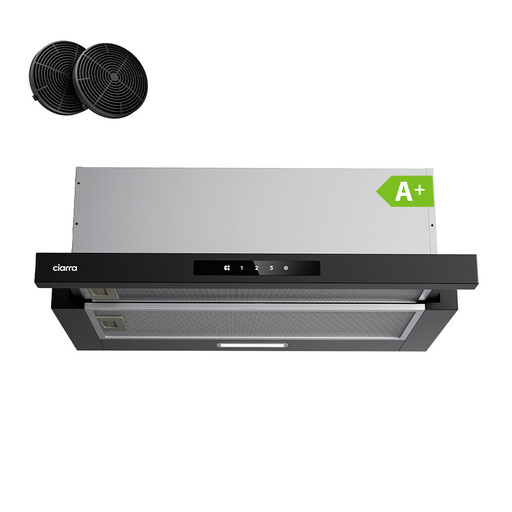
Why This Fits Their Persona: Its pull-out format suits compact UK kitchens and cabinet installations where preserving cupboard space matters.
It supports both ducted and recirculating installation, so buyers can check their kitchen layout before committing to one ventilation method.
A+ energy class, SensorTouch controls, LED lighting and two washable aluminium filters.
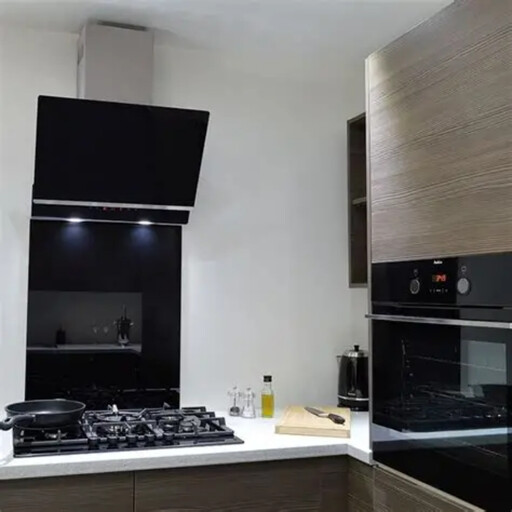
Why This Fits Their Persona: The black angled extractor hood suits contemporary renovations where headroom, appearance and adaptable ventilation are priorities.
The specification states both ducted and recirculation options, with carbon filtration available separately, helping prevent an unsuitable installation purchase.
615m³/h maximum extraction, three speeds plus boost, two LED lamps and dishwasher-safe aluminium grease filters.
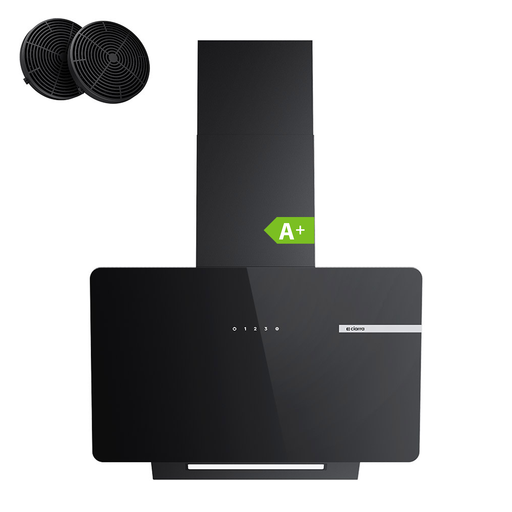
Why This Fits Their Persona: The wall-mounted format and 580m³/h stated airflow are suited to frequent cooking, open layouts and households that need adaptable ventilation.
Its listed recirculation and ducting modes provide a route for both existing vent systems and kitchens where outside ducting is unavailable.
A+ energy class, 64dB maximum noise level, SensorTouch controls and a washable aluminium filter.
Before ordering a 60cm extractor hood, confirm the following:
We have compiled a complete, real-time list of products that fully satisfy these strict selection criteria and UK safety regulations.
Usually, a 60cm cooker hood is intended to align with a similarly sized hob. Check the appliance dimensions and the installation instructions, as the actual width may be slightly below or above 600mm.
They suit different kitchens. Ducted extraction sends air outdoors, while recirculation avoids structural changes but relies on grease and carbon filters. Choose based on your property, installation permissions and maintenance preference.
Cleaning frequency depends on how often and what you cook. Regular frying may require cleaning every few weeks. Always follow the product manual and replace carbon filters according to the manufacturer’s schedule when using recirculation.