
24/7 Customer Support

Free returns

Same-day & Next-day Delivery

Quality Guaranteed

Unlock Your Welcome Offers: FREE Delivery | Up to 80% OFF | Free 30-day JoyPlus trial
Download the APP
By Joybuy Product Recommendation Officer
A 60L dual-compartment kitchen recycling bin can make everyday sorting easier, particularly in family kitchens where general waste and recyclable packaging quickly build up. However, a large bin is not automatically a practical one. Some designs look sleek online but leave little usable space, have awkward inner buckets or require replacement liners that are difficult to find.
This guide explains the main buying pitfalls, the specifications worth checking and which styles may suit different UK households.
A listing showing 60L usually means the combined capacity of both compartments. In a 2 x 30L recycling bin, each side is designed to hold approximately 30 litres, not 60 litres individually. This is useful for balanced waste sorting, but one compartment may fill sooner than the other depending on your household habits.
Before buying, consider what each side will hold. Food packaging and general rubbish may need different collection frequencies, while flattened cardboard and bottles can occupy more space than their weight suggests.
A dual kitchen rubbish bin takes more floor space than a single narrow pedal bin. Check the listed width and depth against the gap beside your cabinets, island or utility area. Also measure upwards: some models reach approximately 90–94cm with the lid open, which may interfere with wall cupboards or shelves.
Leave enough clearance for the pedal and lid to operate without touching a wall. One listed model recommends keeping at least 5cm between the bin and the wall during use.
A soft-close kitchen bin is designed to lower the lid gently and reduce slamming noise. It does not remove the need to empty wet waste regularly or clean the inner buckets. Similarly, an odour-seal rubbish bin may help contain smells when the lid is closed, but no household bin can prevent odours indefinitely if food waste is left inside for too long.
Look for a lid mechanism that closes smoothly, but also prioritise removable buckets, washable surfaces and correctly fitted liners.
For larger households, two equal compartments provide a straightforward kitchen waste separator for general rubbish and recycling. A 60L total capacity is often suitable for busy kitchens, but the correct size depends on your collection schedule and available floor space.
If you have limited room, a 40L model with 2 x 20L compartments may be more suitable. If you separate food scraps as well as recycling and general waste, a triple bin could offer three smaller sections, although each compartment will hold less.
A stainless steel pedal bin or steel outer body is relatively simple to wipe clean and can complement modern kitchen appliances. Fingerprint-resistant or satin-style finishes may reduce visible marks, but the surface should still be cleaned with a soft, damp cloth. Avoid abrasive pads and steel wool, which may scratch the exterior.
Removable inner buckets are particularly useful. Handles make it easier to lift a full liner without dragging the whole bin, while fixing rings or rear bag holes can help keep liners in place. Check bucket dimensions and liner compatibility rather than assuming every standard bag will fit neatly.
A hands-free recycling bin opens through a foot pedal, allowing disposal without touching the lid. Separate pedals can be convenient because you can choose the correct compartment directly. A stay-open function, often at around 90 degrees, is useful when emptying dishes or cleaning the interior.
Pedal mechanisms contain moving parts, so avoid forcing the lid closed by hand, overloading either compartment or placing heavy objects on top. Keep the mechanism dry and position the bin on a flat, stable indoor surface.
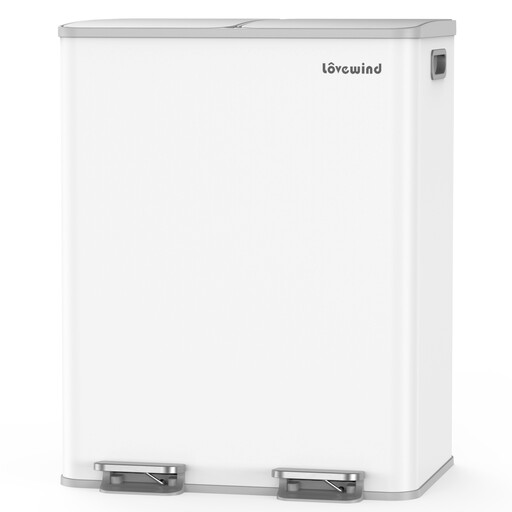
Why This Fits Their Persona: This option suits households starting a consistent waste-sorting routine and wanting a full 60L capacity without adding separate bins around the kitchen.
The two 30L inner buckets make the capacity split clear, while fixing rings help keep rubbish bags secured instead of slipping into the bucket.
Stainless steel exterior, two pedals, two handles, soft-close cushioning and a 90-degree stay-open function.
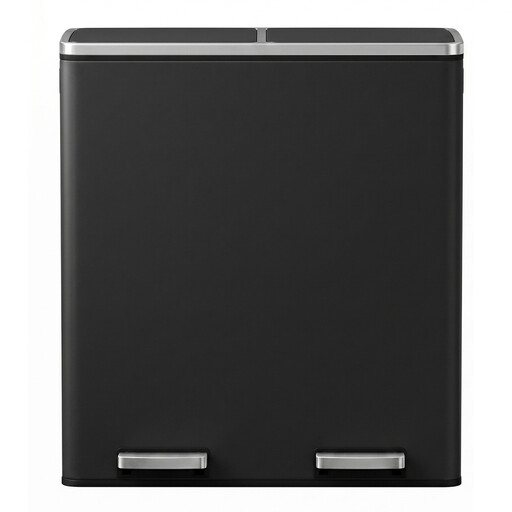
Why This Fits Their Persona: Its dark minimalist finish and substantial steel construction are suited to open-plan kitchens where the bin remains visible.
The product listing specifies removable inner buckets with handles, soft-close lids and an airtight design intended to help contain unwanted odours when closed.
Steel outer body, two 30L sections, pedal operation, soft-close lids and 15 starter rubbish bags included.
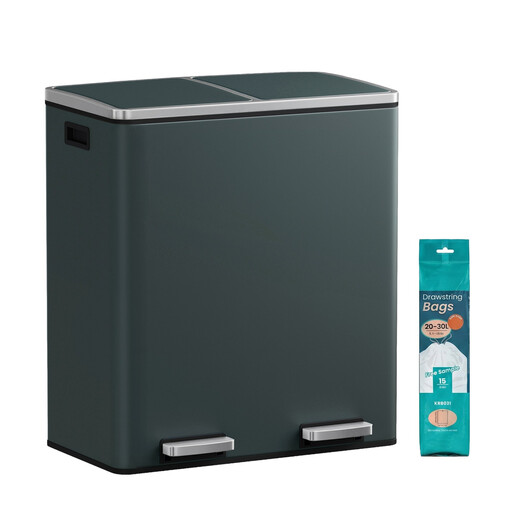
Why This Fits Their Persona: The 60L layout is practical for larger families and busy kitchens that need separate waste and recycling sections between collections.
The specification gives the capacity per compartment, inner-bucket dimensions and a recommended wall clearance, making planning easier before delivery.
Stainless steel exterior, 2 x 30L capacity, removable buckets with handles, soft-close pedals and 15 waste bags.
Place the bin indoors on a level surface, with sufficient room for the pedals and lid. Fit each liner inside its corresponding bucket and use the fixing ring or retaining feature where supplied. Avoid filling either compartment beyond its capacity, as excessive weight can make removal difficult and place strain on the pedal mechanism.
Wipe the outer body with a soft, damp cloth and use mild detergent when necessary. Wash removable buckets with warm soapy water, then dry them thoroughly. Do not use abrasive cleaners, force the lid shut or stand on the bin. These simple habits can reduce staining and unnecessary wear.
UK councils do not all collect the same materials, so check your local recycling guidance before deciding which compartment is for recycling. A divided bin supports sorting at home, but it does not replace local collection rules.
We have compiled a complete, real-time list of products that fully satisfy these strict selection criteria and UK safety regulations.
It can be suitable for a family kitchen, particularly when each side provides around 30L. The right size depends on how often your council collects waste and recycling, whether you separate food waste and how much packaging your household produces.
No. These models use mechanical foot pedals and do not require batteries or mains power. This means there is no electrical running cost, although hinges, springs and pedals still need sensible handling.
Wipe visible spills promptly and wash the removable inner buckets whenever liners leak or odours develop. Wet food waste should not be left for long periods, even when the bin has a soft-close or odour-sealing lid.