Small-desk adventurers
If you move between gameplay, maps, chat and other PC tasks, compare a 75% layout with a 60% board before giving up direct-access keys for more mouse room.


Choose a 75% keyboard if you want more mouse room while keeping dedicated arrow and utility keys close at hand for maps, menus and everyday PC use. Choose 60% if keyboard width is the greater constraint and you are comfortable using shortcuts for omitted keys; adjustable actuation is an optional feature, not a replacement for a workable layout.
If you move between gameplay, maps, chat and other PC tasks, compare a 75% layout with a 60% board before giving up direct-access keys for more mouse room.
If your keyboard and mouse compete for a particularly small surface, a 60% layout is worth considering—provided you are happy to use shortcuts for keys absent from the main layout.
If adjusting key response matters to you, choose a compact layout that works for your controls first, then check the exact model’s settings and software requirements.
Choose it when: You regularly use arrows and utility keys for menus, maps or desktop navigation; Corsair’s UK K65 Plus is one documented example that retains them.
Trade-off: A 75% board takes more width than a 60% board, so measure the space left for your mouse.
Choose it when: Freeing keyboard-side mouse space matters more to you than having every control on a dedicated key.
Trade-off: Razer’s Huntsman Mini lacks a dedicated function row, home cluster and numpad; those inputs use secondary functions and shortcuts.
| Concern | What to check | Who this matters to |
|---|---|---|
| Direct-access controls | Check for dedicated arrows and the other keys you use frequently; inspect the exact keyboard’s shortcut map. | I want room for my mouse without reaching through shortcuts each time I open a map or navigate a menu. Around 42% of consumers put direct-access controls first. |
| Mouse room | Measure the available desk width and decide whether you can use shortcuts for omitted keys. | My desk is so constrained that keyboard width affects where I can move the mouse. For around 33% of consumers, saving mouse space is the primary need. |
| Input customisation | Check the exact model’s adjustment options and software compatibility after settling on a layout. | I want to adjust how my keys respond, but I still need the layout to work for my games. Input customisation comes first for around 25% of consumers. |
A smaller board frees space, but a 60% layout can make frequently used function and navigation commands less direct.
List the keys you use for maps, inventory, chat and desktop tasks. If you often need immediate access, compare 75% layouts before choosing 60%.
ANSI and ISO layouts differ physically, and variants within a keyboard range may not have the same key arrangement.
Check the selected product’s layout designation and images for the physical key arrangement you want.
Adjustment cannot restore keys omitted from a compact layout, and a very sensitive setting may not suit every task.
Choose a workable key arrangement first. If you want actuation tuning, check how the exact model is configured and start with a setting you can control comfortably.
Keychron specifies that its K2 HE uses Gateron Double-Rail Magnetic Switches rather than accepting every magnetic-switch design.
Check the manufacturer’s compatibility statement for the exact keyboard before planning a switch change.
Its compact range includes the 60% Huntsman Mini and the separately specified Huntsman V3 Pro Mini.
The UK K65 Plus Wireless is a 75% option for buyers who want a compact board with direct arrow and utility keys.
The Apex Pro Mini range is relevant if you want a 60% layout with adjustable actuation.
The K2 HE UK ISO offers a 75% layout with magnetic switches for buyers interested in both direct-access keys and customisation.
These choices span 75%, 65%, 60% and 68-key layouts. Compare the controls each arrangement leaves within reach, then check the exact physical layout if UK key positions matter to you.
 No image available
Consider this 75% option if you want to compare a compact keyboard against the direct-key access you need for maps, menus and other PC tasks.
The product name identifies a wireless UK variant; check the selected keyboard’s physical key layout if you specifically need UK ISO.
 No image available
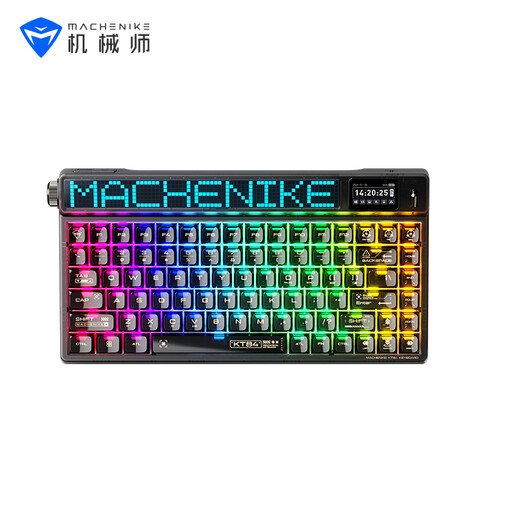
This is a 75% option to assess if you want a compact arrangement for gaming and general PC use.
The named variant has tri-mode connectivity, Gateron White switches and a US QWERTY layout; check that its physical keys suit you if you normally use a UK layout.
 No image available
Consider this 65% layout if you want to examine an option between the 60% and 75% sizes discussed above.
Its name specifies an analog gaming keyboard and a UK layout. Check the exact key map if dedicated function-row access matters for your games.
 No image available
This 60% model is worth considering when freeing mouse space takes priority over dedicated function and navigation keys.
Razer specifies adjustable actuation from 0.1–4.0 mm for the Huntsman V3 Pro Mini. Check the selected variant’s physical layout and shortcut map for the controls you use.
 No image available
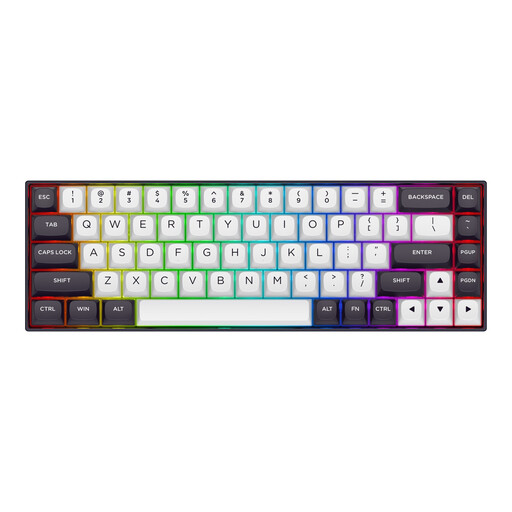
This 68-key model gives you another compact arrangement to compare when mouse room and access to your usual controls both matter.
The product name specifies magnetic switches, Rapid Trigger and an 8000 Hz polling rate; those specifications alone do not establish an advantage in your games. Check whether its US physical layout and any required configuration software suit your setup.
Not if mouse room matters most and you are comfortable using shortcuts for frequently needed keys. Razer says its 60% Huntsman Mini accesses inputs absent from the main layout through secondary functions, so compare your game bindings with the exact model’s shortcut map.
A 75% layout can retain direct-access controls while taking less desk width than a larger arrangement. Corsair specifies dedicated arrows and utility keys on its UK K65 Plus Wireless; check the keys on the particular model you are considering rather than assuming every 75% board is identical.
Choose the physical arrangement you are comfortable using, and confirm it on the exact variant before buying. Logitech describes ISO as the standard arrangement across the UK; ANSI and ISO differ in key shapes and positions, which matters if you rely on familiar key placement or plan to change keycaps.