
24/7 Customer Support

Free returns

Same-day & Next-day Delivery

Quality Guaranteed

Unlock Your Welcome Offers: FREE Delivery | Up to 80% OFF | Free 30-day JoyPlus trial
Download the APP
Juggling separate chargers for your MacBook, smartphone and tablet is a familiar frustration. The promise of a single, powerful 65W GaN charger is compelling: one plug to declutter your desk, lighten your travel bag and fast-charge all your devices. However, the market is filled with options that can be misleading. Many buyers in the UK end up with chargers that underperform, overheat or are simply impractical.
As the Joybuy Product Recommendation Officer, my role is to help you navigate these choices. Before you buy, be aware of these common pitfalls that lead to wasted money and disappointment.
To ensure you get a charger that delivers on its promises, focus on these three non-negotiable specifications.
Understanding wattage is crucial. A 65W output is generally sufficient to fast-charge everything from a MacBook Air and 13-inch MacBook Pro to an iPad, iPhone or even a Steam Deck charger. However, the key is how that power is managed.
Look for chargers that support PD 3.0 (Power Delivery). This is a fast-charging standard that allows the charger and your device to communicate and negotiate the optimal charging speed. For a multi port USB C charger, check the manufacturer's specifications for power distribution. A good charger will clearly state the maximum output per port and how that output changes when multiple ports are active. For example, it might deliver 65W from a single USB-C port, but split to 45W and 20W when two are used.
GaN is more than just a marketing buzzword. It's a semiconductor material that is far more efficient than the traditional silicon used in older chargers. This higher efficiency translates into three practical benefits for you:
For anyone looking to replace multiple bulky power bricks with a single solution, GaN is the technology to look for.
The ideal port layout depends on your devices. Modern laptops, tablets and smartphones predominantly use USB-C. For future-proofing and maximum compatibility, a charger with at least two USB-C ports is advisable.
However, many people still own devices that use USB-A, such as smartwatches, wireless earbuds or older peripherals. A charger that includes one USB-A port alongside two USB-C ports offers excellent versatility, ensuring you can power all your gadgets without needing extra adapters.
Instead of a one-size-fits-all approach, we've matched a few standout options to different user needs, all of which address the pitfalls mentioned above.
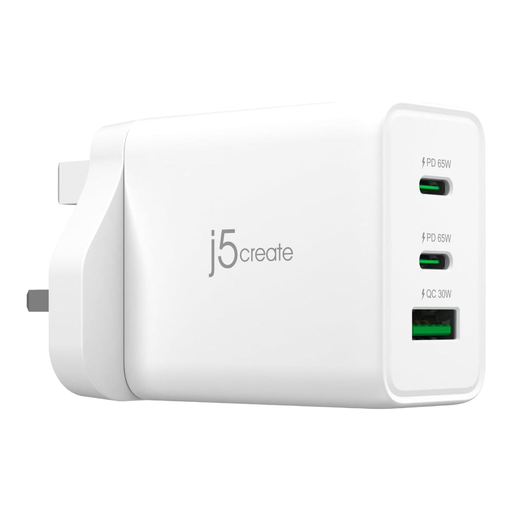
Why This Fits Their Persona: Ideal for the professional or student who carries a laptop, phone and one other accessory. It provides a balanced solution for charging at the office, in a café or at home without carrying multiple adapters.
It features an intelligent IC that automatically balances power, so you know exactly what to expect. It can deliver up to 65W from a single USB-C port or smartly distribute power (e.g., 45W for a laptop and 20W for a phone) when multiple ports are used, avoiding the "total power" myth.
Its versatile 3-port configuration (2x USB-C, 1x USB-A) covers both modern and legacy devices. The compact GaN build ensures it's genuinely portable.
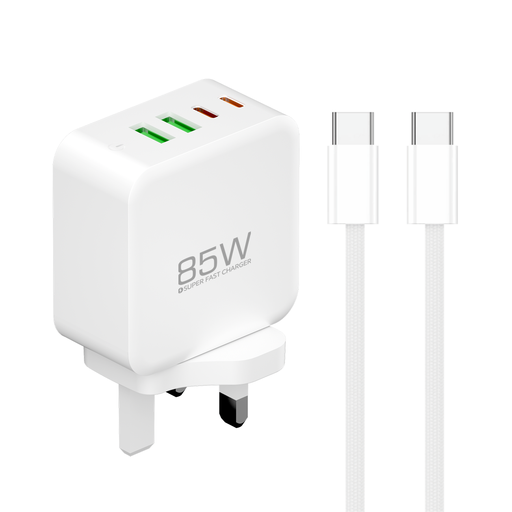
Why This Fits Their Persona: For the user who juggles a high-power laptop, a tablet, a phone and a gaming console like the Steam Deck. This charger offers a higher total output and more ports, making it the single plug for a complete tech arsenal, whether at a hotel or a home office.
The specifications clearly detail its power distribution, noting that the C2 port can deliver a dedicated 65W for a laptop, while other ports share the remaining power. This transparency avoids any guesswork. It also features a British Standard Plug.
The 85W total output and four ports (2x USB-C, 2x USB-A) provide maximum flexibility for charging multiple demanding devices simultaneously.
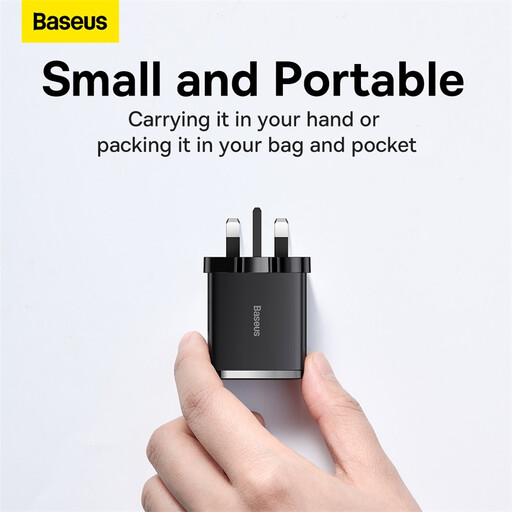
Why This Fits Their Persona: Perfect for students or light users who primarily need to fast-charge a phone and tablet, plus another low-power device like headphones. It offers the convenience of multiple ports without the cost of a high-wattage laptop charger.
By being upfront about its 30W maximum output, it prevents users from overspending on a 65W charger they don't need. It delivers on its promise of fast charging for compatible phones and tablets, avoiding the disappointment of a mismatched purchase.
It is extremely compact and affordable, while still providing three ports and smart recognition chips for safe, efficient charging of smaller devices.
We have compiled a complete, real-time list of products that fully satisfy these strict selection criteria and UK safety regulations.
Yes, it is safe. Modern chargers with Power Delivery (PD) technology are intelligent. They communicate with your device to deliver only the amount of power it can safely handle. A 65W charger will not "overpower" a phone that only requires 20W; it will simply provide the 20W that the phone requests.
A well-made GaN charger from a reputable brand should last for several years under normal use. Their higher efficiency means they run cooler, which reduces stress on internal components and contributes to a longer lifespan compared to older, hotter-running silicon chargers. Always ensure it has proper safety certifications like UKCA to guarantee its build quality.
Yes. The Steam Deck requires a 45W PD charger for full-speed charging while playing. A 65W PD charger comfortably exceeds this requirement, meaning it can power the console at maximum performance and charge the battery simultaneously, making it an excellent all-in-one travel companion for gamers.