Choose an 80-bag box when your household already knows it will use one flavour regularly: Twinings Pure Peppermint is the simpler mint choice, while Twinings Lemon & Ginger suits a preference for that blend. Twinings describes both infusions as caffeine-free, but check the current ingredients before buying. If the drinker is pregnant, NHS guidance says to avoid teas containing liquorice root and have no more than four cups of herbal tea a day; breastfeeding parents should also account for caffeine from other foods and drinks.
Who is an 80-bag box for?
The box size makes most sense when the flavour is familiar and the drink suits the person who will use it.
Breastfeeding parents choosing a caffeine-free drink
An infusion explicitly described as caffeine-free offers a hot-drink option without adding caffeine from that cup. The NHS advises people who consume caffeine while breastfeeding to try not to exceed 300 mg a day, accounting for sources beyond tea.
Pregnant shoppers buying ahead
If the box may be opened during pregnancy, the ingredients and number of cups matter as well as the pack size. The NHS advises avoiding teas containing liquorice root and having no more than four cups of herbal tea a day during pregnancy.
Households settled on one flavour
An 80-bag box suits a cupboard where peppermint or lemon and ginger will be used regularly. If the household has not tried the flavour, a smaller pack gives it a chance to decide before committing to 80 bags.
What should you check before buying?
Start with the exact infusion and pack count, then check caffeine wording and ingredients for the people who will drink it.
| Priority |
What to check |
Your needs |
| Pack and flavour |
Confirm 80 bags on the exact product. Decide whether one flavour will be used often enough to justify a large box. |
I know our household will drink this flavour regularly; otherwise, I would start with a smaller pack. |
| Caffeine |
Look for a caffeine-free statement on the individual infusion, not just the word “tea”. Twinings describes its Pure Peppermint 80 and Lemon & Ginger 80 infusions as caffeine-free. |
While breastfeeding, I want a hot drink that does not add caffeine from that cup. The NHS advises counting caffeine from other foods and drinks too. |
| Pregnancy |
Read the current ingredient label for liquorice root. The NHS advises avoiding teas containing it and having no more than four cups of herbal tea a day during pregnancy. |
If I might drink the tea while pregnant, an 80-bag box does not change the NHS guidance on ingredients or daily cups. |
| Ingredients |
Check whether the product is a single-flavour peppermint infusion or a lemon-and-ginger blend, and review the full current label for ingredients you need to avoid. |
I would rather choose a flavour and ingredient list that everyone drinking from the box can check for themselves. |
| Reason for buying |
Choose on flavour, pack size and caffeine description rather than promises about milk supply or symptoms. Imperial College Healthcare NHS Trust says no special foods or drinks are needed to make breast milk. |
I want a drink for our routine, not a box bought in the expectation that it will resolve a feeding or health concern. |
Buying mistakes to avoid
-
Assuming every 80-bag tea is a caffeine-free herbal infusion
Pack size and tea type are separate details. Clipper, for example, lists 80-bag black tea alongside 20-bag peppermint and lemon-and-ginger infusions.
Check both the bag count and the caffeine description on the exact box or product page.
-
Treating a large box as a daily-use recommendation during pregnancy
According to the NHS, pregnant people should have no more than four cups of herbal tea a day and avoid teas containing liquorice root.
Read the blend’s current ingredients and plan use around that guidance, regardless of how many bags the box holds.
-
Buying tea for a milk-supply or symptom claim
Imperial College Healthcare NHS Trust says no special foods or drinks are needed to make breast milk. A tea’s flavour or packaging is not a reason to rely on it for a feeding concern or symptoms.
Choose tea as a drink; speak to an appropriate healthcare or infant-feeding professional about feeding difficulties or persistent symptoms.
-
Committing to 80 bags of an unfamiliar flavour
Both 80-bag Twinings options here are single-flavour choices, so an unwanted flavour could leave bags unused.
Try a smaller pack or a selection box first if you are uncertain about the taste or ingredients.
Relevant herbal tea brands
These brands offer different herbal ranges and pack formats; a brand’s inclusion here does not mean every product comes in an 80-bag box.
Twinings
Its Pure Peppermint and Lemon & Ginger infusions are identified as 80-bag products by Twinings and listed in Tesco’s UK fruit-and-herbal tea range.
- Twinings describes Pure Peppermint as naturally caffeine-free and Lemon & Ginger as caffeine-free.
- Each box commits the household to one flavour; check the current ingredients before buying.
Pukka
A herbal range to consider when a selection box is more useful than a single-flavour 80-bag box.
- Pukka describes a selection box containing 90 sachets across six blends and says its teas are Fair for Life certified.
- That 90-sachet selection box is a different format from an exact 80-bag box.
Clipper
Its shop lists peppermint and lemon-and-ginger herbal options in smaller packs.
- The Clipper shop lists Organic Peppermint Infusion and Organic Lemon & Ginger Tea in 20-bag packs.
- An 80-bag Clipper tea should not be assumed to be herbal: the shop also lists black tea in that size.
Teapigs
Its herbal range offers flavours to explore if flavour choice matters more than an exact 80-bag format.
- Teapigs lists peppermint, lemon and ginger, chamomile, and honeybush and rooibos among its herbal teas.
- Check the pack count and ingredients of an individual product rather than assuming the range has the format you want.
Tesco
Its own-label peppermint infusion is a smaller-pack alternative for someone trying that flavour.
- Tesco lists its peppermint infusion as a 40-bag pack.
- The own-label pack does not meet an exact 80-bag preference.
80-bag options on Joybuy
These two Twinings boxes offer a choice between peppermint and lemon-and-ginger flavour when an 80-bag herbal infusion is the preferred format.
 No image available
Twinings Pure Peppermint 80 Tea Bags
Choose this if the household wants 80 bags of peppermint rather than a lemon-and-ginger blend. Twinings describes the infusion as naturally caffeine-free. Check the current label before use; NHS pregnancy guidance on herbal tea still applies to this box.
View on Joybuy
 No image available
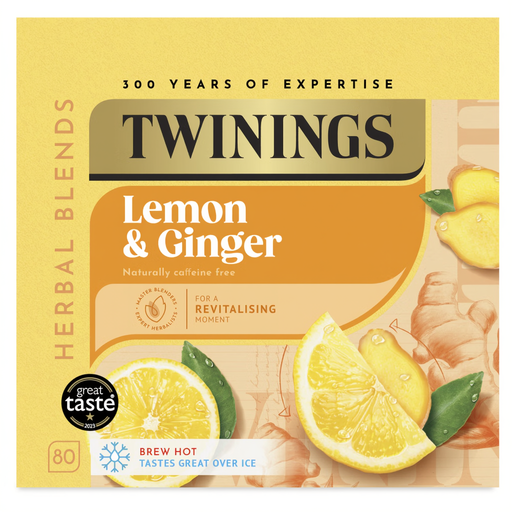
Twinings Lemon & Ginger 80 Tea Bags
Choose this if lemon-and-ginger flavour is more likely to be used regularly. Twinings identifies it as an 80-bag caffeine-free herbal infusion. As it is a blend, review the full current ingredient label, particularly if the tea may be drunk during pregnancy.
View on Joybuy
Common questions
Can I choose herbal tea instead of caffeinated tea while breastfeeding?
A caffeine-free herbal infusion can be one hot-drink option, provided you check the exact product rather than assuming all tea is caffeine-free. Twinings describes its Pure Peppermint 80 and Lemon & Ginger 80 infusions as caffeine-free. The NHS advises people who consume caffeine while breastfeeding to try not to exceed 300 mg a day from all sources.
Does an 80-bag box change how much herbal tea I can drink during pregnancy?
No: the box count is not a daily-use recommendation. The NHS advises having no more than four cups of herbal tea a day during pregnancy and avoiding teas containing liquorice root. Check the ingredients of the exact blend before buying.
Should I buy peppermint or ginger tea to increase milk supply or address symptoms?
Do not buy an ordinary herbal tea on that expectation. Imperial College Healthcare NHS Trust says no special foods or drinks are needed to make breast milk. Choose a flavour you want to drink, and seek appropriate professional advice for feeding concerns or persistent symptoms.
Why check the ingredients when the box already says “herbal”?
Herbal infusions can contain different ingredients, so the description alone does not tell you whether a particular blend suits your circumstances. The NHS specifically advises avoiding teas containing liquorice root during pregnancy. If you are unsure about an ingredient or take medicines, ask a pharmacist or clinician about the specific product.


