
24/7 Customer Support

Free returns

Same-day & Next-day Delivery

Quality Guaranteed

Unlock Your Welcome Offers: FREE Delivery | Up to 80% OFF | Free 30-day JoyPlus trial
Download the APP
An 850W power supply unit can provide a useful balance between capacity, upgrade headroom and running efficiency for a high-performance desktop. It may suit a gaming PC with a demanding graphics card, a content-creation workstation or a system builder planning future upgrades.
However, wattage alone does not determine whether an 850W PSU is suitable. Connector standards, efficiency, case dimensions, cooling behaviour and protection features can make a significant difference to compatibility and day-to-day use.
Two power supplies may both be rated at 850W but offer different GPU connectors. Older models may rely on several PCIe 6+2-pin cables, while newer ATX 3.1 power supply designs can include a native 12V-2x6 connector.
Some product listings also use the term PCIe 5.0 PSU or PCIe 5.1 PSU without clearly explaining whether the cable is included, whether it is native or what power level it supports. Check the technical specification rather than relying on the product title.
An 80 PLUS Gold PSU is assessed for energy efficiency at specified loads. This can help reduce wasted energy and heat compared with less efficient designs, but the certification does not by itself describe fan noise, cable layout, protections or long-term suitability.
Look for the full specification, including efficiency details, fan operation, protection systems and the manufacturer’s stated warranty.
A fully modular power supply allows unused cables to be disconnected, which can simplify cable routing and reduce clutter inside a case. A non-modular design may be straightforward to install, but spare cables remain attached.
Also check the PSU length. Standard ATX units commonly measure around 150mm wide and 86mm high, but depth varies. A 160mm PSU may fit many ATX cases while leaving less room for cable management in compact chassis.
An 850W rating refers to the PSU’s stated continuous output, not necessarily the amount your computer will draw at all times. Compare the estimated consumption of the graphics card, processor, storage, cooling and accessories.
For a gaming PC, the graphics card is often the largest power consumer. Allowing some headroom can help accommodate short-term load changes and future upgrades, but buying a significantly oversized unit may add cost without a practical benefit.
For a new high-performance PC, ATX 3.1 support is a useful specification to consider because it is designed for modern power-delivery requirements and transient loads. A native GPU cable can also avoid the need for an adapter.
The connector terminology needs careful attention:
Do not mix modular cables from different power supplies. Even if the plugs appear similar, the pin assignments may differ and could damage computer components.
A quiet power supply may use a zero-RPM or fanless mode at low loads, allowing the fan to stop when less cooling is needed. At higher loads, fan speed will depend on temperature and internal design.
Useful protection features include over-voltage protection (OVP), over-current protection (OCP), over-power protection (OPP), under-voltage protection (UVP), short-circuit protection (SCP) and over-temperature protection (OTP). These features are not a substitute for correct installation, but they are important specifications to review.
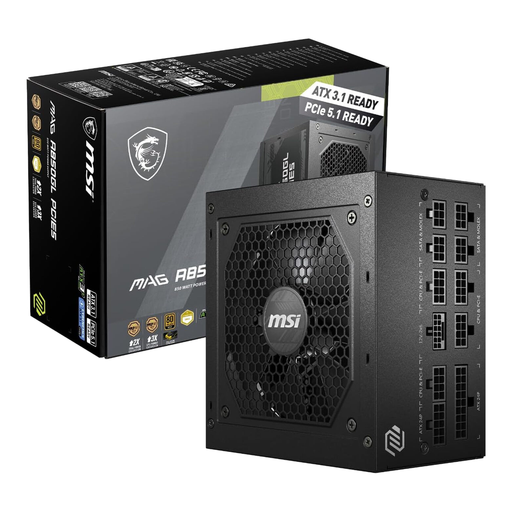
Why This Fits Their Persona: A practical option for UK builders who want modern GPU connectivity and a tidy installation without moving to a higher-capacity unit.
Its specification lists ATX 3.0 and PCIe 5.0 readiness, a native 12VHPWR connector and fully modular cabling rather than leaving these details unclear.
80 PLUS Gold certification, zero-RPM mode, a 135mm FDB fan and OCP, OVP, OPP, UVP, SCP and OTP protections.
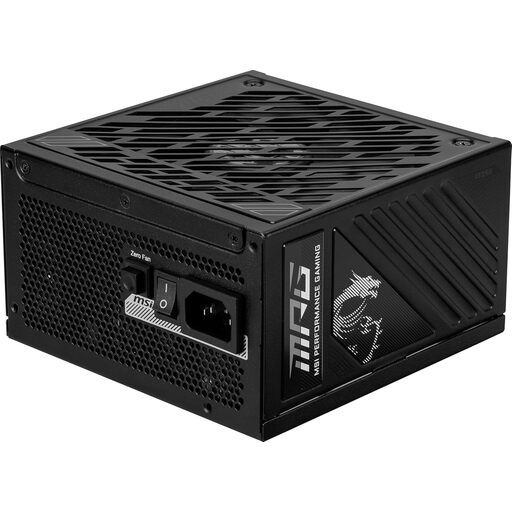
Why This Fits Their Persona: Suitable for builders prioritising native PCIe 5.1 connectivity, cable management and low-load acoustics in a premium gaming or professional system.
The listing identifies native 12V-2x6 connectors for compatible PCIe 5.1 GPUs, helping buyers distinguish direct connectivity from adapter-based solutions.
80 PLUS Gold certification, Cybenetics A++ noise certification, zero-fan mode and a 135mm FDB fan.
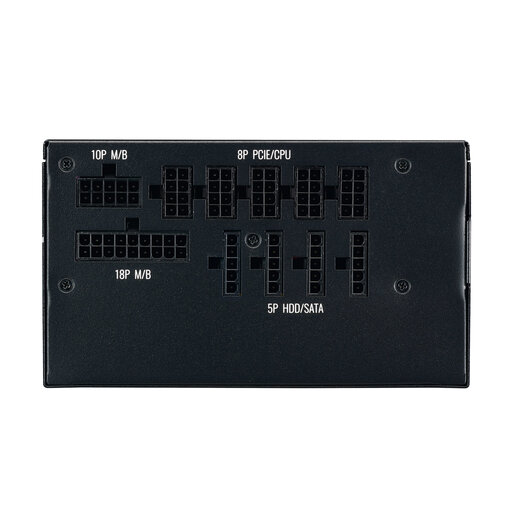
Why This Fits Their Persona: A considered match for demanding gaming, rendering and creator workloads where continuous 850W output and a UK-standard power lead are useful.
The specification states ATX 3.1 compliance, native PCIe 5.0 12VHPWR connectivity and 850W continuous output, rather than only quoting peak capacity.
80 PLUS Gold certification, 140mm hydraulic-bearing fan, 0dB mode at low loads and listed OVP, OCP, SCP, OPP, UVP and OTP protections.
Before ordering, confirm your graphics card’s connector, your case’s maximum PSU depth and whether fixed or modular cables suit your build plan. For more capacity options, browse the 850W range.
We have compiled a complete, real-time list of products that fully satisfy these strict selection criteria and UK safety regulations.
It can be suitable for many high-performance gaming PCs, but the correct capacity depends on the graphics card, processor and other components. Check the manufacturers’ recommended PSU capacity and allow sensible headroom for transient loads and future upgrades.
It may be a practical choice for a new build using a modern graphics card. ATX 3.1 models can include newer GPU power connectors and are designed around current power-delivery requirements. Confirm whether the specific PSU includes a native 12V-2x6 or 12VHPWR cable.
Efficiency certification indicates how effectively the PSU converts mains electricity into power for the computer. A more efficient unit generally wastes less energy as heat at its rated test loads. Actual running costs still depend on your PC’s power draw, usage hours and electricity tariff.