
24/7 Customer Support

Free returns

Same-day & Next-day Delivery

Quality Guaranteed

Unlock Your Welcome Offers: FREE Delivery | Up to 80% OFF | Free 30-day JoyPlus trial
Download the APP
As a Joybuy Product Recommendation Officer, my role is to help you navigate the crowded market of tech accessories. If your desk or travel bag is a tangled mess of different plugs for your laptop, phone and tablet, you're likely looking for a single, powerful solution. A high-wattage GaN charger seems like the perfect answer, but not all are created equal. Let's cut through the marketing jargon and focus on what truly matters.
Before you buy, be aware of these common pitfalls that can lead to disappointment and wasted money:
To ensure you get a charger that performs as expected, focus on these three non-negotiable specifications.
The total wattage tells you the charger's maximum capacity. For most modern users, an 85W charger hits a sweet spot. It's powerful enough to act as a 65W laptop charger while simultaneously fast-charging your smartphone. Look for chargers that clearly state their power distribution logic. For example, a good 85W model might allocate 65W to one USB-C port and 20W to another when both are in use. This ensures your primary device gets the power it needs. Also, confirm it supports the Power Delivery (PD) protocol, which is the standard used by most modern laptops, as well as being essential for an iPhone fast charger or a Samsung super fast charger.
A modern multi port USB C charger is essential. USB-C is the current standard for fast charging and data transfer for everything from laptops to headphones. An ideal charger for 2026 should have at least two USB-C ports, with one capable of delivering at least 65W. However, having one or two legacy USB-A ports can be incredibly useful for charging older devices, smartwatches or accessories without needing an adapter. A four-port configuration (2x USB-C, 2x USB-A) offers maximum versatility.
Choosing a GaN charger is a must for a high-power device. The efficiency of Gallium Nitride means the charger can be significantly more compact and portable than an old silicon-based brick, all while running much cooler. Beyond the UKCA mark, look for built-in protections like over-voltage, over-current and short-circuit protection. These features safeguard your expensive electronics from potential damage caused by power irregularities.
Instead of a generic list, we've matched specific chargers to different user needs.
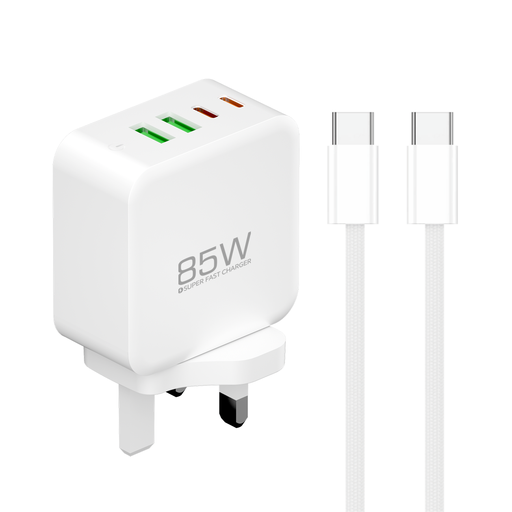
Why This Fits Their Persona: This is for the UK professional or student who needs to power a USB-C laptop, a smartphone and other accessories from a single wall socket, whether at a hot desk or at home. It consolidates multiple bulky plugs into one sleek unit.
It clearly specifies its power distribution, offering a dedicated 65W from one USB-C port even when another port is in use (providing 20W), avoiding the "total wattage" confusion.
Features four ports (2x USB-C, 2x USB-A) for maximum device compatibility. The GaN technology ensures it remains compact and cool despite its high power output.
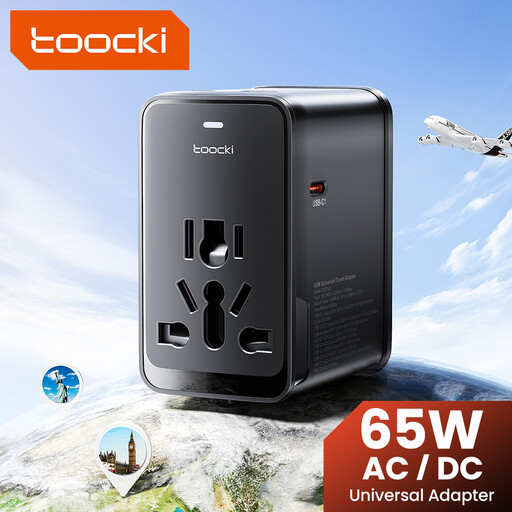
Why This Fits Their Persona: Perfect for the UK resident who travels frequently for business or leisure. This single device replaces a bag of adapters and chargers, working seamlessly in the UK, EU, US and Australia.
As a GaN charger, it remains incredibly compact and lightweight for travel, avoiding the bulk of older multi-voltage chargers. Its 65W PD output is sufficient for most modern ultrabooks and MacBooks.
Its all-in-one design with integrated sliders for different plug types is far more reliable than using separate, easily lost adapters. It features 3 USB-C ports and 1 USB-A port.
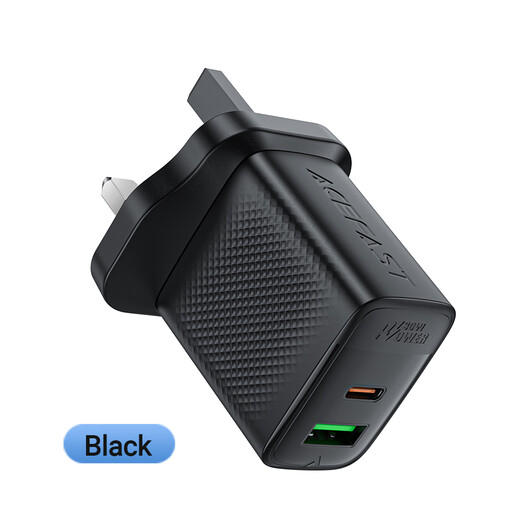
Why This Fits Their Persona: Ideal for students or anyone who doesn't need to charge a high-power laptop but wants a safe, fast and compact charger for their phone, tablet and wireless earbuds. It offers modern tech without the high price tag.
This is a certified UKCA-compliant GaN charger, offering superior safety and efficiency compared to cheap, uncertified chargers that often fail or pose risks. Its 30W output is clearly stated and ideal for fast-charging phones.
It provides access to compact GaN technology at a very accessible price. The inclusion of both USB-C and USB-A ports ensures it works with both new and older charging cables.
We have compiled a complete, real-time list of products that fully satisfy these strict selection criteria and UK safety regulations.
Yes, it is completely safe. Modern chargers that use the Power Delivery (PD) standard are intelligent. They communicate with the connected device (your phone) to determine the maximum power it can safely handle and will only supply that amount. An 85W charger will deliver just 20W to a 20W-capable phone, ensuring it charges quickly without damaging the battery.
The key difference is the material. GaN (Gallium Nitride) is a semiconductor material that is far more efficient than the silicon used in traditional chargers. This efficiency means less energy is wasted as heat, allowing GaN chargers to be much smaller, lighter and run cooler than a silicon charger with the same wattage.
To achieve the maximum charging speed, especially for a laptop, the cable is just as important as the charger. You should use a USB-C to USB-C cable that is rated to handle the power. For a 65W or 85W output, a cable rated for 100W or higher is recommended. Using a lower-rated cable (like the one that came with a smartphone) will still work, but it will likely limit the charging speed to the cable's maximum capacity.