
24/7 Customer Support

Free returns

Same-day & Next-day Delivery

Quality Guaranteed

Unlock Your Welcome Offers: FREE Delivery | Up to 80% OFF | Free 30-day JoyPlus trial
Download the APP
Loose paperwork, crowded stationery drawers and important letters disappearing beneath yesterday’s notes can make even a tidy workspace difficult to manage. An A4 mesh desk organiser offers a practical way to separate documents and supplies, but not every desktop storage organiser is equally suitable for daily UK office, study or home-working use.
Before buying, look beyond the number of tiers and promotional wording. The right organiser should fit your available space, accept standard A4 paperwork and remain stable when trays are opened or loaded.
A five-tier organiser may sound like the obvious choice, but extra height can make it unsuitable for shelves, cupboards or desks beneath wall units. A compact two-tier stackable file tray may be more useful if you only need separate spaces for incoming and outgoing paperwork.
Check the organiser’s complete measurements, including width, depth and height. Also consider the space needed to pull a tray forwards without hitting a monitor stand, wall or desk accessories.
Some organisers are designed for papers to be lifted from an open tray, while others use a pull-out document tray. Pull-out designs can make frequently used documents easier to reach, but they need sufficient clearance at the front and should not be overloaded.
For a busy administrative desk, a tiered desk organiser with pull-out trays can help divide documents by project, priority or destination. For occasional storage, a simple stackable file tray may involve less assembly and fewer moving parts.
A metal desk organiser can be made from different types and thicknesses of metal, with varying surface finishes. A powder-coated finish is designed to provide a protective surface, but it should still be kept away from prolonged moisture. Mesh construction also has edges and joins that should be finished smoothly.
Look for practical details such as rounded edges, secure joints and rubber or anti-slip feet. These features are particularly useful on laminate desks, painted surfaces and shared workstations where scratches and movement are concerns.
Standard A4 paper measures 21 × 29.7 cm. However, folders, ring binders and document wallets need additional room, so an A4 file tray should not be judged solely by its paper-size label.
A suitable office document organiser should provide enough internal width and depth for the way you store paperwork. Product dimensions are also important externally. For example, several pull-out models in this range measure approximately 35.5 × 29.5 cm, while the two-tier stackable trays have a more compact footprint.
Match capacity to your actual workload:
A taller organiser is not automatically more useful. Measure the available height before purchasing, especially if it will sit below shelving or a desk hutch.
Powder-coated metal can offer a practical balance of structure and appearance. Mesh sides allow you to see contents more easily than an opaque container, which can reduce time spent searching through trays.
Prioritise:
Do not use a document organiser as a step, and place it on a level surface. If a pull-out tray becomes stiff, follow the supplied adjustment instructions rather than forcing it.
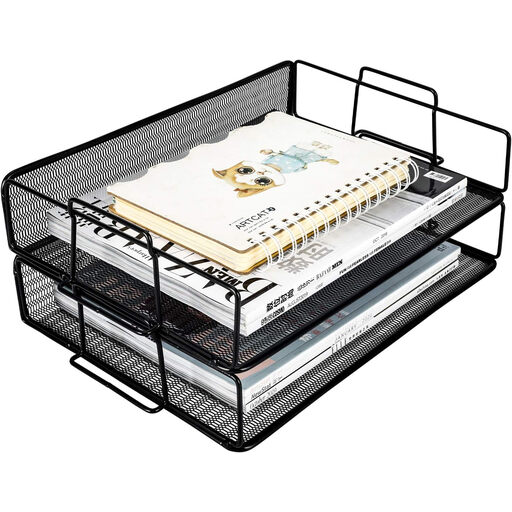
Why This Fits Their Persona: A compact option for students, first home-office setups and anyone who needs basic A4 sorting without taking up much vertical space. Its 34 × 24.5 × 13.5 cm dimensions suit smaller desks.
The two-tier format avoids paying for unused storage and reduces the risk of choosing a tall organiser that will not fit beneath shelving.
Powder-coated metal construction, stackable format and an integrated handle for moving the tray between work areas.
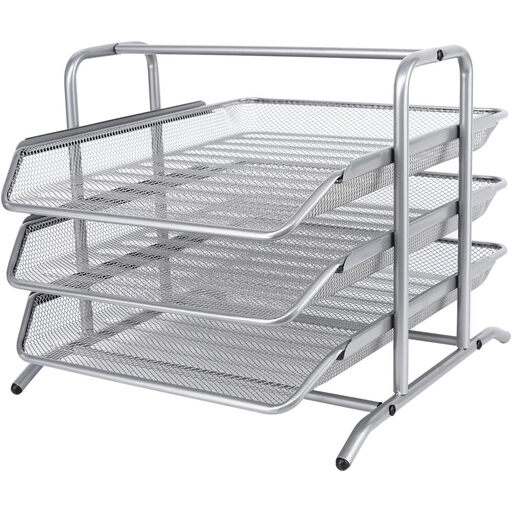
Why This Fits Their Persona: A balanced choice for professional home offices and shared workspaces where presentation, access and everyday organisation all matter.
The listed rounded edges, rubber feet and pull-out trays address common concerns around rough edges, desk marks and awkward document access.
Three A4-compatible pull-out trays, powder-coated metal and four protective rubber feet; assembly screws are included.

Why This Fits Their Persona: Designed for administrative professionals, teachers and busy offices handling several document categories throughout the day.
Its additional height provides more separated storage without requiring multiple organisers, while the pull-out format keeps documents accessible.
Five A4-compatible tiers, a listed height of 37.5 cm and four rubber feet; it is assembled by tightening the supplied screws.
A document tray is not always the right answer for stationery. If your main problem is loose pens, rulers, scissors, sticky notes or paper clips, consider a desk drawer organiser instead. The five-compartment mesh design in the silver, white and black variants measures 30 × 21.5 × 7 cm and includes three smaller compartments plus two longer sections.
These trays can sit inside a drawer or on a desktop. Anti-slip pads help reduce movement, while the low profile keeps frequently used stationery within reach. Browse the wider accessory tray range if you need storage for smaller accessories rather than A4 files.
We have compiled a complete, real-time list of products that fully satisfy these strict selection criteria and UK safety regulations.
It depends on the tray’s internal width and height. Product listings may state A4 compatibility, but bulky ring binders need more clearance than loose paper. Check the dimensions before ordering and avoid filling trays beyond their recommended capacity.
Some do and some do not. The three- and five-tier pull-out models listed here require screws to be tightened, while the two-tier stackable file tray can be placed directly on a stable desk. Always check that screws are secure before loading documents.
Wipe it with a soft, dry cloth to remove dust. If a slightly damp cloth is needed, dry the organiser thoroughly afterwards and avoid abrasive cleaners. Keep the tray away from excessive moisture, distribute paperwork evenly and check that rubber feet remain clean and intact.