
24/7 Customer Support

Free returns

Same-day & Next-day Delivery

Quality Guaranteed

Unlock Your Welcome Offers: FREE Delivery | Up to 80% OFF | Free 30-day JoyPlus trial
Download the APP
Loose paperwork can quickly take over a desk, particularly when A4 folders, bills, letters, meeting notes and study materials all compete for the same space. An A4 mesh file organiser can make documents easier to sort and retrieve, but choosing the wrong design may create new problems rather than solve old ones.
This guide explains which features matter, the common buying traps to avoid and which formats suit different UK homes, offices and study areas.
A product may be described as A4-compatible, but its usable compartments still need enough width and height for your actual documents. Ring binders, plastic wallets and overfilled folders require more room than loose sheets.
Check the complete dimensions and pocket opening before buying. A narrow wall-mounted file holder may suit letters and slim folders, while a deeper desktop document organiser is more suitable for binders and magazines.
Additional trays offer more categories, but they also increase the organiser’s height or wall load. A five-tier unit may be unnecessary for occasional paperwork, while a two-tier file tray could become crowded in a busy administrative workspace.
Choose compartments according to how you sort documents: for example, “to action”, “to file”, “incoming” and “completed”. This prevents unused sections from taking up valuable space.
Pull-out document trays are convenient, but an overloaded tray can make a lightweight organiser shift or tip when extended. Similarly, a wall file holder must be fixed to a suitable surface with appropriate anchors.
Look for rubber feet, a stable base, reinforced supports and clear assembly instructions. Never exceed the stated or reasonable load capacity, and ensure all screws are tightened before use.
For standard paperwork, confirm that the product is designed for A4 document storage. Compare the organiser’s width, depth and height with your available desk, shelf, door or wall space.
Useful formats include:
If you work at a kitchen table or in a compact home office, measure the clearance around your monitor, keyboard and chair before selecting a desktop model.
Powder-coated metal is commonly used for mesh office storage because it provides a firm structure and a surface that can be wiped clean. A powder-coated finish is not a guarantee that an item cannot rust, so keep metal organisers away from prolonged dampness and dry them after cleaning.
Inspect the stated construction details for rounded or smoothed edges, especially if the organiser will be used by children or placed in a busy shared area. Mesh sides also make contents visible, which can help with retrieval but may be less suitable for confidential paperwork.
A desk organiser should sit level, with all feet making contact with the surface. Rubber feet can help reduce sliding and protect desks from scratches. For wall or door installation, check:
For confidential documents, position the holder away from public access and label compartments by category rather than displaying sensitive information.
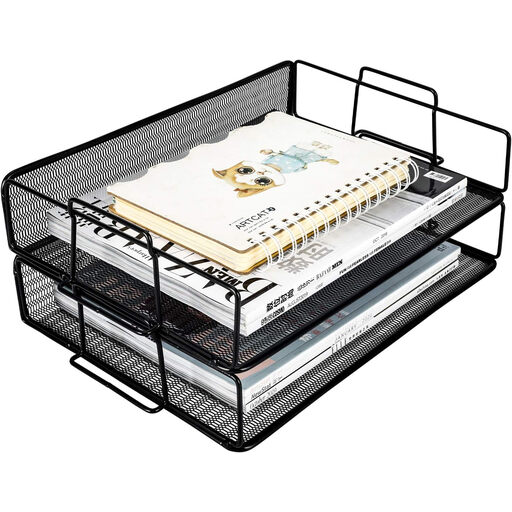
Why This Fits Their Persona: A compact option for students, renters and first-time home-office users who need basic A4 storage without committing to a tall unit.
The two-tier layout avoids paying for unused compartments, while the stackable design allows capacity to be expanded when required.
Metal mesh construction; stackable format; 34 x 24.5 x 13.5 cm dimensions; no installation required.
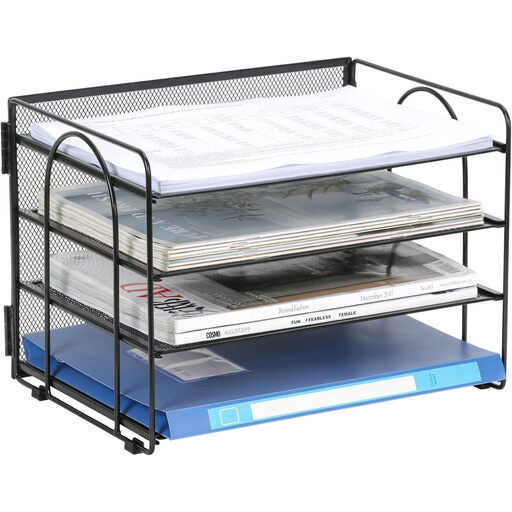
Why This Fits Their Persona: A considered choice for office workers and home-office users who want defined categories in a compact vertical footprint.
L-shaped rear supports are specified to improve load-bearing, while four anti-slip feet address movement and surface scratching.
Four A4 tiers; powder-coated metal; screwless assembly; 33.5 x 23.5 x 23.5 cm dimensions.
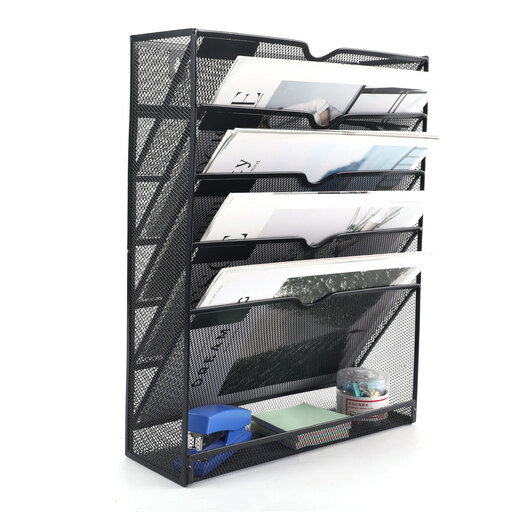
Why This Fits Their Persona: Suitable for busy offices, classrooms and shared home workspaces handling multiple document categories each day.
Wall mounting moves paperwork away from crowded desks, but secure fixing and appropriate wall anchors remain essential.
Six vertical compartments; 32 x 10.3 x 40.5 cm dimensions; supplied mounting screws; suitable for wall or door placement.
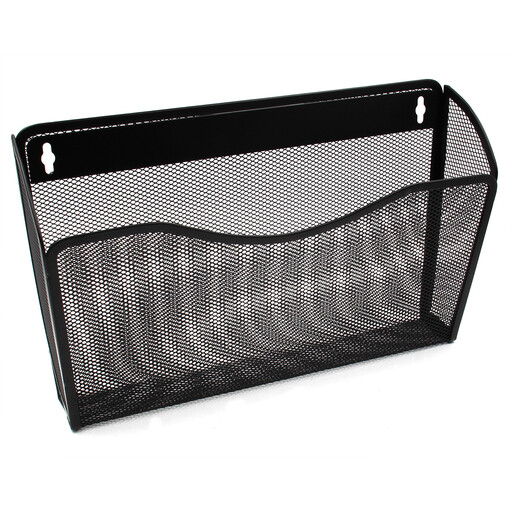
Why This Fits Their Persona: A focused solution for incoming and outgoing post in an entrance, reception area, office or home study.
The single-pocket format avoids unnecessary multi-tier storage when the practical need is simply to keep mail off the desk.
Landscape A4 format; wall or door mounting; 35.5 x 21.5 x 9.5 cm dimensions; powder-coated metal construction.
We have compiled a complete, real-time list of products that fully satisfy these strict selection criteria and UK safety regulations.
It depends on the compartment depth and opening. Many organisers accommodate loose A4 documents, folders, letters and magazines, but bulky ring binders may require a deeper tray. Always compare the listed dimensions with the binder’s actual width.
Some models include mounting screws, but plasterboard may require suitable wall anchors rather than standard fixings. Check the wall construction, expected load and installation instructions before mounting. A securely fixed unit should not be overloaded.