
24/7 Customer Support

Free returns

Same-day & Next-day Delivery

Quality Guaranteed

Unlock Your Welcome Offers: FREE Delivery | Up to 80% OFF | Free 30-day JoyPlus trial
Download the APP
Loose paperwork can quickly take over a home office, classroom, reception desk or student workspace. An A4 mesh file organiser can make everyday filing easier, but the wrong design may create new problems: trays that do not fit folders, wall holders that pull away from plasterboard or lightweight frames that become unstable when filled.
This guide explains the practical specifications to check before buying, then matches several options to different UK working environments.
An organiser may be described as “A4-sized”, but the internal opening can be narrower than expected. Ring binders, wallets and heavily filled folders need more clearance than loose sheets. Check the stated dimensions and consider whether the tray is designed for A4 documents, folders, magazines or bulkier paperwork.
A shallow tray may suit incoming post but become frustrating for project files. For thicker documents, look for a taller opening or a deeper stackable file tray.
Mesh gives a clear view of contents and suits many office interiors, but a slim metal file holder still needs a stable base or secure wall fixings. A desk organiser placed on an uneven surface may tip when a full folder is removed from the front.
For a desk-based metal file holder, check its weight, footprint and whether multiple units can be aligned safely. For wall storage, confirm that the supplied screws and suitable wall anchors are appropriate for the installation surface.
A powder-coated finish can help protect metal from everyday wear, but it does not make an organiser suitable for prolonged moisture or outdoor use. Keep mesh office storage away from condensation and wipe it dry if it becomes damp. Cleaning with a soft, dry cloth also helps preserve the finish.
Start by listing what you need to store:
A two-tier A4 document organiser is useful when you need separate categories without using much desk space. A five-pocket design provides more sorting capacity but requires suitable wall or door space.
Also measure the intended location. A wall holder may fit beside a desk, while a desk tray needs enough clearance to open drawers and allow comfortable document access.
A mesh desk organiser is convenient for paperwork that needs frequent access. Stackable trays use vertical desk space and can be expanded when your filing needs grow, provided they remain properly aligned and balanced.
A wall-mounted file holder frees the desktop and can work well for post, bills, lesson materials or shared office forms. Before mounting, check the wall construction, door clearance and likely load. A wall-mounted unit should be fixed securely rather than attached merely because it is lightweight.
Powder-coated metal offers a firm frame and a wipe-clean surface. Mesh sides also make contents easier to identify without pulling out every file. Look for clearly stated construction details rather than relying on phrases such as “heavy duty” or “industrial style”.
For regular use, check whether the product includes handles, mounting screws, assembly requirements and cleaning instructions. These details often have more practical value than decorative features.
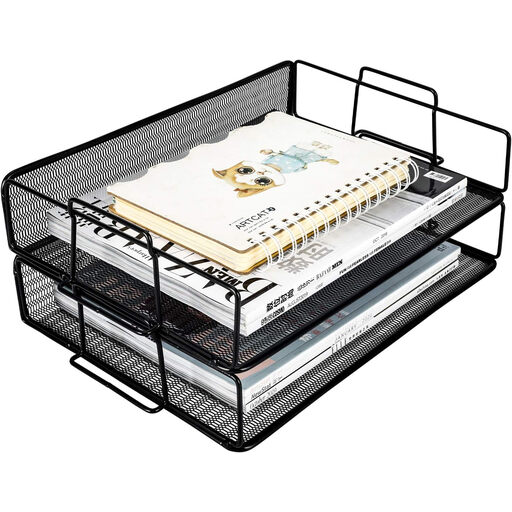
Why This Fits Their Persona: A compact choice for students, home-office users and anyone starting to sort everyday paperwork without giving up much desk space.
Its two-tier format makes the capacity clear, while the metal frame and powder-coated finish avoid reliance on thin disposable plastic trays.
Two A4-sized tiers, stackable design, integrated handle and 34 x 24.5 x 13.5 cm dimensions.
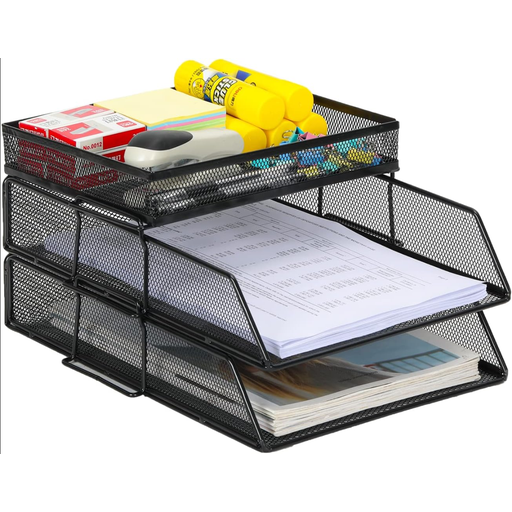
Why This Fits Their Persona: Suitable for a more structured home office or professional desk where files, folders and frequently used paperwork need additional vertical clearance.
The 17.7 cm height is stated clearly, helping buyers allow for bulkier documents rather than discovering that folders cannot slide into the tray.
Powder-coated metal construction, integrated handle, top holder and 25 x 33.5 x 17.7 cm dimensions.
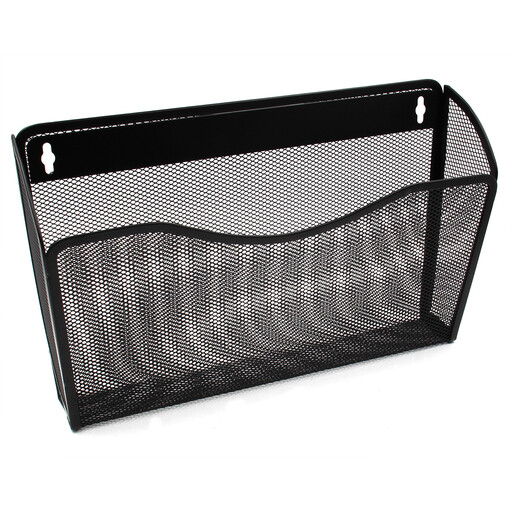
Why This Fits Their Persona: A practical option for reception areas, home entrances, teachers’ workspaces and offices needing a dedicated location for incoming or outgoing post.
The single-pocket layout avoids pretending to provide multi-category storage. Its purpose is clear: accessible landscape A4 paperwork mounted securely on a wall or door.
35.5 x 21.5 x 9.5 cm format, metal construction, powder-coated finish and mounting screws included.
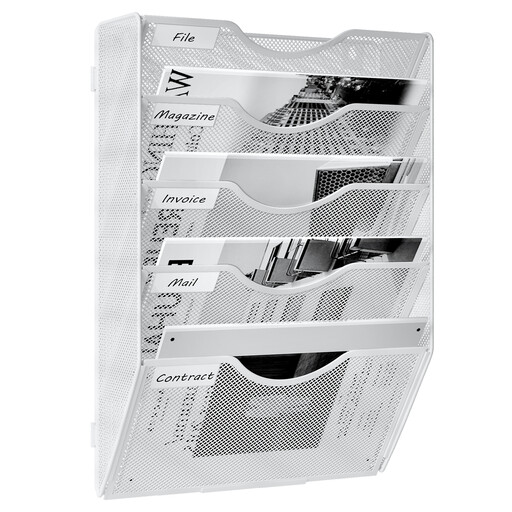
Why This Fits Their Persona: Designed for offices, schools and households that need several visible categories for documents, bills, letters, magazines or forms.
Five separate pockets provide defined filing spaces, reducing the need to overfill one compartment or stack unrelated documents together.
Five A4 pockets, white powder-coated metal, 32.5 x 10.8 x 42 cm dimensions and mounting screws supplied.
For a desk-based tray, place the organiser on a flat, stable surface and distribute weight evenly. When stacking units, align them carefully and follow the product’s guidance on capacity. Avoid using the handle to swing or carry an overloaded tray.
For an A4 wall file holder, identify the wall material before drilling. Plasterboard, brick and timber may require different fixings. Check that doors can open fully and that the holder will not obstruct handles, switches or walkways. Recheck mounting hardware occasionally, particularly in shared offices.
Use a soft, dry cloth for routine cleaning. If a slightly damp cloth is needed, dry the metal afterwards and avoid abrasive products. Keeping paperwork below the recommended load helps the frame, fixings and pockets remain stable.
We have compiled a complete, real-time list of products that fully satisfy these strict selection criteria and UK safety regulations.
It depends on the tray’s internal height and depth. A shallow model may suit loose papers and slim folders, while a taller tray is more practical for ring binders, magazines and fuller files. Always compare the stated dimensions with the size of your folders.
It can be, but the fixing method must suit the wall structure and expected load. Use appropriate wall anchors where required, follow the installation instructions and ensure the holder is securely attached before adding documents.
Routine care is limited to dusting or wiping with a soft cloth. Avoid prolonged moisture, abrasive cleaners and overloading. In a dry indoor office or study, these simple steps help preserve the powder-coated finish and maintain stable document storage.