
24/7 Customer Support

Free returns

Same-day & Next-day Delivery

Quality Guaranteed

Unlock Your Welcome Offers: FREE Delivery | Up to 80% OFF | Free 30-day JoyPlus trial
Download the APP
Loose paperwork can quickly take over a desk, particularly when invoices, meeting notes, student work, forms and folders all need different homes. An A4 mesh file organiser can make documents easier to see and retrieve, but not every tray or wall pocket is suited to everyday UK office or home-office use.
The right choice depends on more than the number of tiers. Check the dimensions, construction, mounting method and the type of paperwork you actually handle before buying.
A product may be described as an A4 document organiser, but the internal width and opening height determine whether it can accept wallets, ring binders or several papers at once. A narrow pocket may suit letters and thin folders but become awkward when filled with thicker documents.
Check the stated interior width and slot height rather than relying on the product title alone.
A six-tier unit offers more compartments, but it may be too tall for a shelf or too deep for a small footprint. Equally, a compact desk file tray may fit neatly beside a monitor but provide insufficient room for project folders.
Measure the proposed location first, including clearance above a desk and space needed to remove documents comfortably.
Metal construction can provide a firm framework, but stability also depends on weight distribution, base design and whether the organiser is stacked or wall-mounted. A tall mesh file holder should be securely fixed to a suitable wall or door. A freestanding model should sit on a flat, stable surface and should not be overloaded.
A powder-coated finish is also worth checking. It can help protect the surface from everyday wear and moisture, although no metal organiser should be left in persistently damp conditions.
Standard A4 paper measures 210 × 297 mm. Allow additional room for plastic wallets, folders and handling space. For a desk file tray, compare the external width with the usable tray width. Wall pockets commonly have a slim depth, so they are more appropriate for categorised papers, magazines, letters and thin files than large binders.
If you need to store varied paperwork, look for features such as:
A 2-tier file tray is suitable for separating incoming and outgoing paperwork or keeping active and pending documents apart. Stackable trays allow capacity to grow vertically, provided the units remain properly aligned and balanced.
A 5-tier file holder or 6-tier wall file holder is more suitable when documents need to be divided by client, class, project, household member or priority. Measure height carefully: one wall-mounted model listed below is 40.5 cm high, while another five-tier option is 42 cm high.
For wall or door installation, check whether mounting screws are included and select anchors suitable for the wall type, such as plasterboard, brick or masonry. The fixing must support the organiser and its contents; do not rely on adhesive strips unless the product specifically supports that method.
For desktop use, look for rubber feet or a broad base to reduce movement and help protect the work surface. A pull-out tray may improve access, but it should slide smoothly and should not be forced when overloaded.
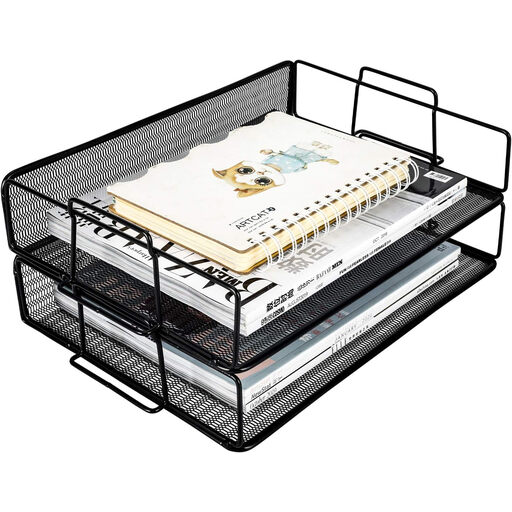
Why This Fits Their Persona: A compact option for students, first home offices and users with a small footprint where two clear filing levels are enough.
Its two-tier format avoids paying for unused capacity, while the stated 34 x 24.5 x 13.5 cm dimensions make desk planning more straightforward.
Metal mesh construction, stackable design, integrated handle and no installation requirement.
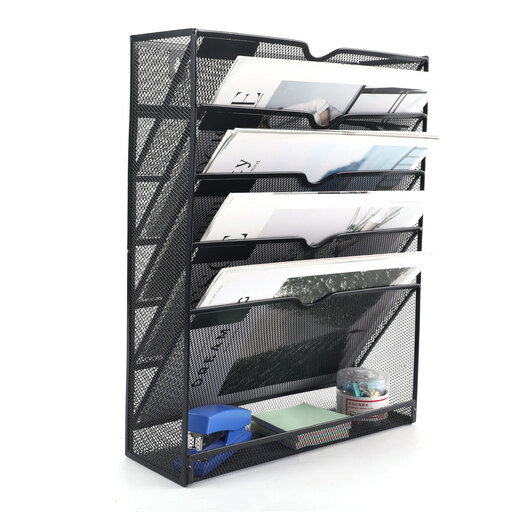
Why This Fits Their Persona: Suitable for organised workspaces that need a neat, vertical filing system for bills, letters, folders and frequently used documents.
The unit can be wall-mounted or used freestanding, so buyers can choose the safer, more practical position for their room rather than forcing it onto a crowded desk.
Six compartments, label panels, bottom tray and powder-coated metal finish; dimensions are 32 x 10.3 x 40.5 cm.
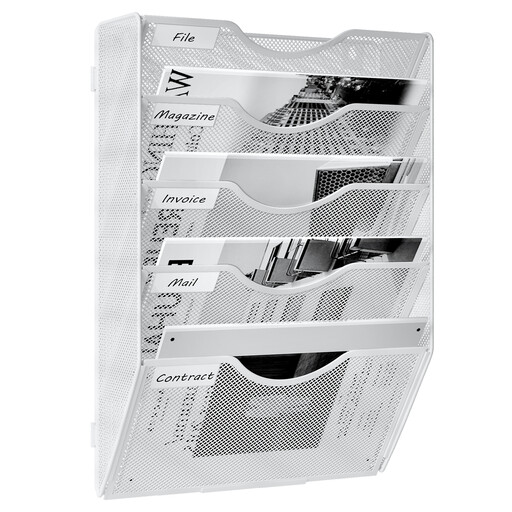
Why This Fits Their Persona: A practical match for teachers, administrators and small businesses managing several document categories every day.
Its five separate A4 pockets reduce the temptation to create one overloaded compartment, while wall mounting frees valuable desk space.
Five vertical pockets, arched fronts for access, powder-coated metal and included mounting screws.
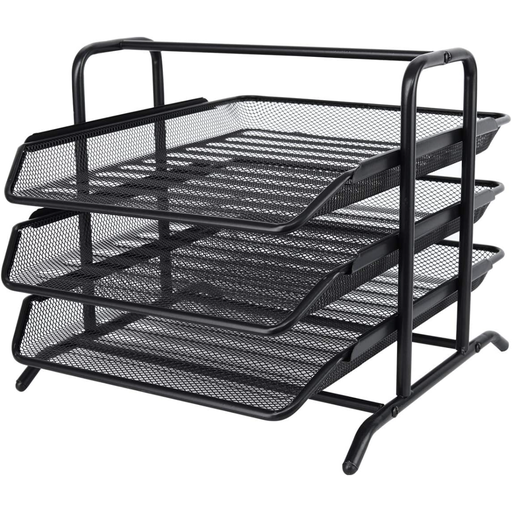
Why This Fits Their Persona: Designed for home-office users who prefer pull-out access and need to organise documents, books and supplies on a desk.
Rubber feet help protect the desk, while the stated 35.5 x 29.5 x 26 cm size allows buyers to check fit before assembly.
Three pull-out trays, rounded edges, metal construction and a non-slip foot design.
For a desk model, place the organiser on a level surface and distribute heavier folders across the lower trays. If using a stackable file tray, align each unit properly and check that the combined arrangement does not wobble.
For wall-mounted storage:
Avoid storing sharp or hazardous objects in open wall pockets, and keep installation components away from children.
We have compiled a complete, real-time list of products that fully satisfy these strict selection criteria and UK safety regulations.
Yes, provided its dimensions and capacity match the workspace. Metal mesh models offer visible storage and can suit desks, shelves or walls. Check for a stable base, protective feet and a finish that can be wiped clean. Avoid placing the organiser where it may be exposed to persistent condensation or dampness.
Most are straightforward if the correct fixings are used. The key consideration is the wall material. Plasterboard, brick and masonry require different anchors, and the organiser should be securely fixed before documents are added. If you are unsure about the wall’s condition or load capacity, seek appropriate household maintenance advice.
Assign each tier or pocket a clear purpose, such as “to action”, “invoices”, “school”, “letters” or “archive”. Remove completed paperwork regularly and avoid filling every compartment beyond its practical capacity. A label plate or simple handwritten label can make a vertical file organiser much easier to use consistently.