
24/7 Customer Support

Free returns

Same-day & Next-day Delivery

Quality Guaranteed

Unlock Your Welcome Offers: FREE Delivery | Up to 80% OFF | Free 30-day JoyPlus trial
Download the APP
Loose paperwork, overflowing in-trays and missing stationery can make even a tidy workspace difficult to use. An A4 mesh file organiser can create a clear place for documents, letters, magazines and office supplies, but the wrong design may waste valuable desk space or become awkward to use.
Before buying, look beyond tier numbers and promotional wording. The most useful organiser is the one that fits your available space, document volume and daily routine.
A product described as a “large” organiser may offer plenty of compartments but still be unsuitable for your desk or wall. Check the complete dimensions, including width, depth and height, before ordering.
For example, a tall wall-mounted unit may save desk space, while a four-tier desktop model occupies a footprint of approximately 25 × 33.5 cm. A compact drawer organiser may fit inside a standard drawer but will not accommodate full A4 folders.
A4 compatibility usually refers to loose documents, letters or standard folders. Ring binders, padded envelopes and heavily filled project files need additional clearance. Look for the internal width and tray height where these measurements are supplied.
A shallow desktop file tray may work well for papers awaiting action but feel restrictive when used for binders or books. If you regularly store thicker documents, consider taller tiers or a pull-out in-tray design.
A lightweight mesh organiser can be convenient, but several loaded tiers can shift if placed on an uneven surface. Stackable models should be properly aligned, while a wall-mounted file holder must be fixed securely using suitable hardware for the wall type.
Avoid overloading pull-out trays or carrying a loaded unit by a handle unless the product instructions specifically allow it. For wall storage, check the fixings regularly and keep heavier items in lower compartments where practical.
Measure the intended location first:
A four-tier A4 mesh file tray can provide vertical storage without needing a large footprint. For higher paper volumes, a 10-tier wall file holder offers more compartments but requires a suitable vertical surface.
Metal construction is generally more resistant to bending than thin plastic, although the actual durability depends on the frame, joints and how heavily it is loaded. A powder-coated finish provides a smooth coated surface and is used across the products listed here.
Mesh sides make contents easier to identify and allow dust to be removed with a cloth. They can also have exposed edges, so inspect the product description for information about finished or ground edges. Keep coated metal away from prolonged damp conditions to reduce the risk of corrosion.
Consider how documents will be retrieved:
A good office document organiser should support a simple filing routine, such as “to action”, “to file”, “accounts” and “reference”. Without categories, adding more tiers may simply create more places for clutter to accumulate.
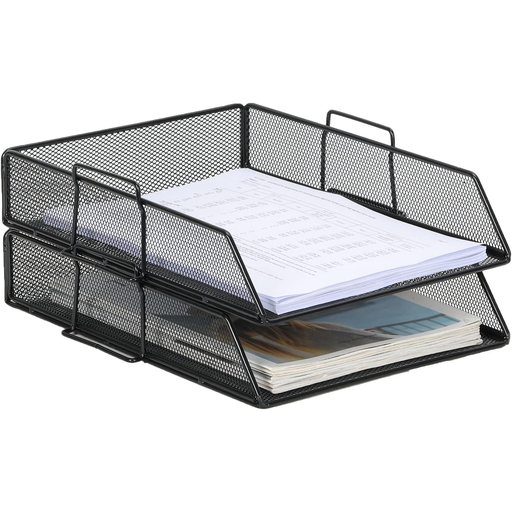
Why This Fits Their Persona: A practical starting point for a student, home-office user or occasional paperwork organiser who needs two levels of A4 storage without committing to a tall unit.
Its stated 25 × 33.5 × 13.5 cm dimensions make it easier to assess against available desk space, while the handle and stackable format support flexible use.
Metal construction, two A4-compatible tiers, integrated handle and stackable design.
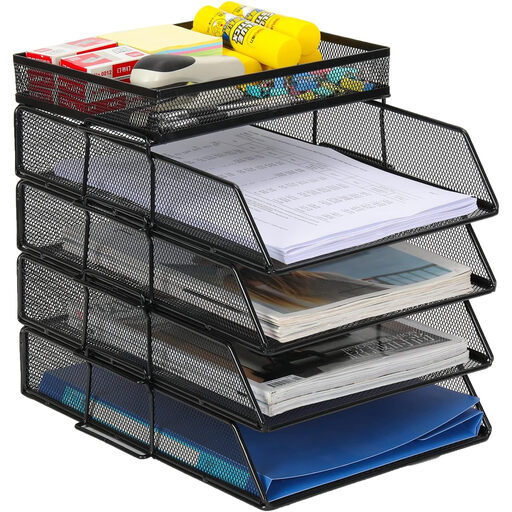
Why This Fits Their Persona: Suitable for a well-used home office or professional desk where separate levels for current projects, incoming post and reference documents are useful.
The four-tier arrangement provides defined storage rather than relying on one overloaded tray, and its top compartment separates stationery from paperwork.
Four A4-capable trays, dedicated top stationery compartment, interlocking stackable design and powder-coated metal finish.
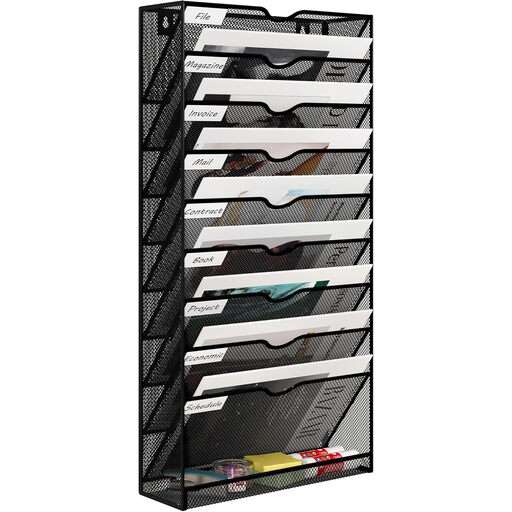
Why This Fits Their Persona: A suitable option for administrators, teachers, shared offices and busy households handling multiple categories of daily documents.
The 10 labelled tiers make categories visible, while the wall-mounted format avoids filling a limited desktop with a tall filing system.
Ten A4-sized slots, label plates, bottom tray and stated dimensions of 32 × 10.3 × 62 cm.
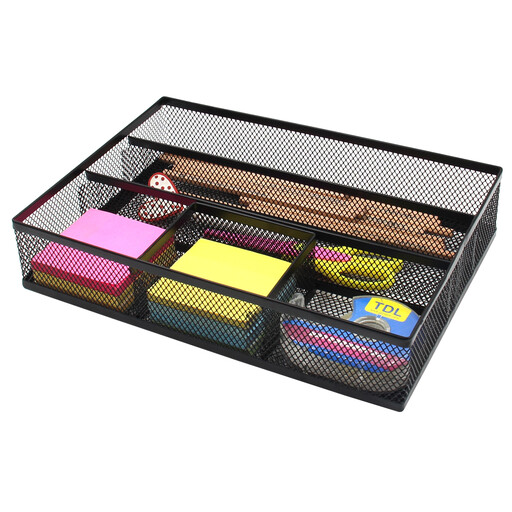
Why This Fits Their Persona: Useful for students and desk users who need a compact stationery organiser for pens, rulers, scissors, clips and sticky notes rather than A4 paperwork.
Its five-compartment layout avoids mixing small accessories with writing tools, and anti-slip pads help reduce movement on a desk or inside a drawer.
Five compartments, compact 30 × 21.5 × 7 cm dimensions and four anti-slip rubber pads.
We have compiled a complete, real-time list of products that fully satisfy these strict selection criteria and UK safety regulations.
Place a desktop file tray on a level surface and distribute weight across the tiers. For stackable models, check that each tray is properly interlocked before adding documents. Wipe mesh with a soft, dry cloth; if a damp cloth is used, dry the organiser fully afterwards.
For a wall file holder, identify the wall material before choosing anchors. Secure the unit before loading it, and avoid placing it where it could be knocked by a door or walkway. A wall organiser should hold paperwork, not be used as a shelf for heavy objects.
Some models can hold folders and ring binders, but capacity depends on tray height and internal width. Check the stated measurements and avoid assuming that “A4” means every binder will fit comfortably.
A coated metal finish can help protect the surface, but prolonged moisture may still cause corrosion, particularly around scratches or exposed edges. Keep the organiser dry and wipe away spills promptly.
It depends on your space and access needs. A stackable file tray is portable and requires no wall drilling, making it suitable for rented homes or changing workstations. A wall-mounted file holder uses vertical space and can offer more compartments where desktop area is limited.