
24/7 全天候客户支持

免费退货

当日/次日达

品质保障

开启新人专享福利: 全场免邮 | 低至 2 折 | 免费试用 30 天 JoyPlus 会员
下载 Joybuy
Loose paperwork can quickly take over a home office, shared workspace or classroom. An A4 mesh file organiser offers visible, accessible storage, but not every tray or wall holder suits the way UK households and workplaces handle documents.
Before buying, it is worth looking beyond a product photograph. A compact organiser may not fit folders, a tall wall unit may require more secure fixings than expected, and a lightweight tray can become unstable when overloaded. This guide explains the practical details to check, followed by our top recommendations for different storage needs.
An organiser labelled “A4” may accommodate loose sheets but leave little room for ring binders, expanding files or thick project folders. Check the internal width, pocket height and tray depth, rather than relying only on the document-size label.
For example, a narrow mesh wall file holder may be suitable for letters and slim folders, while a deeper A4 mesh file tray is more appropriate for magazines, binders and paperwork awaiting action.
A metal document organiser can be durable yet unstable if it is placed on an uneven desk or stacked without proper alignment. Look for features such as rubber feet, anti-slip pads, integrated handles or a broad base. For a wall-mounted file holder, the condition and type of wall are equally important.
Do not assume that supplied screws suit every UK wall. Plasterboard, brick and masonry may require different anchors. The holder should be fixed securely before adding documents, and its load should remain within the manufacturer’s stated limit.
Solid plastic storage can conceal what is inside, making it easy for paperwork to become forgotten. Mesh allows users to identify documents at a glance and can improve access in busy offices, home studies and school staffrooms. However, open mesh does not protect papers from dust or moisture as well as a closed box, so it is less suitable for damp areas or long-term archival storage.
Measure the available area first. A desktop file organiser needs enough clearance for drawers, monitors and other equipment. A wall unit should leave space for opening doors and retrieving files without hitting nearby shelves.
Useful measurements include:
A tiered file organiser makes effective use of vertical space, but its height should match the room available above or beside the desk.
Powder-coated metal is commonly used for a black mesh organiser because it provides a coated surface over the metal framework and is straightforward to wipe clean. It should still be kept away from prolonged moisture, particularly in garages, conservatories or unheated sheds.
Inspect the product description for:
A white mesh organiser can work well in bright home offices, while black finishes are often practical for busy workspaces where everyday marks are more noticeable on lighter surfaces.
A wall-mounted file holder frees desk space and keeps frequently used paperwork visible. Confirm whether mounting screws are included and whether the unit can also stand on a desk. If fitting to a door, check the door thickness, hinge clearance and whether the added weight could affect opening and closing.
For desktop storage, no installation is generally needed, but the surface should be flat and stable. A stackable letter tray should be aligned carefully, especially when more than one unit is combined. Never use a file organiser as a step, seat or support for heavy objects.
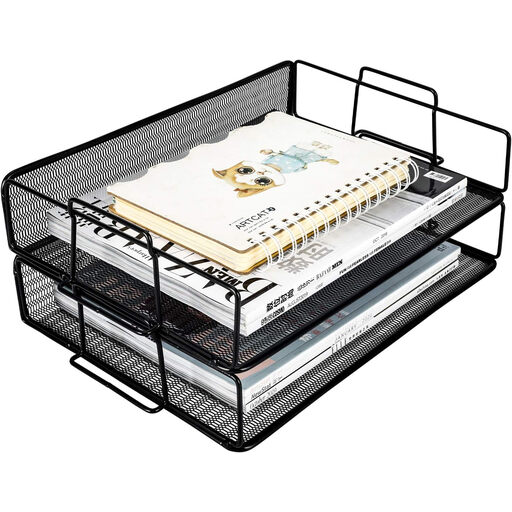
Why This Fits Their Persona: A straightforward choice for students, renters and home-office users who need two visible A4 levels without wall installation.
Its listed 34 x 24.5 x 13.5 cm dimensions make desk planning easier, while the two-tier format avoids buying a tall unit for a modest paperwork load.
Powder-coated metal construction; stackable design with an integrated handle; no installation required.
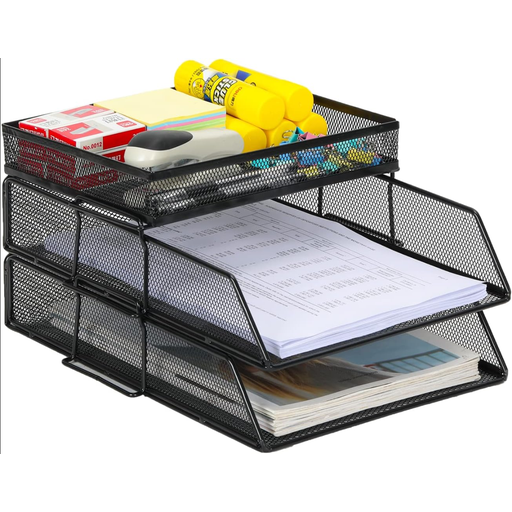
Why This Fits Their Persona: Suitable for professionals who want a more substantial desktop file organiser for active projects, folders and magazines.
The increased 17.7 cm height is clearly specified, helping buyers allow for bulkier documents instead of selecting a shallow tray.
Metal with a powder-coated finish; integrated handle; stackable, tiered storage with no assembly required.
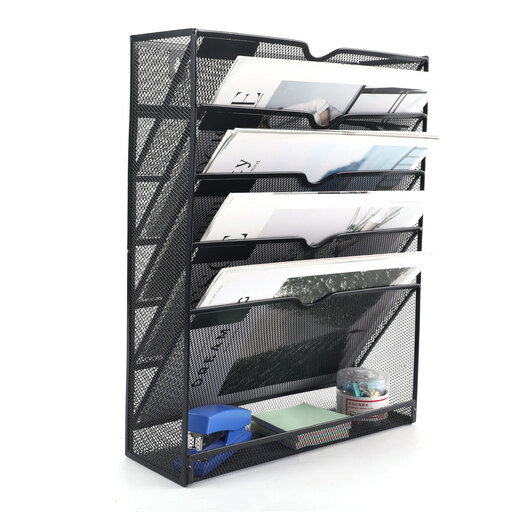
Why This Fits Their Persona: A practical match for offices, classrooms and households managing several categories of recurring paperwork.
Its six-tier layout provides dedicated compartments, while the listed 60 mm interior slot height clarifies the available capacity.
Can be wall-mounted or door-mounted; 32 x 10.3 x 40.5 cm footprint; powder-coated metal mesh.
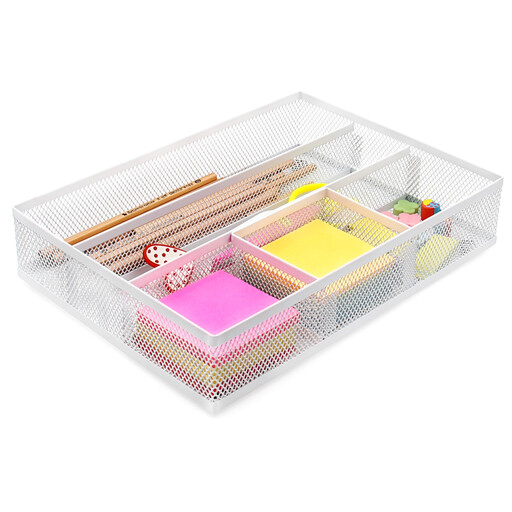
Why This Fits Their Persona: Designed for stationery rather than full files, it suits home workers, teachers and students who need smaller items under control.
The five compartments are specified as three small 10 x 9 cm bins and two 30 x 6 cm long sections, reducing guesswork about fit.
30 x 21.5 x 7 cm dimensions; four anti-slip pads; suitable for desks or drawers.
We have compiled a complete, real-time list of products that fully satisfy these strict selection criteria and UK safety regulations.
Some are, but not all. Check the tray depth and internal height before ordering. Two-tier trays with greater height are more likely to accommodate folders and binders than slim wall pockets designed for loose papers and letters.
Some models are described as suitable for wall or door mounting. Check the fixing method, door clearance and weight limit first. Use appropriate anchors for the installation surface, and confirm that the door can support the holder and its contents without affecting the hinges.