
24/7 Customer Support

Free returns

Same-day & Next-day Delivery

Quality Guaranteed

Unlock Your Welcome Offers: FREE Delivery | Up to 80% OFF | Free 30-day JoyPlus trial
Download the APP
As a Joybuy Product Recommendation Officer, I see countless people searching for the perfect A4 notebook. Whether for lectures, project deadlines or meeting minutes, the right notebook can make all the difference. However, the market is flooded with options that look good on the shelf but fail in practice. Before you buy, it's crucial to understand the common pitfalls that lead to frustration and wasted money.
Many notebooks fall victim to a few key design flaws. The most common issue is poor durability; a flimsy cover or weak spiral notebook binding can fall apart after just a few weeks in a backpack. Another frequent complaint is subpar paper quality. Thin paper that allows ink to bleed through renders half your notebook unusable. Finally, many so-called "A4" notebooks feature pages that, once torn out, are actually smaller than the standard A4 size, making them impossible to file neatly.
This guide will help you navigate these traps by breaking down the essential features to look for, ensuring your next purchase is a practical and lasting one.
To avoid disappointment, focus on a few core parameters rather than just the cover design. These details determine the notebook's usability and lifespan.
Paper quality is often measured in GSM (Grams per Square Metre). This figure indicates the paper's density and thickness.
university notebooks and office stationery. It provides a smooth writing surface and minimises bleed-through with most standard ballpoint and rollerball pens.When looking at a lined notebook multipack, always check the GSM. A low price might be tempting, but if the paper is too thin, you are effectively getting half the number of usable pages.
The way a notebook is bound affects its durability and how it lies on a desk.
wirebound notepad is a popular choice for students as it can be folded back on itself and lies completely flat, saving desk space. Look for a sturdy twin-wire binding, as single, thin spirals can easily get crushed and snag on other items in your bag.hardcover journal offers excellent protection for your notes. The rigid cover prevents pages from getting bent or damaged. This style is often preferred in professional settings for its durability and smart appearance.project book with dividers is invaluable. These often feature repositionable dividers, some with a notebook with pockets for storing loose handouts, making them a complete organisational tool.If you plan to file your notes, two features are non-negotiable. A perforated pages notebook allows you to tear out sheets cleanly without ragged edges. For true A4 filing, check that the pages are "true A4" after being torn out. Some notebooks include a wider margin with pre-punched holes, ensuring the main body of the page remains full A4 size for seamless integration into a ring binder.
Based on these practical criteria, we have matched a few standout options to different user needs.
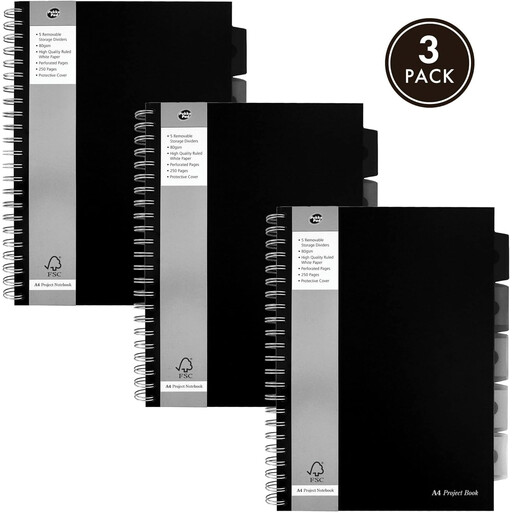
Why This Fits Their Persona: This is built for anyone juggling multiple modules or projects. The integrated dividers and pockets eliminate the need for separate folders, keeping everything for a topic in one place. It's a workhorse for serious study or complex work.
The durable, wipe-clean polypropylene cover resists the wear and tear of daily commutes, avoiding the "flimsy cover" pitfall. The 80 gsm paper prevents ink bleed-through.
Five repositionable dividers with storage pockets offer excellent organisation. Pages are perforated for clean removal.
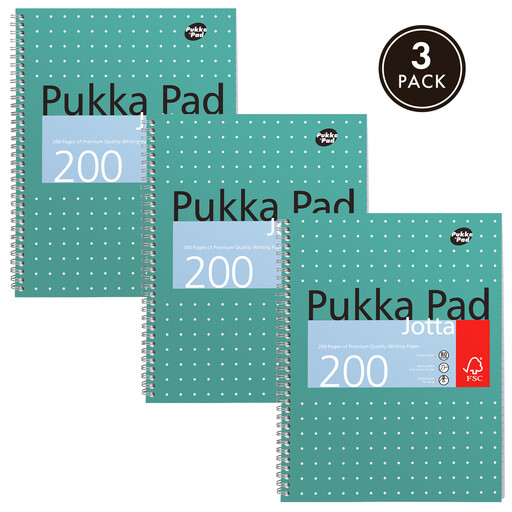
Why This Fits Their Persona: This is for the person whose notes always end up in a ring binder. Its primary function is to provide clean, standard-sized sheets for archiving, making it perfect for compiling revision notes or meeting reports.
It directly solves the "not truly A4" problem. The pages are designed with a perforated, 4-hole punched margin, so each sheet tears out to a perfect A4 size, ready for filing.
Features 200 pages of quality 80 gsm paper and a sturdy twin-wire binding that allows the notebook to lie flat for easy writing.
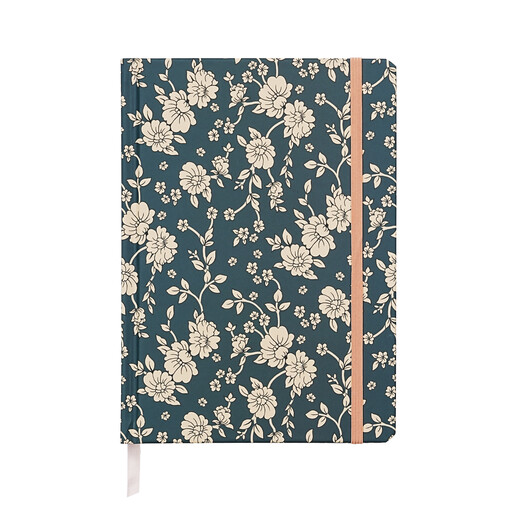
Why This Fits Their Persona: This is for someone who values the tactile experience of writing. It's less about tearing out pages and more about creating a lasting record, whether for journaling, creative writing or personal planning. The `A5 notebook` size is also convenient for carrying.
The durable hardcover journal design prevents damage and the high-quality 100g offset paper provides a smooth, bleed-resistant surface, far superior to standard thin paper.
Includes thoughtful features like a bookmark ribbon and an elastic closure band. The thicker paper is a pleasure to write on with a variety of pens.
We have compiled a complete, real-time list of products that fully satisfy these strict selection criteria and UK safety regulations.
Yes, for the vast majority of students, 80 gsm paper is perfectly adequate. It provides a good balance of quality and value, and it will handle notes taken with standard ballpoint, rollerball and most gel pens without significant bleed-through. If you are an avid fountain pen user or use very wet ink, you may prefer to step up to 90 gsm or 100 gsm paper for a cleaner result.
The primary difference is size. An A4 notebook page measures 210 x 297 mm, which is the standard size for printer paper. This offers ample space for detailed notes, diagrams and mind maps, making it ideal for in-depth study or office work. An A5 notebook is half that size (148 x 210 mm), making it much more portable and convenient for taking to meetings or carrying in a smaller bag.
The best defence is to choose a notebook with a robust cover from the start. Look for a wirebound notepad with a thick card or, even better, a rigid polypropylene (plastic) cover. These are much more resistant to bending and protect the wire binding from being crushed. A hardcover journal with a spiral binding is another durable option that combines protection with the lay-flat convenience of a spiral.