
24/7 Customer Support

Free returns

Same-day & Next-day Delivery

Quality Guaranteed

Unlock Your Welcome Offers: FREE Delivery | Up to 80% OFF | Free 30-day JoyPlus trial
Download the APP
Balancing busy schedules, lecture timetables, and multiple office projects often starts with putting pen to paper. Yet standard exercise pads quickly turn into a jumble of unindexed notes when you attempt to capture several distinct subjects in one place. Choosing a notebook equipped with movable dividers, tear-out filing margins, or dedicated chapter sections helps you categorise your thoughts the moment you write them down, saving valuable time when reviewing actions later.
Selecting the right pad requires matching your daily writing habits with the correct structural details. From wire bindings that lay flat on compact desks to paper weight that resists ink bleed-through, understanding the subtle differences between formats makes everyday note-taking far more enjoyable. This guide highlights the key technical considerations and common shopping oversights so you can select a notebook setup tailored to your routine.
Many notebooks state an A4 cover size, but their perforation lines sit well inward from the wire binding. When you tear out a sheet, the resulting page can be significantly narrower than standard 210 by 297 millimetre paper. This leaves you with an undersized leaf that misaligns with other handouts in plastic display wallets or lever arch files. Always look for pads specifically formatted to yield true A4 dimensions after detaching.
A sleek cover often conceals paper that is too lightweight for rollerball, fountain, or liquid ink pens. Lightweight papers below 70gsm frequently allow ink to shadow or bleed through to the reverse side, effectively halving the usable page count of your pad. Choosing notebooks with at least 70gsm to 80gsm density helps keep both sides of every sheet clear and legible.
Glued or permanently bound tabs look organised initially, but they force an arbitrary page limit onto every topic. When one subject expands rapidly and exhausts its allocated pages while an adjacent section remains untouched, you are left carrying wasted paper and fragmented notes. Repositionable dividers that lift and reattach let you adjust section sizes to match your actual workload.
The internal paper quality determines how smoothly your pen glides and whether you can write comfortably on both sides of every page without visual distraction.
Dividing mechanisms allow you to house multiple modules or client records within a single cover, drastically lightening the load in your work bag.
The way a notebook is bound dictates how easily it opens in tight spaces and whether individual leaves can transfer neatly into long-term filing systems.
These selected notebooks offer practical page layouts, durable bindings, and versatile organisation systems for varied writing demands.
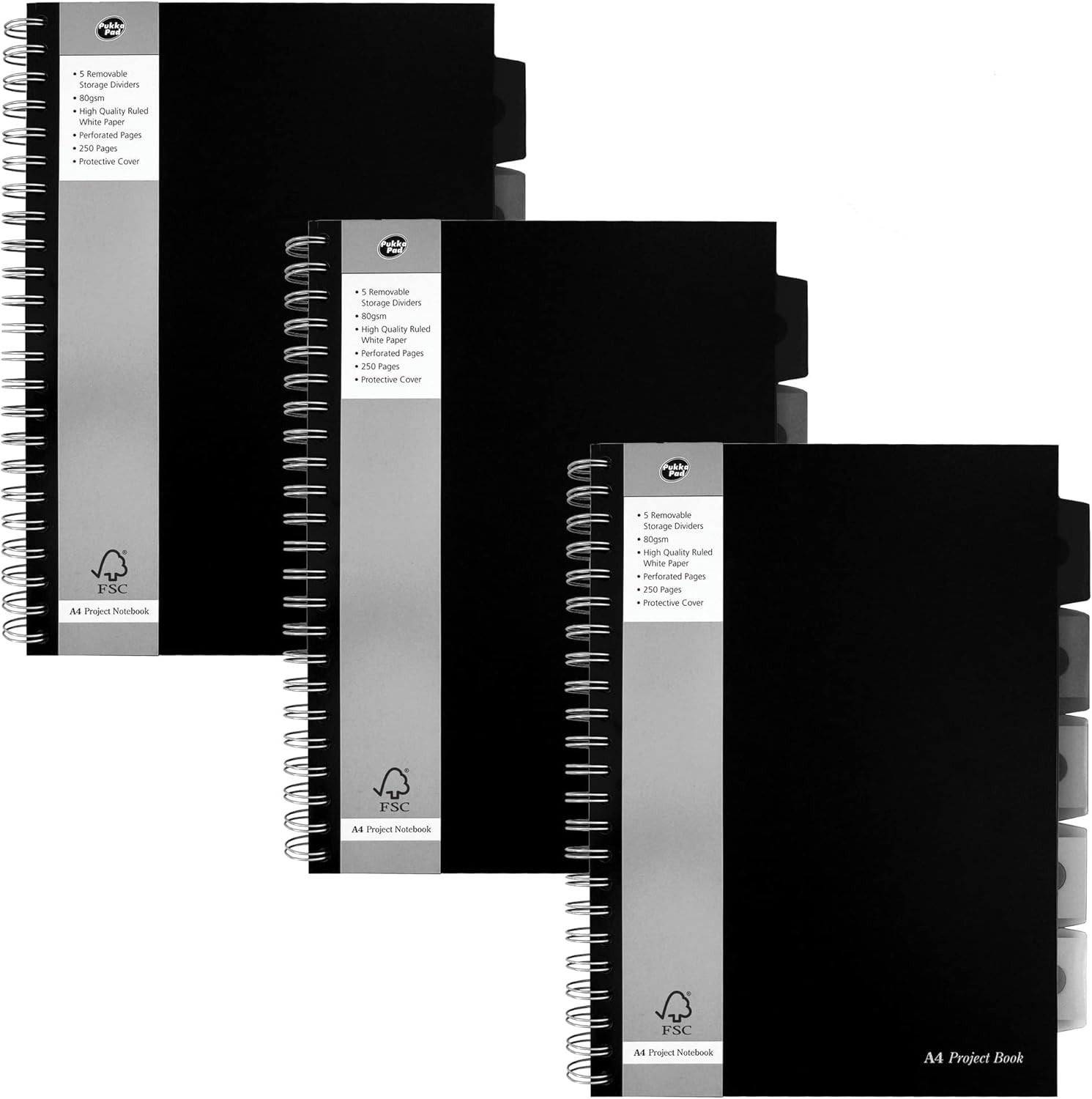
Why This Fits Their Persona: This pack of three substantial A4 books features feint-ruled FSC-certified 80gsm paper that provides a smooth surface for neat, double-sided handwriting. Five repositionable dividers allow you to partition your notes across distinct modules or clients without carrying separate pads.
It bypasses the limitation of fixed-section stationery because the dividers lift out and re-clip wherever your changing project demands require. The wipe-clean front cover also resists minor spills, protecting internal notes during daily transit.
Each of the five repositionable dividers includes an integrated pocket for loose reference papers, making it effortless to keep related documents paired with your handwritten notes.
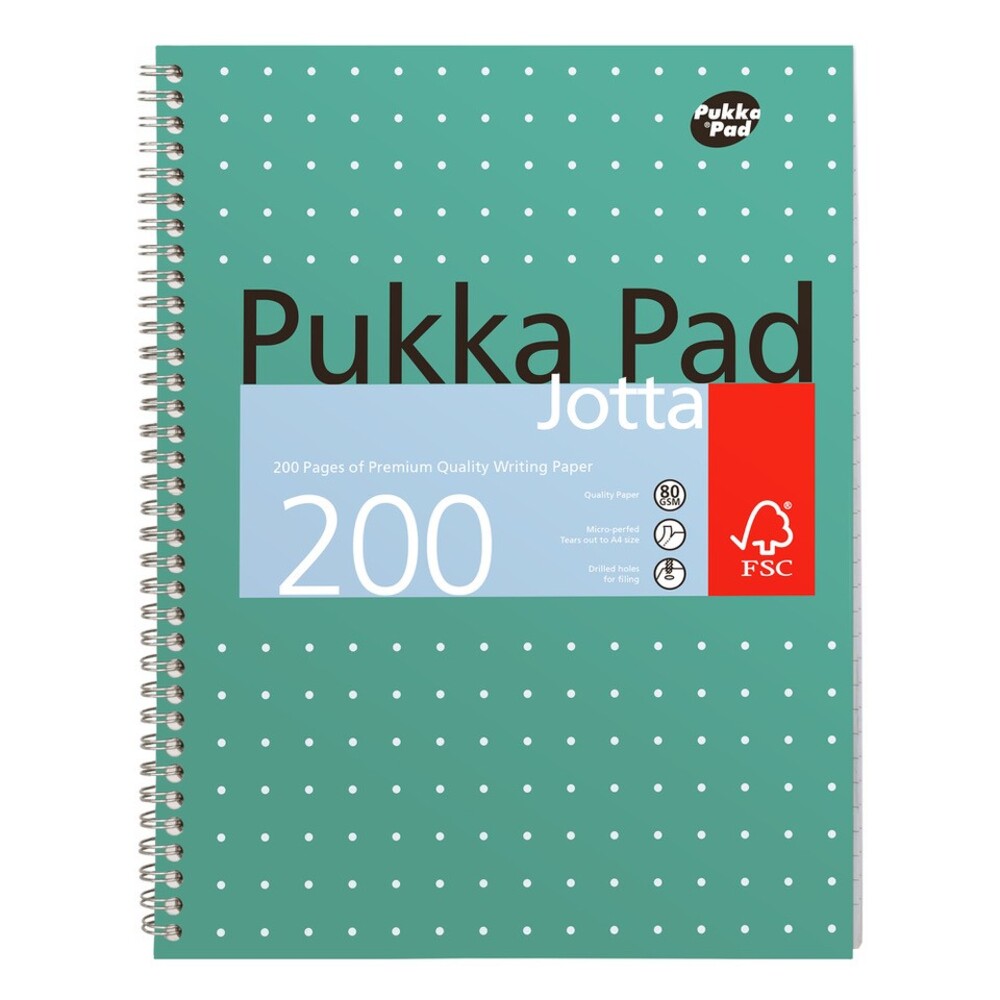
Why This Fits Their Persona: Engineered for straightforward meeting minutes and immediate filing, each wirebound metallic Jotta book contains 200 pages of 80gsm paper with standard 8mm lined ruling. The twin-wire binding lets the pad sit completely flat on any work surface.
It eliminates the annoyance of shrunken, ragged leaves by incorporating a 4-hole punched margin that tears out at true A4 dimensions. Your handwritten pages slot directly into standard UK lever arch files without hanging unevenly.
The combination of true A4 tear-out sizing and pre-punched four-hole margins ensures your working notes integrate directly into permanent filing binders without trimming or punching.
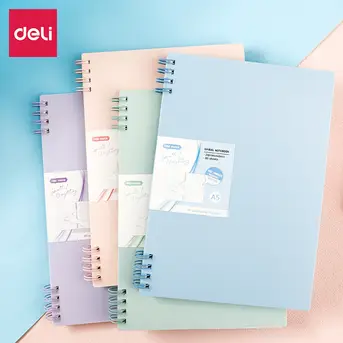
Why This Fits Their Persona: Measuring 148 by 210 millimetres, these A5 notebooks slip effortlessly into small satchels, tote bags, or desk drawers. Each pad in the 4-pack provides 60 sheets delivering 160 pages of 70gsm paper, ideal for keeping separate logs for daily admin, habit tracking, and quick thoughts.
It avoids the bulk and weight of carrying oversized A4 folios when your daily routine only calls for quick lists, desk-side memos, or reflective journaling.
A compact A5 footprint paired with a flexible spiral spine delivers a light, portable format that makes taking notes on the go simple and uncluttered.
If you require hardback casebound ledgers, refill pads, or specialised dot-grid journals, our wider collection has stationery options to suit every workspace style.
Repositionable dividers are constructed with flexible plastic teeth along their inner edge that slot directly into the wire spine. You can gently unhook the teeth from the coil and press them back into place in a different section of the notebook without tearing the paper or bending the wire.
Standard perforated pads frequently include the wire binding in their overall A4 dimension, leaving you with a page that is several millimetres narrower once detached. Notebooks with true A4 tear-out margins place the perforation so the removed sheet measures exactly 210 by 297 millimetres, ensuring a uniform fit inside plastic punch pockets and presentation binders.
Store wirebound notebooks vertically on a bookshelf or stacked flat on a sturdy desk surface. Storing them loosely inside bags alongside open zippers, loose cables, or rough items can snag and warp the metal wire, which makes turning pages difficult over time.