
24/7 Customer Support

Free returns

Same-day & Next-day Delivery

Quality Guaranteed

Unlock Your Welcome Offers: FREE Delivery | Up to 80% OFF | Free 30-day JoyPlus trial
Download the APP
Managing multiple subjects, clients or projects can quickly become a chaotic affair. An A4 project book seems like the perfect solution, promising to bring order to your notes. Yet, many of us have been let down by a promising purchase. A notebook that looks sturdy in the shop can become a tattered mess within weeks, leaving your important work disorganised.
As a Joybuy Product Recommendation Officer, my role is to help you see past the marketing and identify the features that truly matter. Before you spend your money, be aware of these common pitfalls that can render a project book useless:
To ensure your next purchase is a reliable tool rather than a source of frustration, focus on these three non-negotiable specifications.
Paper thickness is measured in grams per square metre (gsm). While budget notebooks often use 60-70 gsm paper, this is where issues like ink bleed-through and "ghosting" (where writing is visible from the other side) become a problem.
For a dependable project book, look for paper that is at least 80 gsm. This weight provides a good balance of smoothness and opacity, handling most ballpoint, rollerball and gel pens without significant bleed-through. It feels more substantial and is less likely to tear when you turn a page, offering a much better writing experience.
The dividers are what elevate a simple notebook into an organisational system. The most functional designs feature repositionable dividers, which allow you to adjust the size of each section as your project or module evolves. This flexibility is invaluable for managing dynamic workloads.
Also, check if the dividers include storage pockets. These are perfect for tucking away loose handouts, receipts or sticky notes related to a specific section, keeping everything you need in one place. A notebook with dividers that are both durable and functional is the hallmark of a well-designed multisubject notebook.
The binding holds everything together, so its quality is paramount. A twin-wire A4 spiral notebook binding is generally more robust than a single spiral, as it is less likely to bend out of shape. It also allows the notebook to lay completely flat or fold back on itself, which is useful for writing in tight spaces.
Equally important is the cover. A standard card cover offers minimal protection. For a notebook that will see daily use, a rigid polypropylene (polyprop) cover is a far better choice. It is water-resistant, wipe-clean and protects the pages inside from damage, ensuring your notes remain professional and intact throughout the term or project lifecycle.
Instead of a generic list, we have matched specific products to different user needs. This ensures you find a tool that genuinely supports your workflow.
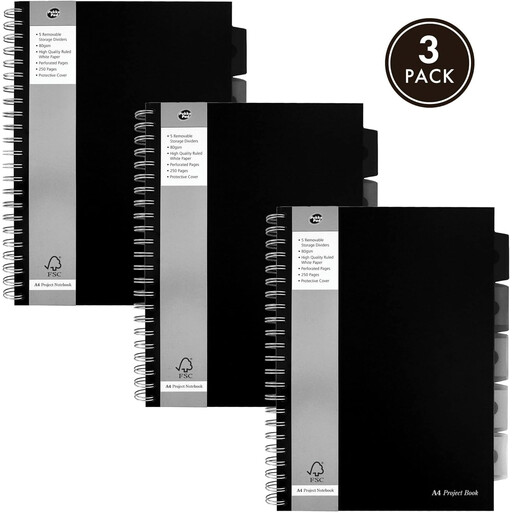
Why This Fits Their Persona: Ideal for students and professionals who need a single, reliable notebook to manage multiple complex subjects. This is a classic Pukka Pad project book, built to withstand the rigours of daily transport and heavy use.
It directly addresses all three pitfalls with its durable polypropylene cover, five repositionable dividers with storage pockets, and high-quality 80 gsm paper that minimises ink bleed.
The pages are micro-perforated for clean and easy removal, perfect for filing or submitting work. The wipe-clean cover maintains a professional look.
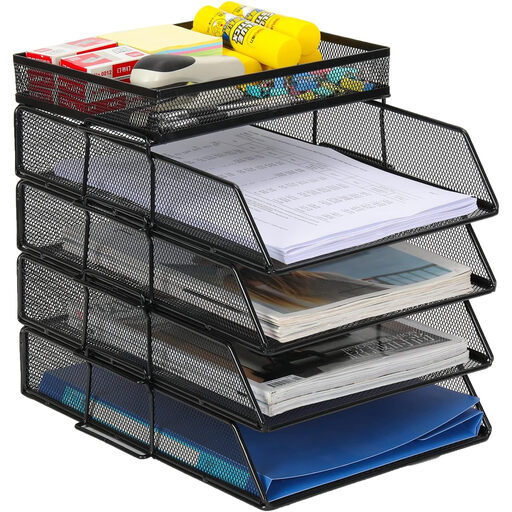
Why This Fits Their Persona: This is for the person whose work doesn't end in the notebook. If you frequently use the perforated pages from your project book to file reports, submit assignments or organise client documents, this desk tray is the essential next step.
It prevents the chaos of loose papers piling up on your desk. Instead of a disorganised stack, it provides a structured system for sorting documents removed from your project book.
The four-tier stackable design allows for clear categorisation by subject or priority. It also includes a top tray for stationery, keeping all your essential tools in one organised hub.
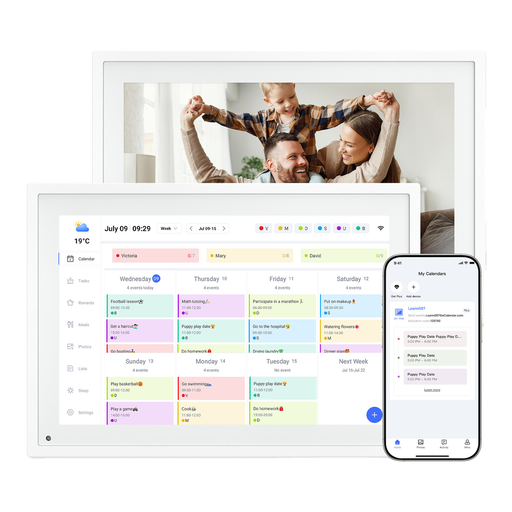
Why This Fits Their Persona: For those who love the tactile nature of writing in a project book but need a more powerful tool for high-level planning. This digital calendar acts as a central hub for deadlines, appointments and schedules, freeing up your notebook for pure content.
It prevents your project book from becoming a cluttered mix of notes, to-do lists and reminders. By separating scheduling from note-taking, both tools become more effective.
Features two-way schedule syncing via a mobile app, ensuring your plans are always up-to-date across devices. It serves as a shared family or office organiser, visible to everyone.
While a project book is great for notes, visualising your weekly or monthly schedule is key to staying on track. We have compiled a complete, real-time list of organisational tools that satisfy strict selection criteria.
The primary difference lies in organisation and durability. A project book is specifically designed as a multisubject notebook, featuring built-in dividers to create distinct sections. They also tend to have more robust covers and higher-quality paper to withstand the demands of managing multiple topics over a longer period.
For most writing tools, including ballpoints, gel pens and rollerballs, 80 gsm paper performs very well with minimal ghosting or bleed-through. However, very wet fountain pens or alcohol-based markers may still show through. If you use these regularly, you might consider paper with a weight of 90 gsm or higher, though 80 gsm is a reliable standard for everyday academic and professional use.
To maximise the lifespan of your notebook, avoid over-stuffing the divider pockets, as this can put stress on the binding. When carrying it in a bag, try to place it alongside flat items like laptops or folders to protect the spiral wire from being crushed. Finally, regularly review and file away pages you no longer need (if they are perforated) to keep the book manageable.