
24/7 Customer Support

Free returns

Same-day & Next-day Delivery

Quality Guaranteed

Unlock Your Welcome Offers: FREE Delivery | Up to 80% OFF | Free 30-day JoyPlus trial
Download the APP
As a Joybuy Product Recommendation Officer, my role is to help you find products that genuinely solve a problem. When it comes to staying organised, whether for university, the office or managing projects at home, the right notebook can make all the difference. An A4 project book with dividers is a popular choice, but not all are created equal. Many look good on the shelf but fail to perform, leading to wasted money and disorganised notes.
This guide cuts through the marketing jargon. We will look at the common design flaws that cause frustration and break down the essential features you should check before buying. This will help you choose a reliable student revision notebook or office organiser pad that serves you well for months to come.
Before you add a notebook to your basket, be aware of these frequent issues. A low price tag can often hide design flaws that make a project book unusable within weeks.
5 subject notebook A4 into a single, messy pile of paper.To avoid these pitfalls, focus on a few key specifications. These non-negotiable features are the difference between a dependable organisational tool and a source of clutter.
The cover is your notebook's first line of defence. For a book that will travel with you, a standard card cover is rarely sufficient. Look for two main types:
office organiser pad used in meetings.The dividers are what make a project book a project book. Their design is crucial.
A4 notebook with pockets is a significant upgrade. These integrated storage pockets are perfect for holding loose handouts, receipts or important documents, keeping everything related to a subject in one place.The quality of the paper directly impacts the writing experience.
Based on these practical criteria, we have matched a few standout options to different user needs. These project books are built with features that directly address the common pitfalls.
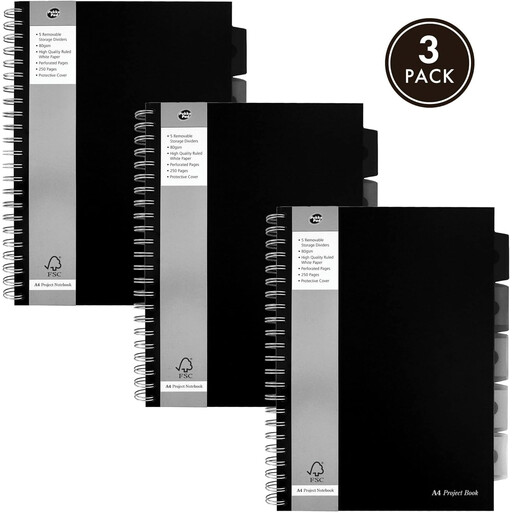
Why This Fits Their Persona: Ideal for students juggling multiple modules. The generous 250-page count handles extensive note-taking, while the wipe-clean polypropylene cover withstands being thrown in a rucksack. The multi-pack offers great value for a full academic year.
The repositionable plastic dividers are durable and will not tear easily. Its 80gsm paper prevents ink bleed, and the micro-perforated pages ensure clean removal for filing.
Five colour-coded dividers with storage pockets for organising handouts. 250 pages per book provide ample space for detailed notes.
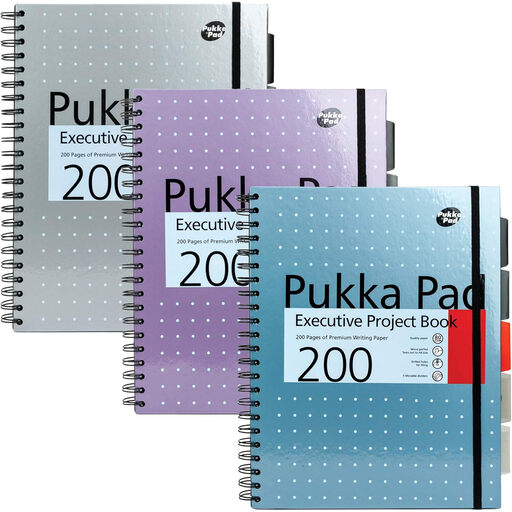
Why This Fits Their Persona: Perfect for project managers and consultants who need a smart and sturdy notebook for client meetings. The hardback cover provides a professional look and superior protection for notes, ensuring it always looks presentable.
The rigid hardback cover prevents the book from bending and protects the wire binding from being crushed. It uses the same reliable 80gsm paper and functional dividers as other quality Pukka Pad project book models.
Durable hardback cover for a professional appearance and enhanced note protection. Includes 5 repositionable dividers with storage pockets.
A standard notebook is simply a collection of bound paper. An A4 project book is an organisational system. Its key feature is the inclusion of durable, often repositionable, dividers that allow you to create separate sections for different subjects, clients or projects within a single book. Many also include pockets for storing loose papers, adding another layer of organisation.
For most fountain pen users, 80gsm paper is a good starting point and generally performs well with fine to medium nibs and standard inks, showing minimal feathering or bleed-through. However, users of very wet, broad nibs or heavily saturated inks may prefer to look for paper with a weight of 90gsm or 100gsm for complete peace of mind.
Start by choosing one with a durable cover, like polypropylene or a hardback. Reinforce the first and last pages with tape if they see heavy use. Use the divider pockets for loose sheets rather than stuffing them between pages, which puts stress on the binding. Finally, when carrying it in a bag, try to place it alongside flat items like laptops or folders to prevent the wire binding from being crushed.