
24/7 Customer Support

Free returns

Same-day & Next-day Delivery

Quality Guaranteed

Unlock Your Welcome Offers: FREE Delivery | Up to 80% OFF | Free 30-day JoyPlus trial
Download the APP
A simple A5 lined notebook seems like a straightforward purchase, yet many of us have a drawer filled with disappointing buys. There are the ones with paper so thin that ink bleeds through, spines that crack after a month, and covers that look worn after a single trip in a bag. Finding a reliable notebook for your studies, work or personal journaling shouldn't be a gamble.
As a Joybuy Product Recommendation Officer, my role is to help you see past the marketing jargon and focus on the features that genuinely matter. Before you buy another notebook that lets you down, let’s look at the common pitfalls and how to sidestep them.
To avoid these issues, you don't need to be a stationery aficionado. You just need to know which specifications to check. Here are the three core parameters to focus on.
The single most important factor for writing quality is the paper's weight, measured in Grams per Square Metre (GSM). This number tells you how thick and dense the paper is.
The binding determines how the notebook opens, lies and lasts. The main types you'll encounter are:
While A5 is a versatile and popular size, consider how you'll use the notebook. For large-scale planning, an A4 project book might be more suitable. For quick notes on the go, a smaller reporters notepad could be a better fit.
Look for functional features that match your needs. A durable polypropylene (PP) cover is wipe-clean and withstands daily commutes. An elastic closure keeps your pages secure, while a ribbon bookmark helps you find your place. For complex projects, a project book with dividers is an invaluable organisational tool.
Based on these practical criteria, here are a few recommendations matched to different user needs.
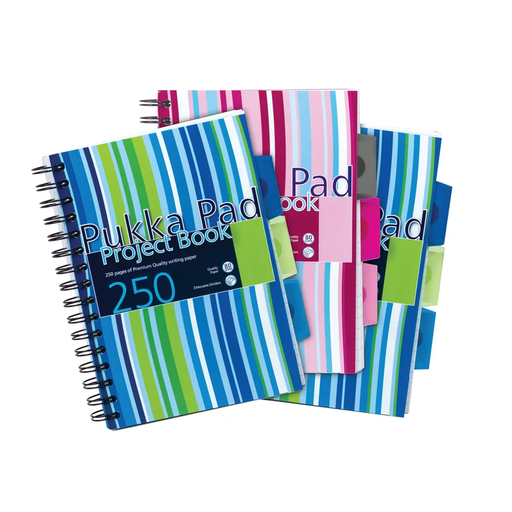
Why This Fits Their Persona: Ideal for students juggling different modules or professionals managing multiple projects. The A5 size is portable, while the internal structure provides the organisation of a larger binder.
The sturdy wire binding avoids the "three-week spine" flaw, and the 80 GSM paper is a reliable choice that balances cost and quality, preventing the worst of the bleed-through trap.
Features 3 repositionable dividers with storage pockets, allowing you to separate topics and store loose handouts. Pages are perforated for clean removal.
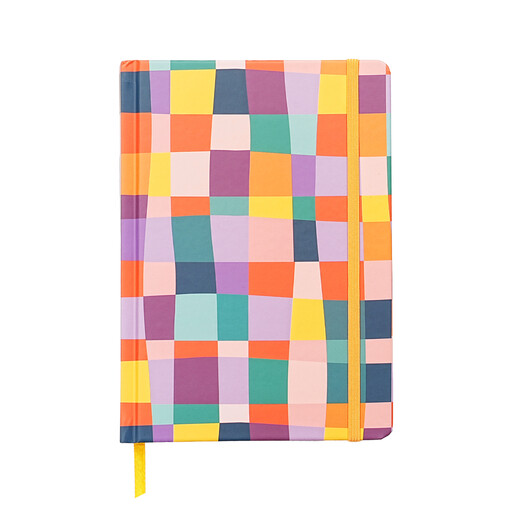
Why This Fits Their Persona: For those who appreciate a high-quality writing experience, whether for a personal journal, meeting notes or creative writing. It offers a premium feel without a prohibitive price tag.
The 100g offset paper directly solves the bleed-through problem, making it ideal for fountain pen users. The durable hardcover and elastic band avoid the scuff and functionality traps.
Thick, cream-coloured paper provides a smooth writing surface with minimal ink bleed. Includes a ribbon bookmark and elastic closure for secure, organised use.
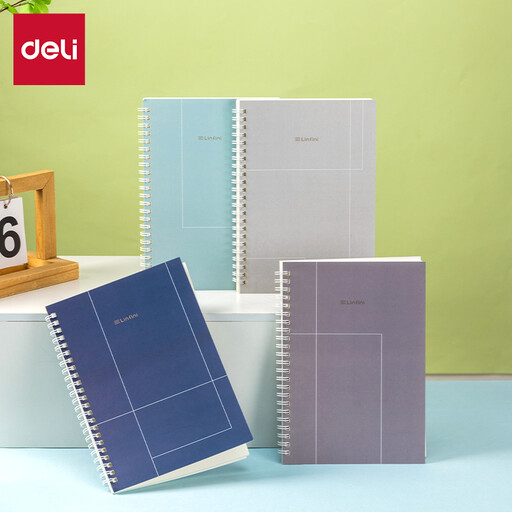
Why This Fits Their Persona: A cost-effective solution for anyone who gets through a lot of paper. This notebook multipack is great for household lists, casual class notes or stocking up a home office.
While the 70gsm paper is on the thinner side, the value proposition is the main focus. The practical spiral binding is more reliable for lay-flat use than a cheap, glued spine.
Excellent value with four notebooks in one pack. The lay-flat spiral binding is convenient for quick and easy note-taking in any situation.
We have compiled a complete, real-time list of products that fully satisfy these strict selection criteria and UK safety regulations.
For many fountain pens with fine nibs and dry inks, 80 GSM paper can perform adequately with minimal ghosting. However, if you use broad nibs or wet, saturated inks, you will likely experience some ghosting and potential bleed-through. For a guaranteed clean page, opting for 90 GSM or ideally, 100 GSM paper is the safer choice.
While A5 (148 x 210 mm) is the most common portable size, B5 (176 x 250 mm) is a popular alternative in the UK. It sits between A5 and A4, offering more writing space per page without the full bulk of an A4 notebook, making it a great compromise for detailed note-taking.
Look for a spiral notebook where the wire ends are properly crimped or bent inwards towards the spine. This small manufacturing detail prevents the wire from catching on bag linings or clothing. If a wire does come loose, you can often use a pair of pliers to gently bend it back into a closed loop.