
24/7 Customer Support

Free returns

Same-day & Next-day Delivery

Quality Guaranteed

Unlock Your Welcome Offers: FREE Delivery | Up to 80% OFF | Free 30-day JoyPlus trial
Download the APP
From lecture halls to boardrooms, the humble A5 notebook is an indispensable tool for capturing thoughts, organising projects and staying on top of daily tasks. Yet, finding a reliable one can be surprisingly difficult. Many of us have been let down by a purchase that looked promising online but failed in practice. Before you add another notebook to your basket, it's worth knowing the common pitfalls that lead to disappointment and wasted money.
As a Product Recommendation Officer, I see where consumers often go wrong. They are frequently caught out by three main issues:
By understanding a few key details, you can easily sidestep these problems and find an A5 notebook that perfectly suits your needs, whether it's for school, the office or personal journaling.
To avoid the common traps, focus on these core parameters. They are the true indicators of a notebook's quality and longevity, far more than flashy cover designs.
The single most important factor for your writing experience is the paper's weight, measured in GSM (Grams per Square Metre). This number tells you how thick and durable the paper is.
The way a notebook is bound dictates how it handles daily use and how comfortably you can write in it.
To help you navigate the options, we've matched some well-regarded A5 notebooks to different user needs, ensuring they address the common pitfalls.
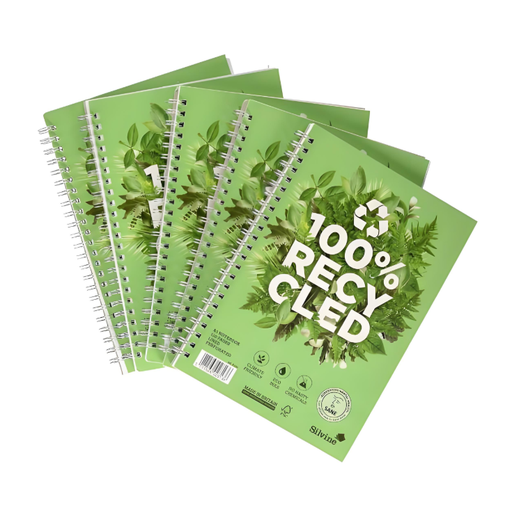
Why This Fits Their Persona: This multipack is ideal for students or office workers needing multiple notebooks for different subjects or projects. It combines practicality with a genuine commitment to sustainability, offering a responsible choice for everyday use.
It directly counters vague eco-claims by using high-quality 80gsm recycled paper. The sturdy wirebound spine avoids the flimsy binding issue and the 80gsm weight is a reliable standard against ink bleed-through.
Pages are pre-punched with four holes for easy filing in a binder and are perforated for clean tear-out, adding a layer of organisational convenience.
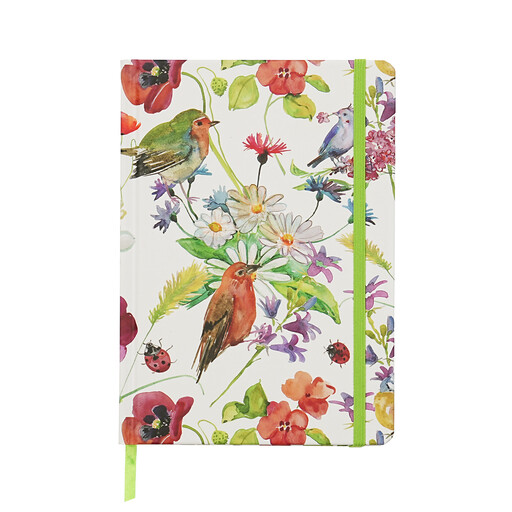
Why This Fits Their Persona: For those who see a notebook as more than just paper. This is for the journaler, writer or gift-giver who values aesthetics, a tactile feel and a premium writing experience that inspires creativity.
The premium 100g offset paper provides a smooth surface that eliminates the ink bleed-through problem. Its durable hardcover binding ensures it won't fall apart, making it a lasting keepsake.
It combines an artistic, nature-inspired design with practical features like a ribbon bookmark for easy navigation and an elastic closure to keep pages secure.
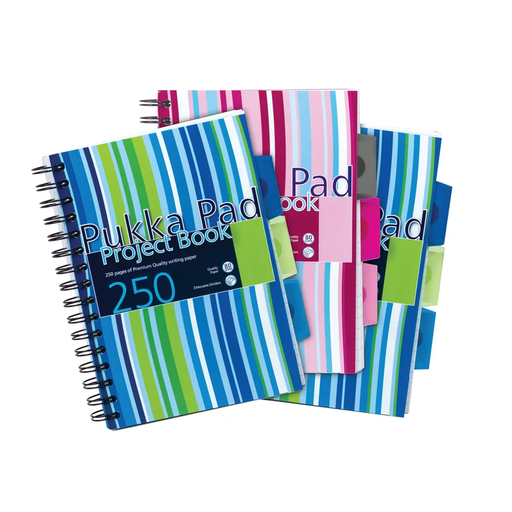
Why This Fits Their Persona: This is for the user juggling multiple projects, meetings or subjects. It's a complete organisational system in a compact A5 format, designed for maximum efficiency and clear separation of notes.
The robust wire binding is built for heavy use. The 80 GSM FSC Certified paper provides a quality writing surface that avoids the bleed-through trap while also confirming its responsible sourcing.
Its standout feature is the set of repositionable dividers, each with a storage pocket. This allows for dynamic organisation that a standard notebook cannot offer.
We have compiled a complete, real-time list of products that fully satisfy these strict selection criteria and UK safety regulations.
For most people, yes. An 80gsm paper weight is a reliable standard for general use in an office notebook or for school. It provides a good writing experience with most common pens (ballpoint, gel) and minimises the ghosting or bleed-through you'd see with thinner 70gsm paper. If you are a fountain pen enthusiast or want a more premium feel for journaling, stepping up to 100gsm is a worthwhile consideration.
While both are popular, they serve slightly different purposes. An A5 notebook (148 x 210mm) is the classic portable size, fitting easily into most handbags, backpacks and briefcases. A B5 notebook (176 x 250mm) is noticeably larger, offering more writing space per page. It's a good compromise for those who find A4 too big and A5 too small, making it popular with university students for lecture notes.