
24/7 Customer Support

Free returns

Same-day & Next-day Delivery

Quality Guaranteed

Unlock Your Welcome Offers: FREE Delivery | Up to 80% OFF | Free 30-day JoyPlus trial
Download the APP
From lecture halls to boardrooms, the humble A5 notebook remains an essential tool for capturing ideas, organising projects and planning our days. Yet, choosing the right one can be surprisingly difficult. The market is flooded with options, and it is easy to end up with a notebook that disappoints. As a Joybuy Product Recommendation Officer, my role is to help you navigate the choices and find a notebook that genuinely meets your needs, without falling for common marketing traps.
This guide will walk you through the key features to consider and highlight the pitfalls to avoid, ensuring your next A5 notebook is a purchase you will not regret.
Before you add a notebook to your basket, be aware of these frequent issues that can turn a promising purchase into a frustrating experience.
To avoid these pitfalls, focus on a few key specifications. Understanding these will empower you to select a high-quality lined journal or project book that performs as expected.
Paper weight is measured in Grams per Square Metre (gsm). This single number tells you a lot about the paper's thickness and durability.
notebook multipack options but may show ghosting (where you can see writing from the other side) or bleed-through with wetter inks.office notebooks and notebooks for students. It offers a good balance of smoothness and opacity, handling most pens well with minimal bleed-through.thick paper journal quality. It provides a luxurious, smooth writing surface that is ideal for fountain pen users, artists and anyone who enjoys bullet journal planning. Ink bleed-through is highly unlikely.The binding affects how the notebook opens, lies flat and holds up over time.
spiral notebook is a practical choice as it can be folded back on itself and typically lies completely flat. This makes it easy to write on any surface. Look for twin-wire binding, which is more durable than a single spiral.hardcover notebook binding. It is highly durable and offers excellent protection for your pages. While some may not lay perfectly flat initially, they are built to last and look professional.Consider how and where you will use your notebook.
A4 project book or A5 equivalent with built-in dividers, pockets and perforated pages can be an invaluable organisational tool.To help you find the right fit, here are a few recommendations matched to different user needs, all of which address the common pitfalls.
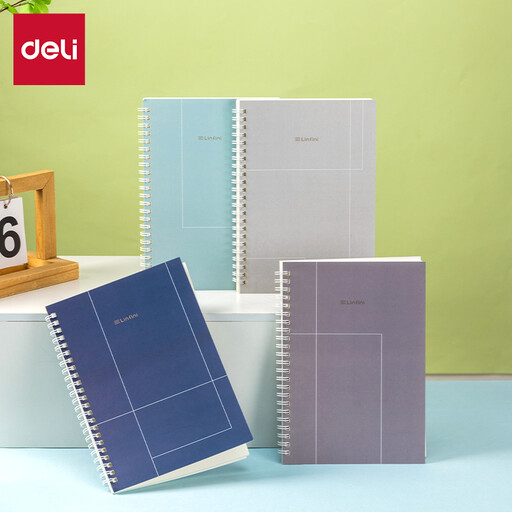
Why This Fits Their Persona: This multipack offers excellent value, providing four separate notebooks for different modules or terms. The spiral binding is practical for taking notes in crowded lecture halls where desk space is limited.
The twin-wire spiral binding is more robust than cheap alternatives, preventing pages from falling out. While the 70gsm paper is light, it is perfectly functional for ballpoint pens and pencils used in most lectures, avoiding the cost of premium paper where it is not needed.
Excellent value with four notebooks in one pack. The spiral binding allows the notebook to lay flat or fold back on itself for easy use.
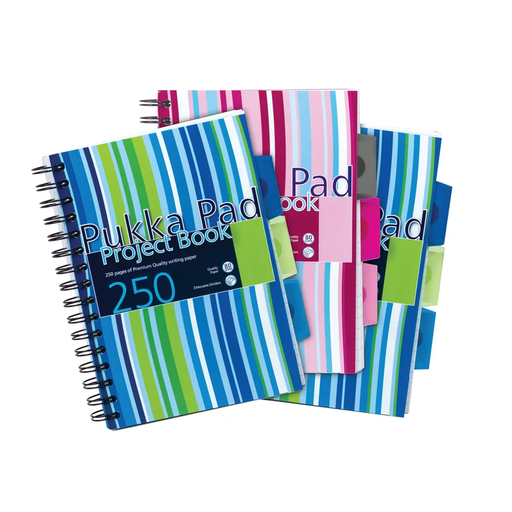
Why This Fits Their Persona: Ideal for managing multiple clients, projects or meeting topics. The A5 size is portable for commuting, while the internal organisation system keeps all notes structured and professional.
This project book directly solves the disorganisation that comes from using a single, unstructured notebook. The 80 gsm paper is a reliable standard for office pens, and the sturdy cover protects against the wear and tear of daily travel.
Features 3 repositionable dividers with storage pockets for superior organisation. The 250 pages offer ample space for extensive note-taking.
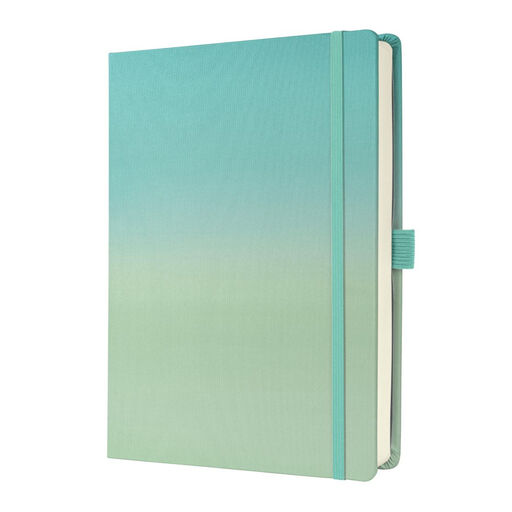
Why This Fits Their Persona: This journal is designed for creativity. It is perfect for those who practise bullet journaling, hand lettering or simply want a premium writing experience where paper quality is the top priority.
The premium 120 g/m? paper directly solves the ink bleed-through problem, welcoming fountain pens and markers. Its innovative lay-flat binding also eliminates the frustration of bindings that prevent you from writing across the full page.
Features exceptionally thick 120 g/m? paper and a 180° lay-flat design. The sturdy hardcover provides a firm writing surface anywhere.
We have compiled a complete, real-time list of products that fully satisfy these strict selection criteria and UK safety regulations.
For most fountain pen users with fine or extra-fine nibs, 80 gsm paper can be adequate, but you may experience some minor ghosting. For a completely bleed-free experience, especially with broader nibs or wetter inks, we recommend opting for a thick paper journal with 100 gsm paper or higher.
An A5 notebook measures 148 x 210 mm, making it highly portable and a popular choice for journaling and general note-taking. A B5 notebook is slightly larger at 176 x 250 mm, offering more writing space per page without being as large as A4. It is a good compromise for students and professionals who need extra room for detailed notes.
This depends on the subject. For a single university module, a notebook with around 80-100 sheets (160-200 pages) is often sufficient. For more intensive subjects or for combining multiple topics, a project book with 200+ pages and dividers is a more practical choice. Buying a notebook multipack at the start of the academic year is also a cost-effective strategy.