
24/7 Customer Support

Free returns

Same-day & Next-day Delivery

Quality Guaranteed

Unlock Your Welcome Offers: FREE Delivery | Up to 80% OFF | Free 30-day JoyPlus trial
Download the APP
From lecture halls to boardrooms, the humble A5 notebook is an indispensable tool for capturing ideas, organising projects and journaling our thoughts. Yet, choosing the right one can be surprisingly difficult. The market is flooded with options, and it's easy to fall for a stylish cover only to be let down by the product's performance. As a Joybuy Product Recommendation Officer, my role is to help you see past the marketing and focus on what truly matters.
Before you add another notebook to your basket, let's look at the common pitfalls that lead to buyer's remorse.
To avoid these traps, you need to look at a few core parameters. Understanding these will empower you to select a notebook that genuinely fits your purpose, whether it's for school, the office or creative pursuits.
Paper quality is arguably the most critical factor. It's measured in GSM (Grams per Square Metre). A higher GSM number generally means thicker, more opaque paper that is less prone to ink bleeding or "ghosting" (where writing is visible from the reverse side).
The binding holds everything together and dictates how the notebook opens and wears over time.
The cover provides protection and style. A hardcover notebook offers a firm writing surface, making it ideal for writing on the go. Softcover notebooks are lighter and more flexible. When it comes to features like a notebook with dividers or elastic bands, consider your actual needs. For an A4 project book used for multiple university modules, dividers are essential. For a personal gift journal, an elegant fabric cover and a ribbon bookmark might be more important.
To help you find the right fit, here are a few recommendations matched to different user needs, all of which successfully navigate the common buying traps.
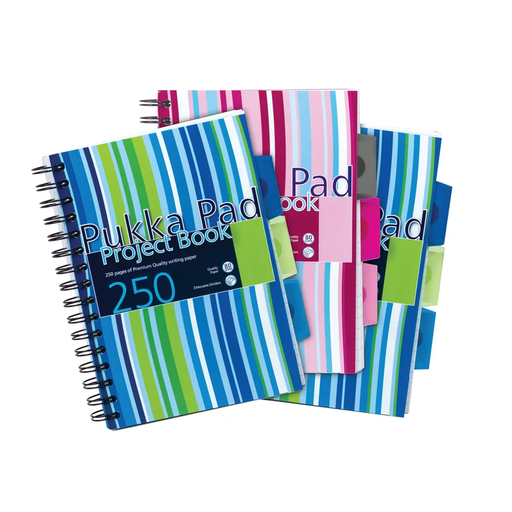
Why This Fits Their Persona: This pack of notebooks is built for organisation. The A5 size is perfectly portable for carrying between lectures, meetings and the office, while the internal dividers make it easy to manage multiple subjects or projects in one place.
It sidesteps the "feature fallacy" by providing genuinely useful tools for its target user. The repositionable dividers with storage pockets are practical, not gimmicks. The 80gsm paper is a reliable standard, avoiding the bleed-through issues of cheaper alternatives.
Excellent organisational flexibility with 3 repositionable dividers and storage pockets. The cost-effective pack of notebooks is ideal for a full term or multiple projects.
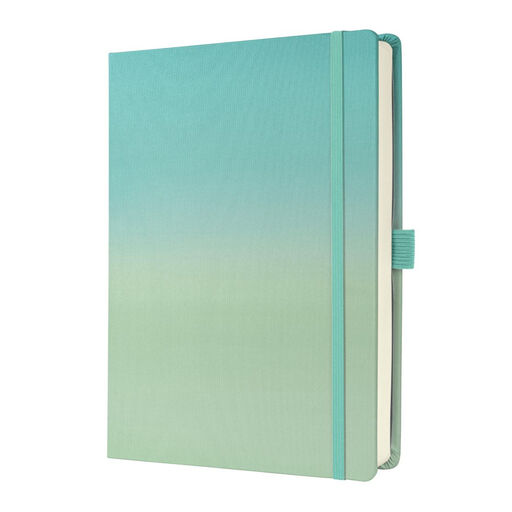
Why This Fits Their Persona: This journal is designed for creativity. It's perfect for the UK bullet journal community, artists and fountain pen enthusiasts who demand high-quality paper and a comfortable writing experience. The numbered pages also aid in structured journaling.
It directly solves the "bleed-through nightmare" with its premium 120 g/m? paper. It also conquers the "binding breakdown" with a special 180° lay-flat design, ensuring every inch of the page is usable without fighting a stiff spine.
The combination of a true lay flat journal binding and exceptionally thick paper notebook quality makes it ideal for demanding creative work. The sturdy hardcover provides a solid surface for drawing and writing anywhere.
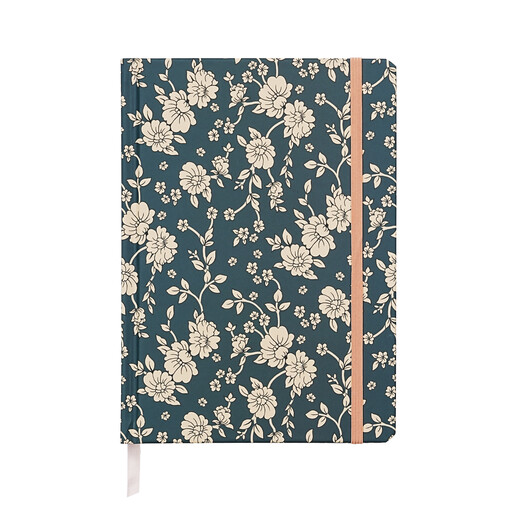
Why This Fits Their Persona: This is for the person who wants a notebook that is both functional and beautiful. It's a perfect desk companion, a reliable journal for daily thoughts or a thoughtful gift journal. The design adds a touch of personality to everyday note-taking.
This notebook proves that style doesn't have to mean sacrificing substance. It avoids the bleed-through trap with quality 100g paper, a clear step up from the basic minimum. The durable hardcover and elastic closure provide practical, long-lasting functionality.
A great balance of aesthetics and performance. The hardcover notebook design is durable, while the 100g paper offers a smooth, high-quality writing experience for most pens.
We have compiled a complete, real-time list of products that fully satisfy these strict selection criteria and UK safety regulations.
While the terms are often used interchangeably, the main difference lies in intent and layout. A notebook, especially one for school or office, is typically a lined journal used for structured note-taking. A journal can be more personal and may come in various formats—lined, unlined or with a dot-grid for a bullet journal—to encourage creative expression, planning or reflection.
This depends entirely on your use case. For a single project or a short course, a lightweight notebook with 50 sheets (100 pages) is portable and sufficient. For a year-long diary or an extensive journal, 96 sheets (192 pages) is a popular and substantial size. A large A4 project book for comprehensive study might contain 200-250 pages.
For most fountain pen users, 100gsm paper is a very good choice. It's thick enough to prevent most inks from bleeding through or feathering, offering a much smoother experience than standard 80gsm paper. However, if you use particularly wet inks or broad nibs, opting for a 120gsm paper will give you the most reliable and satisfying results.