
24/7 全天候客户支持

免费退货

当日/次日达

品质保障

开启新人专享福利: 全场免邮 | 低至 2 折 | 免费试用 30 天 JoyPlus 会员
下载 Joybuy
From lecture halls to boardrooms, the humble notebook remains an essential tool. Yet, choosing the right one can be surprisingly frustrating. A promising hardcover journal might have pages too thin for your favourite pen, or a spiral notebook can start unravelling within weeks. As the Joybuy Product Recommendation Officer, my role is to help you see past the marketing and select a notebook that genuinely meets your needs. Before you buy, be aware of these common pitfalls that lead to wasted money and disappointment.
To ensure you get a notebook that performs well, focus on a few key specifications. These objective metrics will tell you more about a notebook's quality than any stylish cover.
Paper weight is measured in Grams per Square Metre (gsm). This single number is a reliable indicator of thickness and quality, directly impacting your writing experience.
office writing pads and budget notebooks multipack options. It's suitable for ballpoint pens and pencils but may struggle with heavy ink flow, leading to bleed-through.student notebooks and everyday office use. It offers a better balance, providing a smoother feel and greater resistance to ink ghosting from most gel and rollerball pens.lined journal products.The way a notebook is bound affects its durability, how it lies on a desk and its portability.
hardcover journal offers excellent protection for your notes and a professional appearance. Quality case-bound books are durable, though they may not always lie perfectly flat when new.lined journal.While A5 notebooks are the focus for their perfect balance of portability and writing space, your specific task might call for something different. An A4 project book with built-in dividers is invaluable for organising different subjects or work projects. For sharing notes, look for pages with a micro-perforation for clean and easy tearing.
Instead of a one-size-fits-all approach, we have matched some reliable options to specific user needs.
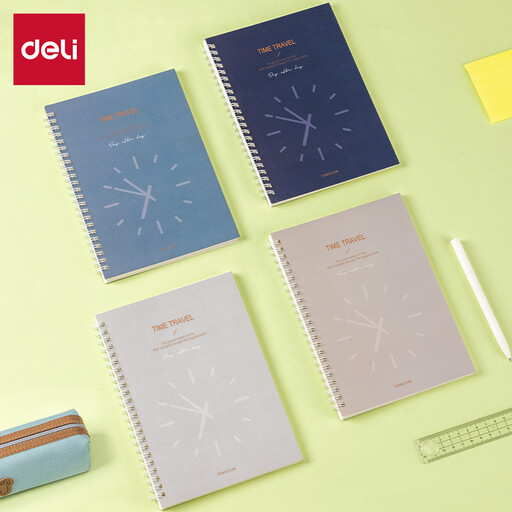
Why This Fits Their Persona: For students needing to stock up for the academic year, this notebooks multipack offers practicality without a hefty price tag. The A5 size is ideal for carrying between lectures, and the spiral binding is functional for quick note-taking on small desks.
While the 70gsm paper is standard, the value of a 4-pack means you are well-supplied for all your modules. The functional spiral binding avoids the cracking spine issue of cheap, glue-bound books.
Excellent value for money. The lay-flat spiral design is highly practical for academic settings.
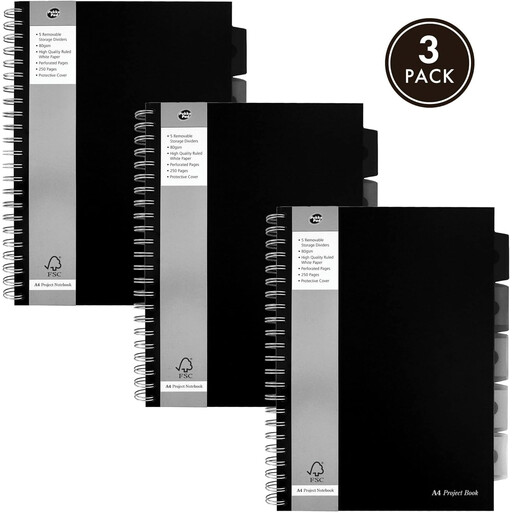
Why This Fits Their Persona: This A4 project book is built for organisation. It is ideal for professionals managing multiple clients, projects or meeting streams, who need to keep distinct sets of notes separate but accessible in one place.
The durable polypropylene cover and strong wire binding directly counter the durability pitfall. Its 80 gsm paper is a reliable standard that resists bleed-through from typical office pens and it is FSC certified, avoiding vague eco-claims.
Features five repositionable, colour-coded dividers with storage pockets for exceptional organisation. Pages are perforated for clean removal.
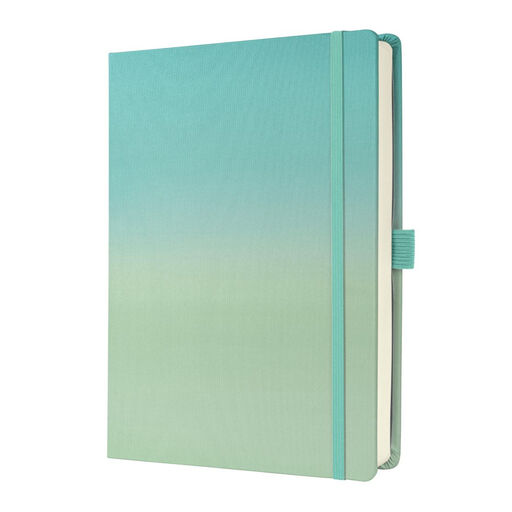
Why This Fits Their Persona: For those who use a notebook for bullet journaling, sketching or creative writing, the quality of the paper and the book's construction are paramount. This journal is designed as a canvas for creativity.
It directly solves the ink-bleed problem with its premium 120 g/m? paper. The innovative lay-flat binding is far more durable and functional for writing or drawing across a two-page spread than a standard glued spine.
Features exceptionally thick, smooth paper suitable for hand lettering and creative penmanship. The 180° lay-flat design provides a seamless surface.
We have compiled a complete, real-time list of products that fully satisfy these strict selection criteria and UK safety regulations.
The main difference is thickness and opacity. 80gsm paper is a versatile standard, suitable for most everyday pens. 100gsm paper is noticeably thicker and more robust. It provides a smoother writing feel and is far more resistant to ink "ghosting" and "bleeding," making it a better choice for fountain pens, markers or those who simply prefer a higher quality feel.
This depends on the student's needs. A spiral notebook is often more practical for lectures as it can be folded back, saving desk space. Its pages can often be torn out cleanly for handing in assignments. A hardcover journal offers superior durability for notes that need to be kept for an entire course or year, protecting them from the wear and tear of being carried in a rucksack.
The most effective way is to choose a notebook with higher-quality paper, ideally 80gsm or above. If you are using a notebook with thinner paper, consider switching to a ballpoint pen or pencil. For those who love gel or fountain pens, investing in a notebook with 100gsm or 120gsm paper is the most reliable solution.