
24/7 Customer Support

Free returns

Same-day & Next-day Delivery

Quality Guaranteed

Unlock Your Welcome Offers: FREE Delivery | Up to 80% OFF | Free 30-day JoyPlus trial
Download the APP
A5 notebooks are popular across the UK because they offer a useful balance between writing space and portability. At approximately 148 × 210 mm, they fit easily into many backpacks, work bags and home-office drawers without feeling too small for meeting notes or daily journaling.
However, attractive covers and large page counts can hide important differences. Before buying, check the paper weight, binding, page format and pack quantity. A notebook that looks suitable online may be awkward to carry, prone to ink show-through or poorly matched to the way you write.
A listing may state “50 sheets”, which means 100 individual sides of paper. Another may advertise 196 pages. These figures are not directly comparable unless you check how the manufacturer counts them.
For everyday planning or short-term projects, an A5 notebook multipack can offer practical value. For long-term journals for writing, a single book with nearly 200 pages may be more convenient than replacing smaller notebooks frequently.
A stylish softcover is light and flexible, but it may offer less protection when carried in a crowded bag. An A5 hardcover notebook usually provides a firmer writing surface and better protection for the pages, although its cover and spiral binding can add bulk.
A textured or laminated cover may also need care. Keep paper products away from moisture, drinks and prolonged direct sunlight, particularly when commuting or using them in busy classrooms and offices.
Paper weight is a useful starting point, but it is not the only consideration. 80gsm paper is common for routine school and office notes, while 100gsm paper generally feels heavier and smoother. Ink behaviour can still vary according to the pen, pressure and amount of ink used.
If you use gel pens, fountain pens or wetter rollerball ink, look for product information describing the paper surface and ink show-through. Avoid treating marketing phrases such as “premium paper” as a technical specification unless the listing also provides a measurable paper weight.
A standard A5 format measures 148 × 210 mm. It is compact enough for many bags while offering more room than a pocket notebook. Check the overall dimensions if the notebook has a thick hardcover, spiral wire or protective cover, as these can affect how easily it fits into a laptop bag or organiser.
For school and office stationery, A5 is often a practical middle ground. If you need diagrams, printed handouts or extensive project planning, an A4 or B5 project book may be more suitable.
A lined A5 notebook or A5 ruled notebook helps keep notes aligned for lectures, meeting minutes, revision and personal writing. Check whether the listing refers to pages or sheets, and look for additional features such as margins, perforated edges or punched holes.
Margins can improve structured note-taking, while perforated pages are useful when you need to hand in an assignment or move notes into a folder. Dividers and storage pockets are particularly helpful when one book needs to hold several subjects or workstreams.
The binding affects how the notebook behaves during use:
For buyers seeking a recycled notebook, check the stated material rather than assuming that a green-coloured cover indicates recycled paper. The paper specification should identify whether recycled content or a certification is included.
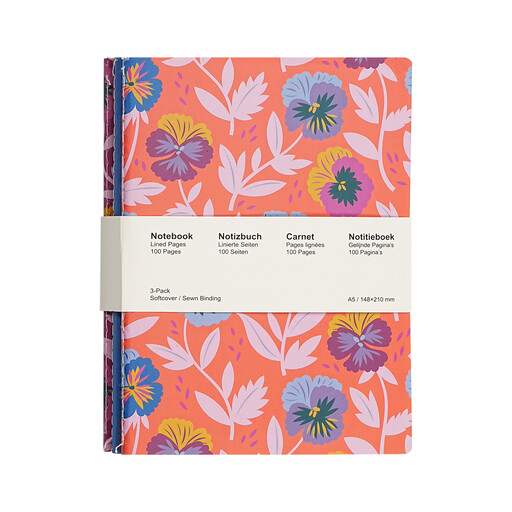
Why This Fits Their Persona: Three lightweight A5 notebooks give students, new home-office users and everyday note-takers separate books for different subjects or tasks.
The pack quantity is clearly stated, and each notebook has 50 sheets of 80g ruled cream offset paper rather than relying only on cover design.
Three A5 books, stitch binding and a lay-flat design support portable school, office and journaling use.
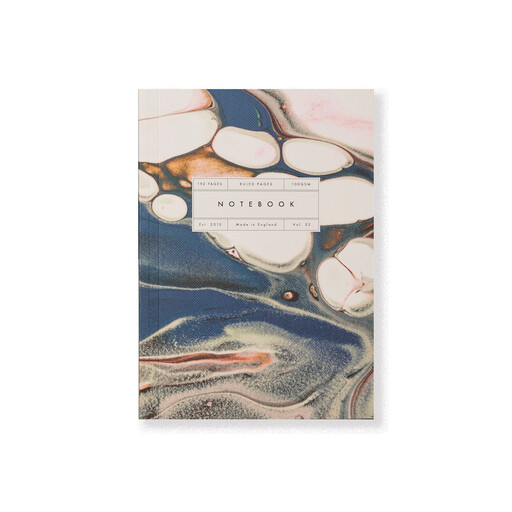
Why This Fits Their Persona: Writers, journalers and professionals wanting a more substantial everyday notebook may value the 100gsm ivory paper and textured cover.
The listing gives specific paper and cover weights: 100gsm ivory pages and a 300gsm textured cover, plus 196 ruled pages with margins.
A5 portability, 196 ruled pages and a heavier cover provide a defined format for regular writing and reflections.
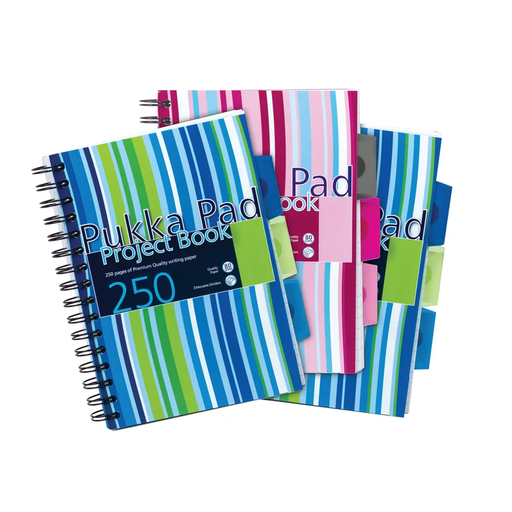
Why This Fits Their Persona: Teachers, university students and professionals managing several subjects, clients or projects can use dividers and pockets to separate information.
It combines a stated 250 pages with three repositionable dividers and storage pockets, so organisation features are clearly defined.
A5 dimensions, 8mm ruling, 80gsm FSC-certified paper, perforated pages and repositionable dividers support structured project work.
We have compiled a complete, real-time list of products that fully satisfy these strict selection criteria and UK safety regulations.
Yes. Their 148 × 210 mm format is portable enough for bags while providing space for lecture notes, meeting minutes, planning and revision. Choose ruled pages for standard writing, or a project book with dividers if you need to organise several subjects or workstreams.
Neither is automatically suitable for every user. 80gsm paper is a common lightweight option for routine notes and multipacks. 100gsm paper is heavier and may feel smoother, making it appealing for longer writing sessions or users who prefer fountain pens. Always consider the specific pen and writing pressure, as paper performance can vary.
Its lifespan depends on page count, binding, storage and frequency of use. A 50-sheet softcover may suit a short project or rotating subject system, while a 196-page notebook can support regular journaling for longer. Wirebound and spiral designs may be convenient for frequent page turning, but avoid bending the wire and store all notebooks in a dry place to protect the paper.