People keeping a single torch ready
If you keep one or two spare rechargeable AA cells, being able to see when each cell has finished charging matters more than having a large number of slots.


If you prepare one to four rechargeable NiMH AA cells for a torch, individual-slot charging and per-cell status indicators help you manage a lone spare without waiting for a pair. Consider eight slots when several cells regularly need charging together; choose a USB-powered multi-chemistry model only after checking its supported cells and power supply. Whichever format you choose, confirm the plug arrangement and a suitable dry place to use it at the shared desk.
If you keep one or two spare rechargeable AA cells, being able to see when each cell has finished charging matters more than having a large number of slots.
You need somewhere dry and uncovered to place the charger, away from drinks and materials that could obstruct ventilation. Follow the instructions for the charger and its power supply.
If you regularly prepare AA or AAA cells for torches and other devices, individual control across four or eight slots can help you manage several cells in one session.
Check the battery label and charger instructions before comparing slots or indicators: AA describes a size, not a rechargeable chemistry. Then decide how many cells you need to prepare together and where the charger can sit safely.
| Concern | What to check | Who this matters to |
|---|---|---|
| Battery compatibility | Confirm that the cell is rechargeable and that its chemistry and AA size are explicitly permitted by the charger instructions. Do not put ordinary alkaline cells in a NiMH-only charger. | I want to know my torch cells can go into the charger before I consider its other features. Roughly 50% of consumers would make compatibility their primary concern. |
| Desk placement and charge status | Look for clear charge indicators and a dry, uncovered place to charge away from drinks. Follow the model's instructions on supervision. | At a desk shared with colleagues, I need to tell whether a cell is ready without leaving charging equipment in an unsuitable spot; around 30% of consumers would put safe, visible charging first. |
| Cells charged together | Count how many AA cells must be ready at once, and check whether the charger accepts one cell independently or requires a pair or larger set. | When several torches or devices need spare cells, I would rather prepare the required batch together. Approximately 20% of consumers would prioritise charging capacity. |
AA identifies the cell size, not its chemistry. Energizer's Recharge Pro instructions permit rechargeable NiMH cells and warn against charging other battery types.
Read the battery label and the exact charger manual before buying or inserting a cell. Never treat a torch cell as rechargeable solely because it fits an AA slot.
Panasonic says the BQ-CC55's plug configuration varies by sales region. An input-voltage range therefore does not tell you which plug comes in the box.
Confirm the supplied plug, cable or required power arrangement for the version you intend to buy.
Energizer documents two- or four-cell charging for Recharge Pro, while Panasonic documents independent charging of one to four compatible cells for the BQ-CC55. That distinction matters when only one torch spare needs charging.
If single-cell charging is part of your routine, check that the model explicitly supports it rather than relying on its total slot count.
A USB cable does not necessarily make a charger ready to use at the desk. ANSMANN lists a USB-C cable with the Lithium 2 but excludes a USB power adapter.
Check the required adapter and confirm that each cell type is supported before choosing a multi-chemistry model.
The Lithium 2 may require a separate compatible USB power adapter.
Its AA/AAA NiMH charger range includes models for a few torch spares and an eight-slot option for larger batches.
The documented Recharge Pro arrangement suits people who normally charge rechargeable NiMH cells in pairs or sets of four.
Its documented Lithium 2 offers a USB-powered route where supported NiMH AA/AAA and supported lithium-ion cells both matter.
These Duracell charger bundles are choices to consider when preparing rechargeable AA torch cells. Check each charger's permitted chemistry, charging arrangement and supplied power connection against your own cells and desk setup.
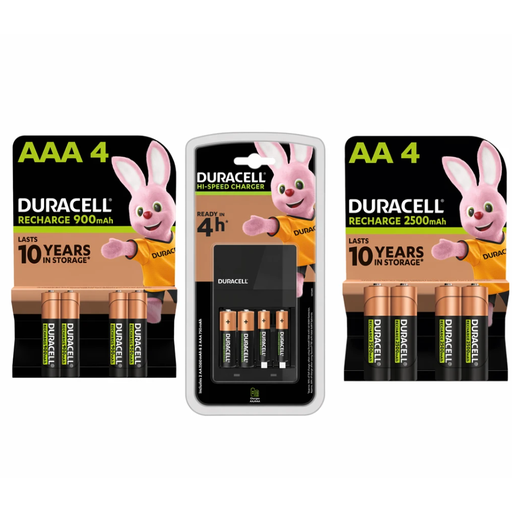 Image unavailable
If you want to prepare a lone torch spare as well as several cells, check the charger's instructions for independent-slot operation and permitted battery chemistry.
The bundle includes both AA and AAA rechargeable cells; confirm that the supplied power connection and indicator behaviour suit your desk.
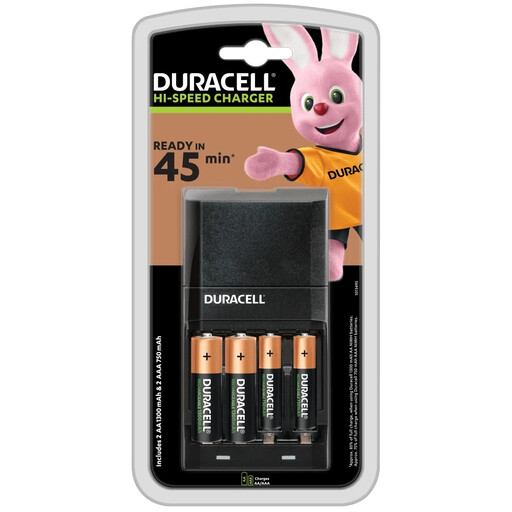 Image unavailable
If you normally prepare torch cells in pairs, check the CEF27 instructions for its permitted chemistry and charging arrangement; do not assume it can charge one spare on its own.
The bundle contains two AA and two AAA batteries. Confirm the supplied plug or other power arrangement before choosing it for a shared desk.
No—not in a conventional NiMH charger. Energizer's Recharge Pro instructions permit rechargeable NiMH cells and warn that charging other battery types can cause leaks, rupture or explosion. Check the cell label and charger instructions before use.
Use a dry location that meets the charger's instructions, away from drinks and with the unit uncovered. For USB charging equipment, Electrical Safety First also advises ventilation and says not to leave it charging overnight or while you are away. Do not operate a damaged charger.
No. Panasonic specifies 100–240 V input for the BQ-CC55 but says its plug configuration varies by sales region. Check the plug and supplied power accessories for the version you intend to buy.
Take spent cells to an appropriate battery collection point and the old charger to electrical recycling rather than putting them in household rubbish. GOV.UK includes AA and rechargeable batteries in its battery-recycling guidance; check which items your chosen collection point accepts.