If you already have a suitable USB power source, a USB-input NiMH charger such as the GP ReCyko P461 can leave a scarce wall socket free; using a USB wall adaptor would still occupy one. Choose individually controlled bays if you often charge one or three cells, or a two- or four-cell mains charger if you prepare complete sets and can spare a socket. Before putting rechargeable AA cells in the toy train, check its manual and battery compartment for compatibility with 1.2 V NiMH cells.
Who needs which charger?
Households short of plug sockets
If an existing powered USB port or power bank is available, a USB-input charger may let you prepare the train’s cells without occupying another wall socket. Check the input requirement: GP Batteries specifies 5 V / 2 A for its ReCyko P461.
People charging incomplete sets
If you need to top up one cell, three cells or a mix of AA and AAA cells, look for individual charging control rather than just four physical bays. Panasonic specifies one-to-four-cell control for the BQ-CC55; Ansmann specifies individually configurable bays for the Powerline 4.2 Pro.
Households maintaining several rechargeable sets
If you rotate several sets of cells, test and refresh functions may be worth considering alongside ordinary charging. Ansmann specifies those programmes for the Powerline 4.2 Pro, though they add steps when all you need is a charge.
What matters when choosing?
Check the train’s battery requirements before choosing a charger. Then decide how you will power it, how many cells you need to charge at once and whether ordinary charging or cell-maintenance functions fit your routine.
| Concern |
What to check |
Who this matters to |
| Keeping a socket free |
Check the charger’s USB input requirement against a powered USB port or power bank you can use. GP Batteries specifies 5 V / 2 A for the P461. |
When the train’s batteries need charging and every wall socket is spoken for, I want to use a suitable USB source I already have. Around 43% of consumers would put keeping a socket free first. |
| Charging an incomplete set |
Look for explicit one-to-four-cell, individual-bay control and confirm the supported AA or AAA cell types. |
If only one cell needs a top-up, I do not want to wait until I have a complete set to charge. For around 29% of consumers, that flexibility would be the primary concern. |
| Having cells ready |
Compare quoted charge times only alongside their stated cell capacity and power conditions. Decide whether status indicators or test and refresh modes would be useful. |
When playtime depends on the next charged set, I care about the turnaround; with several older sets, I may also want to check individual cells. Readiness or upkeep would come first for around 28% of consumers. |
Mistakes to avoid
-
Assuming USB power means no socket will be used
A USB charger still needs a suitable power source. The GP ReCyko P461 requires a 5 V / 2 A USB input, while a USB wall adaptor would occupy the socket you hoped to leave free.
Check both the charger’s input rating and the USB source you intend to use before choosing it for a socket-limited room.
-
Putting disposable AA batteries in a NiMH charger
An AA-sized battery is not necessarily rechargeable. Energizer’s charger instructions warn that charging an incompatible or non-rechargeable battery can cause leaking, rupture or explosion.
Read each cell’s label and charge only rechargeable NiMH cells in a charger specified for them.
-
Assuming four bays mean four independent channels
A charger specified for two- or four-cell groups may not suit a lone replacement cell. Panasonic specifies individual one-to-four-cell charging for the BQ-CC55, whereas Energizer describes two- or four-cell charging for its UK Pro Charger.
Confirm the permitted number of cells and individual-bay control rather than relying on the bay count.
-
Treating a quoted charge time as universal
Published times depend on stated conditions. GP Batteries’ 2.6-hour figure for the P461 concerns four specified 2,100 mAh AA cells and its required USB input; it is not a time for every battery or power source.
Compare the cell capacity, number of cells and input conditions attached to each time claim before planning when the train’s batteries will be ready.
Relevant brands to consider
These charger lines illustrate different ways to handle limited sockets, uneven sets and cell upkeep; check the exact model and supplied variant before buying.
GP Batteries
The ReCyko P461 is a USB-input, four-channel AA/AAA NiMH charger offered in a kit with four AA cells.
- GP Batteries specifies individual LED indicators and battery-error indication, alongside a 5 V / 2 A USB input.
- A suitable USB source is still necessary; a wall USB adaptor would still take up a mains socket.
Panasonic eneloop
Panasonic specifies the BQ-CC55 for individually charging one to four eneloop or eneloop pro AA/AAA cells in any combination.
- Individual control makes the specified model relevant when only part of a set needs charging.
- It uses an AC outlet. Panasonic says the plug configuration varies by sales region, so confirm the supplied plug.
Energizer
The UK Pro Charger is a mains-powered option specified for charging two or four AA/AAA NiMH cells; its kit includes four 2,000 mAh AA cells.
- Energizer specifies charge-status indicators and automatic shut-off. Its four-hour full-charge claim varies by battery.
- The published two- or four-cell arrangement is not the choice to assume will charge a single cell.
Ansmann
The Powerline 4.2 Pro supports one to four AA/AAA NiMH cells and offers per-bay maintenance functions.
- Ansmann specifies charge, discharge, refresh and capacity-test programmes for its individually configurable bays.
- Those programmes add operating steps when the task is simply to charge cells for the next play session.
Joybuy mains-charger options
These kits suit routines in which a wall socket is available while the toy train’s rechargeable cells charge. Neither is a USB-input alternative for keeping that socket free; choose between them according to the number of cells you need to prepare.
 No image available
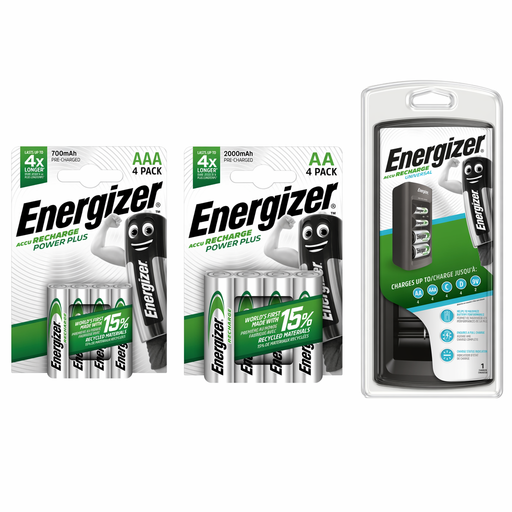
Energizer Recharge Starter Kit: Universal Charger with AA & AAA Batteries
Consider this kit if you need to charge an uneven number of cells and can spare a mains socket. Check its individual-channel operation and the cells included against the set you need for the train.
Before using rechargeable AA cells, check the train’s manual and battery compartment for compatibility with 1.2 V NiMH cells.
View on Joybuy
 No image available
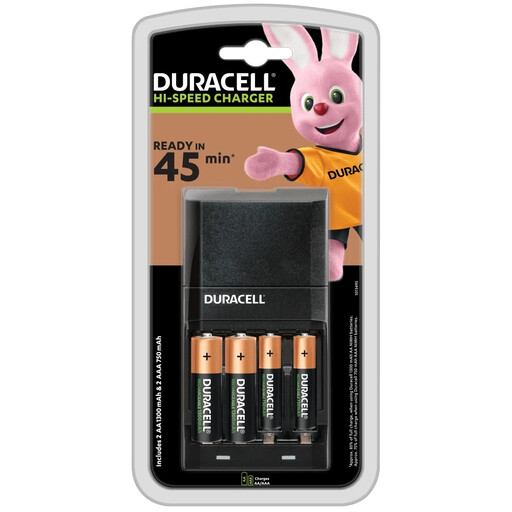
Duracell CEF27 45 Minute Charger with 2 AA & 2 AAA Batteries
Consider this kit if you prepare two- or four-cell sets and have a mains socket available. The bundle includes two AA and two AAA batteries; check whether those quantities suit the train’s required AA set.
Confirm the supplied plug variant and the battery and charging conditions behind the 45-minute claim. Check the train’s manual and battery compartment before using 1.2 V NiMH AA cells.
View on Joybuy
Common questions
Can I charge ordinary disposable AA batteries?
No: use only rechargeable NiMH cells in a charger specified for NiMH batteries. Energizer’s charger instructions warn that charging non-rechargeable batteries or another incompatible type can cause leaking, rupture or explosion.
Will a USB charger free up a plug socket?
It can if you already have a USB source that meets the charger’s input requirement. GP Batteries specifies 5 V / 2 A for the ReCyko P461; powering it through a USB wall adaptor would still occupy a mains socket.
Can I charge just one AA cell?
Yes, if the particular charger supports single-cell charging. Panasonic specifies individual one-to-four-cell charging for the BQ-CC55, while Energizer’s UK Pro Charger specification describes two- or four-cell charging.
Can rechargeable AA cells go straight into any toy train?
Check the train’s manual and battery-compartment label before using 1.2 V NiMH AA cells. The charger’s compatibility with those cells does not establish that a particular train accepts them or tell you how many AA cells it needs.
What should I do with worn-out rechargeable AA cells?
Take them to an appropriate battery collection point rather than putting them in ordinary household waste. UK government guidance describes battery collection and recycling requirements; follow the collection point’s instructions for accepting cells.


