For a holiday-cottage desk clock, choose a charger around how you prepare its batteries: a straightforward NiMH charger if you can plan ahead, individual charge control if you often charge just one or two cells, or a rapid charger if preparation is regularly left until departure day. Before buying rechargeable AAs, check that the clock accepts 1.2 V NiMH cells and follow the charger’s battery-chemistry instructions.
Who is this for?
Occasional cottage visitors
If weeks or months pass between visits, you may care more about how prepared cells store and whether the clock accepts them than about the shortest charging time. Panasonic publishes storage information for its standard eneloop cells, but the clock’s own battery instructions still matter.
People charging one or two cells at a time
If the clock needs only a small number of replacement cells, check whether a charger accepts that number rather than requiring a pair or larger set. Panasonic specifies individual charge control for its BQ-CC55.
Visitors preparing batteries at short notice
A rapid charger may be useful when there is little time before departure. Read its stated charging conditions carefully: a time quoted for particular cells is not a time for every rechargeable AA.
What matters when choosing?
Start with the clock’s battery requirements, then decide whether storage readiness, small-batch charging or a short turnaround is your main concern.
| Concern |
What to check |
Who this matters to |
| Readiness between visits |
Check the clock’s instructions for rechargeable AA compatibility and compare the cells’ stated storage characteristics. |
If visits are far apart, I want the cells I prepared to remain useful until I return; around 45% of consumers put storage readiness first. |
| Small-batch charging |
Check whether the charger accepts the number of cells you need and whether its slots are individually controlled. |
When the clock needs just one or two replacement cells, I do not want to wait to assemble a larger set; roughly 33% of consumers prioritise flexible small-batch charging. |
| Charging before departure |
Read the timed claim alongside its specified battery capacity and quantity, and check the full-charge instructions. |
If I notice weak batteries shortly before travelling, turnaround matters more to me; about 22% of consumers place short-notice charging first. |
Mistakes to avoid
-
Putting ordinary alkaline AAs in a NiMH charger
Battery chemistry is a safety requirement, not an interchangeable label. Duracell’s CEF27 instructions warn against charging alkaline, zinc-carbon, lithium or other non-specified batteries.
Use rechargeable cells expressly permitted by the exact charger’s instructions, and check the chemistry and polarity markings before charging.
-
Assuming rechargeable AAs suit every desk clock
Panasonic describes its eneloop AAs as about 1.2 V, but that does not establish what a particular clock accepts.
Read the clock manual or battery-compartment label before changing battery type. If its instructions require alkaline cells, do not assume NiMH cells are suitable.
-
Choosing maximum charging speed for an occasional visit
A fast-charge time applies under the manufacturer’s stated conditions. It may offer little practical benefit if you normally prepare the clock’s batteries well before travelling.
Choose rapid charging for a recurring short-notice need; otherwise, focus on compatible cells and a charging pattern that fits the number you maintain.
-
Putting worn cells or a charger in household rubbish
Rechargeable batteries and electrical equipment need separate recycling routes.
GOV.UK advises using a battery collection point for portable batteries and an appropriate electrical-waste route for an unwanted charger.
Relevant brands to consider
Panasonic eneloop
A relevant AA NiMH cell and charger range if you prepare batteries between cottage visits or need individual charge control.
- Panasonic specifies individual charge control for the BQ-CC55. For standard eneloop cells, Panasonic states 70% capacity retention after ten years under its specified 20 °C storage test conditions; actual storage conditions can differ.
- Check the exact charger bundle, plug and charging pattern before choosing it for your clock’s battery count.
Duracell
Its Advanced Charger is relevant when batteries sometimes need preparing shortly before a cottage visit.
- Duracell describes automatic shut-off and approximately 85% of a full charge after 45 minutes when using its 1300 mAh AA NiMH batteries.
- That timed figure is conditional; it should not be treated as a full-charge time for other cells or as a reason to choose rapid charging when you can plan ahead.
Energizer
Its Compact Charger illustrates a conventional NiMH AA/AAA charging option.
- Energizer’s Compact Charger instructions specify charging one to four AA or AAA NiMH rechargeable cells.
- Check the instructions, charging pattern, plug and bundle for the particular Energizer model you are considering; Compact Charger details do not establish those features for every model.
Joybuy products for planned charging
These AA charger choices are relevant if you can prepare rechargeable batteries before travelling. Check each model against the clock’s cell count and battery instructions before choosing.
 No image available
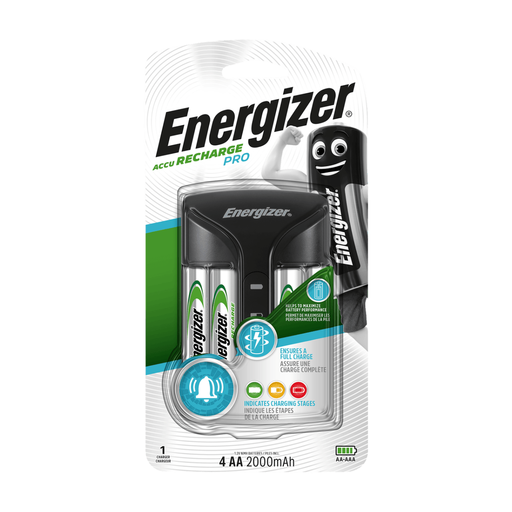
Energizer Pro Charger (UK) with 4 × AA 2000 mAh rechargeable batteries
This bundle may suit you if you want a set of AA cells to prepare before visiting the cottage.
- Check that the clock accepts rechargeable NiMH AAs and whether its cells should be replaced as a set.
- If you need to charge a single cell, confirm that the charger permits it.
View on Joybuy
 No image available
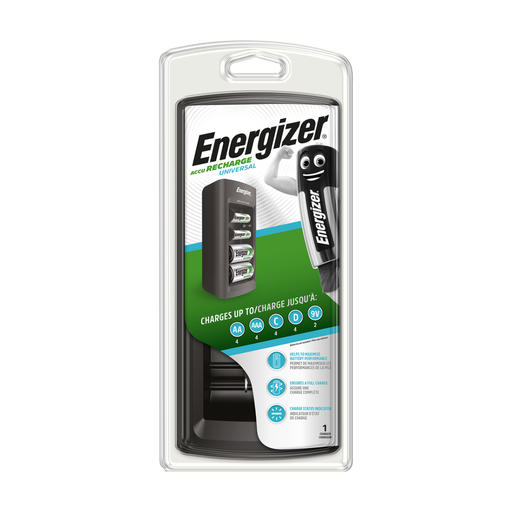
Energizer Universal Battery Charger
For planned charging before a cottage visit, consider this model if its AA charging pattern fits the number of cells your clock uses.
- Confirm the permitted cell quantity, supplied plug and whether batteries are included.
- Check the clock’s instructions before using 1.2 V rechargeable NiMH AAs.
View on Joybuy
Frequently asked questions
Can I recharge ordinary alkaline AA batteries?
No: do not put ordinary alkaline AAs in a charger intended for NiMH rechargeable cells. Duracell’s CEF27 instructions exclude alkaline, zinc-carbon, lithium and other non-specified batteries; follow the chemistry requirements for your exact charger.
Will 1.2 V rechargeable AAs work in my desk clock?
Check the specific clock’s manual or battery-compartment label before using them. Panasonic says its eneloop AAs start at about 1.2 V and describes a typical AA-device operating range of 0.9 V to 1.5 V, but the clock maker’s requirements take precedence.
Do I need a rapid charger for occasional cottage visits?
A rapid charger is chiefly useful if you regularly need to prepare batteries at short notice; planned charging does not depend on maximum speed. If a timed claim matters to you, check its specified cells and whether it describes a partial or full charge.
Where should worn AA cells and an old charger go?
Use separate battery and electrical-waste collection routes rather than household rubbish. GOV.UK says portable rechargeable AAs can be taken to suitable battery collection points; an unwanted charger can go to an appropriate electrical recycling point.


