Last-minute cottage preparers
If you discover flat radio batteries shortly before leaving, look at the stated charging time for your cells and whether the charger can handle the number you need. Allow time to test the radio before departure.


For occasional cottage trips, choose a charger specified for rechargeable AA NiMH batteries and for the number of cells your radio uses. Independent slots are useful if you need to charge one cell or an uneven set; a charger that handles pairs can suit planned use with matched cells. Check the supplied batteries, power connection and stated charging arrangement before you travel.
If you discover flat radio batteries shortly before leaving, look at the stated charging time for your cells and whether the charger can handle the number you need. Allow time to test the radio before departure.
If you mainly use rechargeable AAs during cottage stays, a straightforward charger and battery set may cover the task. Check that its charging arrangement fits the radio’s battery count.
If AA and AAA cells from several devices need charging at different times, individually controlled slots let you charge an uneven number of cells rather than assembling pairs.
Start with rechargeable AA NiMH compatibility and your radio’s battery count, then decide whether charging time, an included AA set or independent slots will make preparation easier.
| Concern | What to check | Who this matters to |
|---|---|---|
| Batteries ready before departure | Check the stated time for the AA NiMH cells you will charge and whether suitable AA cells are included. Allow for variation with battery condition. | If I find flat radio batteries just before leaving, I need enough time to charge them and test the radio. Around 42% of consumers put departure readiness first. |
| A simple occasional-use setup | Check that the charger accepts AA NiMH cells and that its two- or four-cell arrangement fits the set you use. | For a radio used mainly on cottage stays, I want a straightforward rechargeable set I can prepare ahead of time; roughly 33% of consumers prioritise that simplicity. |
| Flexible charging across devices | Look for explicit independent-slot control if you need to charge one cell or an uneven number of AA and AAA cells. | When cells from the radio and other devices run down at different times, I want to charge only those that need it. About 25% of consumers make that flexibility their main concern. |
AA describes a battery’s size, not its chemistry. A charger specified for AA NiMH cells is not a charger for ordinary disposable AA batteries.
Use rechargeable AA NiMH cells with a charger that explicitly supports them; never attempt to recharge disposable cells.
A charger designed to handle pairs is less flexible if you need to charge a single replacement cell or an uneven set.
If that situation is likely, choose a model explicitly specifying independent slots. Otherwise, check that its two- or four-cell arrangement suits your usual set.
Charging time depends on the charger and cells, including their condition; a stated figure is not a promise for every AA battery.
Use the figure for the relevant cells to plan ahead, then charge them and test the radio before travelling.
Panasonic warns that mixing cells with different capacities can contribute to over-discharge and leakage. It also advises against mixing disposable batteries with eneloop rechargeables unless the device maker expressly permits it.
Follow the radio manufacturer’s instructions and use a matched rechargeable set of the same type and capacity.
Its AA/AAA NiMH range includes the BQ-CC55 for charging an uneven number of cells.
The UK Pro Charger is a mains-charger option supplied with an AA NiMH set.
The USB-powered M451 offers individual channels and a cover that also serves as a battery organiser.
These options cover AA rechargeable-battery kits for preparing the radio at home, a USB-powered kit and a charger to consider if you already have suitable AA NiMH cells. Match the charging arrangement and power connection to your plans before choosing.
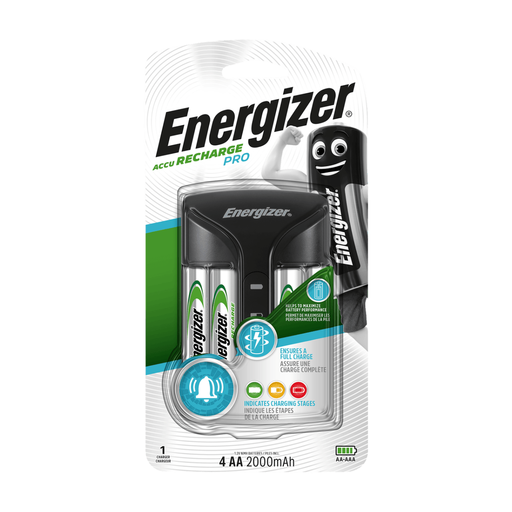 No image available
For preparing an AA battery set at home before the cottage trip.
The product name specifies four 2000 mAh rechargeable AA batteries. If you need to charge one or three cells, confirm the exact charger’s slot arrangement.
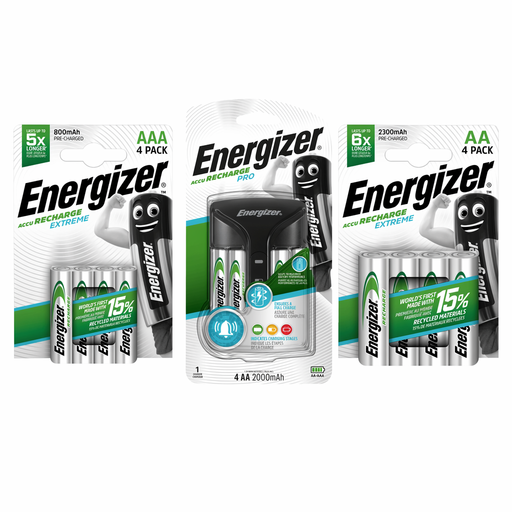 No image available
For preparing radio batteries while also keeping rechargeable cells for other AA or AAA devices.
The kit name identifies a Pro Charger and Extreme AA and AAA batteries. Check the exact bundle contents, charging time and whether the charger handles individual cells if those details matter to your plans.
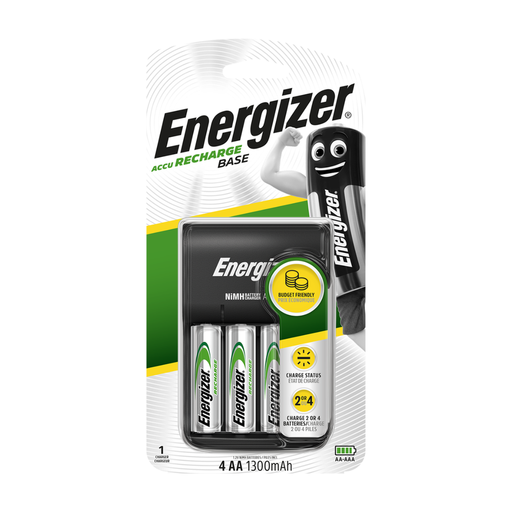 No image available
For charging an AA set where you have a suitable USB power source.
The product name specifies four 1300 mAh rechargeable AA batteries. Check the package’s adapter arrangement and whether the charger can handle a single cell if you need that option.
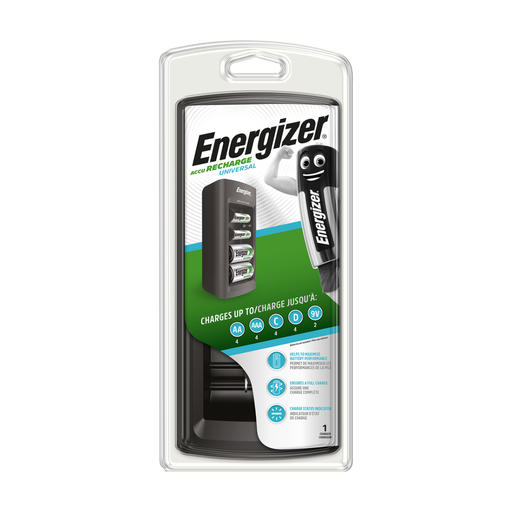 No image available
For preparing radio batteries if you already have suitable rechargeable AA NiMH cells.
Check the exact package for included cells and its UK power connection. Confirm the charging-channel arrangement if you may need to charge cells individually.
No. Use rechargeable AA NiMH cells in a charger explicitly specified for them; an AA-sized disposable battery must not be put in that charger.
Not necessarily: a charger designed for pairs can suit a matched two-cell set that you prepare ahead of time. Independent slots become useful if you also need to charge one cell, three cells or an uneven set; Panasonic specifies that capability for the BQ-CC55.
Allow the time stated for your exact charger and cells, plus enough time to test the radio before departure. Panasonic quotes approximately 90 minutes for two AA eneloop cells on the BQ-CC55, while Energizer UK states four hours for its Pro Charger; neither figure applies to every battery and condition.
Take used batteries to a battery collection point rather than putting them in ordinary household waste. Recycle Now describes in-store battery collection as one option; check your local recycling arrangements for another.