Check your exact label-maker manual before buying a charger: an AA battery compartment does not establish that the device accepts rechargeable NiMH cells. If it does, choose a charger designed for those cells, then decide whether independent slots for small batches or a planned charging routine matters more; treat rapid-charge times as conditional on the batteries specified by the manufacturer.
Who needs to check what?
Label-maker compatibility checkers
If you have an AA-powered label maker, check its exact manual before choosing rechargeable cells. Brother recommends alkaline AA batteries for memory backup on its PT-D410 and PT-D460BT models, while DYMO describes different power arrangements across its devices.
Small-batch room organisers
If you prepare batteries intermittently for labelling folders or storage, individual charging slots may suit the quantities you use. Panasonic states that the BQ-CC55 charges one to four compatible cells independently; Energizer describes individual channels on its 1-Hour Charger.
Last-minute battery preparers
If you need cells ready before a labelling task, compare charging-time claims using the number and capacity of your own batteries. A quoted rapid-charge time need not describe a full charge or an entire label-maker set.
What matters when choosing a charger?
Start with the label maker’s permitted battery chemistry. Once rechargeable NiMH AA cells are confirmed as suitable, consider how many cells you normally charge together and when you need them ready.
| Concern |
What to check |
Who this matters to |
| Device and cell compatibility |
Check the exact label-maker manual for permitted AA cell chemistry, then confirm that the charger supports the rechargeable cells you intend to use. |
If my label maker calls for a different power source, charging NiMH AA cells will not meet this need. Around 44% of consumers put compatibility first. |
| Small-batch flexibility |
Look for an explicit single-cell charging capability and independently controlled slots. |
When I need to prepare just one cell or an unevenly used group, I do not want to wait for a complete pair. Small-batch flexibility comes first for around 33% of consumers. |
| Charging schedule |
Compare stated times at the specified cell count, capacity and charge level; account for the batches your device requires. |
If labelling starts soon, I need to know whether the available charging time covers the cells I will use. Around 23% of consumers prioritise turnaround time. |
Mistakes to avoid
-
Assuming every AA-powered label maker accepts NiMH cells
Battery size does not establish permitted chemistry or power requirements. Brother recommends alkaline AA cells for memory backup on its PT-D410 and PT-D460BT models, and DYMO directs users to the guidance for their particular device.
Find your label maker’s model number and check its manual before selecting rechargeable cells and a charger.
-
Treating a partial-charge time as a full-charge time
Duracell describes its Advanced Charger’s 45-minute result as approximately 85% charge for two 1300 mAh AA NiMH cells, not a full-charge time for every AA battery.
Compare the claim with your cells’ capacity and the number of cells you must prepare, including any additional charging batches.
-
Assuming the same model name means the same plug
Panasonic states that BQ-CC55 plug configurations vary by sales region, so a model name alone does not establish whether a particular version suits your socket.
Check the exact charger variant and mains connection on the listing and packaging before buying.
-
Putting spent rechargeable cells in household rubbish
Rechargeable AA cells need an appropriate battery collection route when they reach end of life.
GOV.UK advises taking most waste batteries to a local supermarket or another qualifying large shop with a battery collection point.
Relevant brands for reference
Panasonic eneloop
The BQ-CC55 is worth considering when independent charging slots matter.
- Panasonic states that it independently charges one to four eneloop or eneloop pro AA/AAA cells in any combination, with automatic shut-off for completed slots.
- Its plug configuration varies by region of sale; check the exact variant.
Duracell
The UK Advanced Charger is relevant when a short, specified charging interval matters.
- Duracell states an approximately 45-minute result for two 1300 mAh AA NiMH cells.
- That result is approximately 85% charge, not a universal full-charge time; preparing more cells can require additional batches.
Energizer
Its UK Pro Charger and 1-Hour Charger offer different stated charging configurations.
- Energizer specifies two or four AA/AAA NiMH cells for the Pro Charger and individual one-to-four-cell channels for the 1-Hour Charger.
- Do not assume the Pro Charger accepts a single cell; Energizer says the 1-Hour Charger’s charging time varies by battery.
Joybuy charger choice
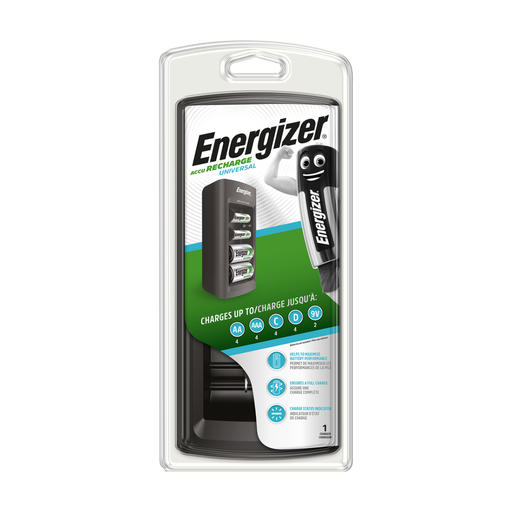
This charger is a product choice to consider when preparing AA batteries for a label maker. Confirm the device’s permitted cells and the charger’s exact charging configuration before deciding whether it suits your routine.
 No image available
Energizer Universal Battery Charger
Consider this charger only after checking that your label maker accepts the rechargeable AA cells you plan to prepare. Confirm the charger’s supported cell chemistry, charging quantities and UK mains connection on the exact product variant; if you charge single cells, check for that capability specifically.
View on Joybuy
Frequently asked questions
Can I put disposable alkaline AA batteries in a NiMH charger?
No. Use a charger only with the rechargeable battery chemistry it specifies; Energizer’s UK AA/AAA charger guidance identifies NiMH rechargeable cells and warns against charging non-rechargeable batteries.
Does a 45-minute claim mean my AA cells will be fully charged?
Not necessarily. Duracell’s 45-minute claim for its UK Advanced Charger means approximately 85% charge for two 1300 mAh AA NiMH cells. Check the stated capacity, cell count and charge level before applying any quoted time to your own batteries.
Where should spent rechargeable AA batteries go?
Take them to an appropriate battery collection point rather than putting them in household rubbish. GOV.UK identifies local supermarkets and other qualifying large shops as collection options for most waste batteries.
What should I check before plugging in a charger?
Check that the exact charger variant has a mains connection suitable for your socket, and follow its supplied instructions. Do not use a damaged charger; a model name by itself may not identify the plug configuration.


