Label-maker owners checking battery compatibility
Check your exact model before choosing rechargeable AA cells. DYMO explains that its label makers can have different power arrangements, including alkaline cells, rechargeable packs and mains power.


Check your exact label maker’s power requirements before buying an AA charger: some models use alkaline cells, a dedicated rechargeable pack or mains power instead of removable rechargeable AA cells. If yours accepts NiMH AA cells, choose individual-slot charging when you need to top up a single cell or partial set; compare stated charging times and power requirements when preparing a spare set quickly. Charge only cells supported by the charger, in the dry indoor conditions specified in its instructions.
Check your exact model before choosing rechargeable AA cells. DYMO explains that its label makers can have different power arrangements, including alkaline cells, rechargeable packs and mains power.
If you sometimes need to recharge just one AA cell, look at the charger’s minimum cell count. Panasonic specifies individual charging on its BQ-CC17, whereas its BQ-CC51 requires same-size pairs.
Compare charging times for the number and capacity of cells you intend to use. Duracell and GP Batteries UK state times for particular charger-and-cell combinations, not for every AA battery.
Start with the label maker’s permitted power source and battery chemistry. Then decide whether charging a partial set or preparing a spare set sooner matters more to you.
| Concern | What to check | Who this matters to |
|---|---|---|
| Device and cell compatibility | Check the exact label-maker manual for permitted cells, then match the charger to their rechargeable chemistry. | I need to know whether my label maker accepts removable NiMH AA cells before choosing a charger. Around 40% of consumers put compatibility and cell chemistry first. |
| Small-set flexibility | Check the minimum cell count and whether slots charge independently; paired-slot models may require same-size pairs. | When only one cell needs charging, I do not want to wait for another depleted cell to make a pair. Roughly 30% of consumers prioritise the flexibility to charge a partial set. |
| Spare-set turnaround | Compare stated times for your cell count and capacity, and check the required mains or USB power input. | If I need a spare set ready before a labelling task, the time for my particular cells matters. About 30% of consumers put charging turnaround first. |
A paired-slot charger may leave you unable to charge a single depleted cell. Panasonic specifies that its BQ-CC51 requires same-size pairs, while the BQ-CC17 can charge one to four cells.
Check the supported cell-count combinations if you expect to top up partial sets.
AA describes the cell size, not whether it can be recharged in a particular charger. Energizer’s NiMH-only charger instructions exclude alkaline, lithium and other unsupported cell types.
Read the chemistry printed on the cell and charge it only in a charger expressly rated for that chemistry.
Duracell’s stated 45-minute result concerns two AA cells under its specified conditions; GP Batteries UK ties its P461 time to a particular four-cell set and USB input.
Compare times using your intended cell count and capacity, and confirm that your power supply meets the charger’s requirements.
A label maker’s AA-sized battery compartment alone does not establish that rechargeable AA cells are permitted. DYMO describes power arrangements that vary by model.
Find the exact model’s battery instructions before choosing either cells or a charger.
Its AA/AAA NiMH charger range includes both paired-slot and individual-slot models, making the exact model important when you charge an odd number of cells.
Its UK AA/AAA NiMH charger range includes models for consumers comparing mains charging and stated shorter charge times.
Its range includes a USB-input charger for preparing up to four AA or AAA cells.
These chargers are relevant when your label maker permits removable rechargeable AA NiMH cells. The two Duracell kits suit consumers considering a supplied cell set; compare each listing’s charging combinations, bundle contents and power connection before choosing.
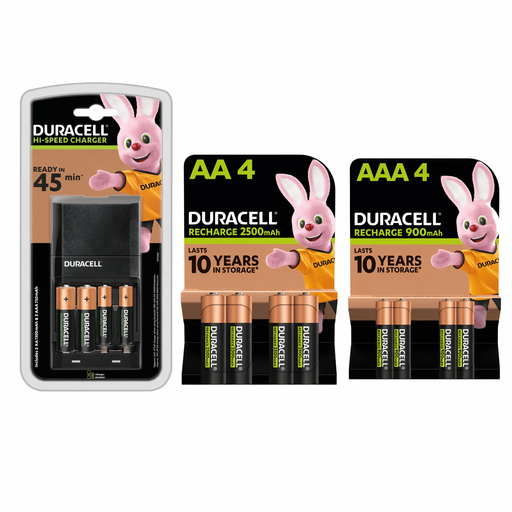 No image available
For preparing a two- or four-cell AA NiMH set, this kit pairs a charger with rechargeable batteries. Check the exact battery quantities and capacities in the bundle, whether the charger accepts a single cell, and which cells and conditions qualify for its stated 45-minute charge time.
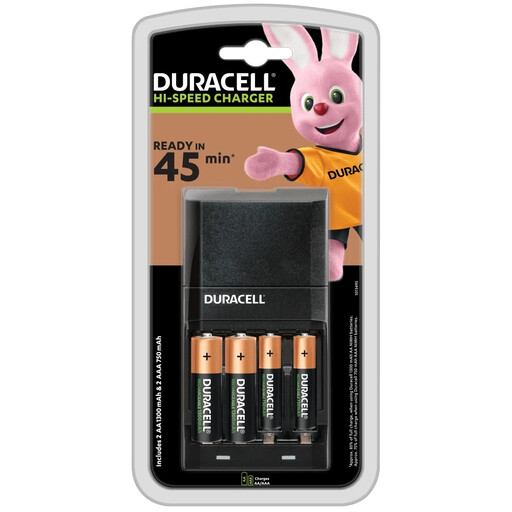 No image available
For preparing a spare AA set, this bundle lists two AA and two AAA batteries and a charger described for two or four AA/AAA NiMH cells. Check the charging time for the included cells and confirm the plug configuration before buying.
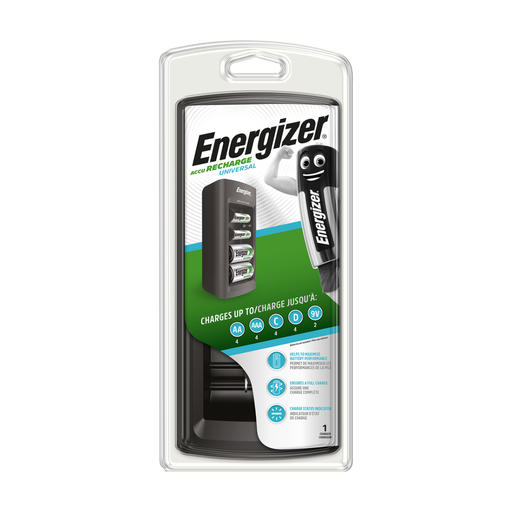 No image available
For consumers using rechargeable AA NiMH cells, this charger is described as supporting AA charging. Check its supported cell-count combinations, charging indicators and UK power connection if you need to charge a single cell or use it on the kitchen counter.
No: battery requirements depend on the exact model. DYMO describes label makers powered by alkaline cells, rechargeable packs or mains supplies, so check your model’s manual before buying removable rechargeable AA cells.
No. Energizer’s instructions for its NiMH-only AA/AAA charger exclude alkaline, carbon-zinc, lithium and other unsupported cells; match the cell chemistry to the charger’s instructions.
Yes, if the charger specifically supports single-cell charging. Panasonic specifies one to four cells for the BQ-CC17, but its BQ-CC51 requires same-size pairs.
A kitchen counter is suitable only if it meets the charger’s dry indoor-use instructions. Energizer says to use its charger in dry locations, so keep the charger away from the sink, water and excessive moisture.
Use appropriate battery and electrical-waste collection routes rather than household rubbish. GOV.UK identifies battery collection points at qualifying retailers and household waste recycling centres for electrical products; check which local collection point accepts each item.