Cottage-weekend planners
You can charge cells at home before setting off. Count the AAs your lantern needs so you can prepare a complete set, and consider carrying a charged spare set if you will depend on the lantern after dark.


Before choosing a charger, check how many AA cells the lantern takes and whether its instructions permit rechargeable NiMH cells. If you need to charge an odd number of cells, look for explicit individual-slot control; if departure is close, a rapid charger may help, but its advertised time applies only under stated battery conditions.
You can charge cells at home before setting off. Count the AAs your lantern needs so you can prepare a complete set, and consider carrying a charged spare set if you will depend on the lantern after dark.
Your lantern may take an odd number of AAs, or your rechargeable cells may have different remaining charges. A charger expressly designed to manage individual compatible cells avoids a requirement to charge matched pairs.
You have little time before departure. A rapid charger is worth considering, provided its stated charging conditions match the cells you plan to use and you do not mistake a partial-charge figure for a full charge.
Start with the lantern's battery instructions and required cell count. Then decide whether you have time to charge a complete set in advance, need independent slots or need a short top-up before leaving.
| Concern | What to check | Who this matters to |
|---|---|---|
| A ready set before travel | Check that the lantern permits rechargeable NiMH AAs, then compare its cell count with the charger's stated AA capacity and the cells included in any bundle. | If I can charge at home, I want a complete set ready before I leave rather than a speed claim I do not need. Roughly 44% of consumers would make dependable pre-trip preparation their primary concern. |
| Odd or uneven cell sets | Look for explicit individual-slot charging and the permitted number and type of cells; do not assume every multi-bay charger accepts a single AA. | When my lantern takes an odd number of cells, I need to charge that set without finding a partner cell. Around 33% of consumers would put charging flexibility first. |
| A top-up before departure | Compare the stated charge time with its cell count, capacity and resulting charge level, as well as the time you actually have. | If packing has run late, I care about how much usable charge I can obtain before leaving, even if it is not a full charge. About 23% of consumers would prioritise a rapid top-up. |
A charger that accepts rechargeable AAs does not establish that your lantern accepts them or that a particular set will provide the lighting you need.
Read the lantern manual or battery-compartment markings for its AA count and rechargeable-battery guidance before choosing cells and a charger.
Duracell's CEF27 figure is approximately 85% charge in 45 minutes for two 1300 mAh AA NiMH cells, not a full-charge time for every AA battery.
Allow more time where possible and prepare a charged spare set if the lantern will be important after dark.
Energizer's CHPRO instructions specify charging two or four AA or AAA NiMH cells. That arrangement may not suit a single cell or a three-cell lantern set.
If you need an odd-number set, check for manufacturer-confirmed individual charging, such as the one-to-four-cell control Panasonic specifies for compatible cells in its BQ-CC55.
Energizer warns that charging battery types other than the rechargeable NiMH cells specified for its chargers can cause leakage, rupture or explosion.
Identify each cell before charging and follow the exact charger instructions. Take unwanted batteries to an appropriate collection point rather than trying to recharge them.
The BQ-CC55 is relevant when an odd-number set or cells with different remaining charges make individual control useful.
Its UK AA/AAA NiMH range includes a route for charging ahead of travel and a route for a quicker, conditional top-up.
The CHPRO is a two-or-four-cell AA/AAA NiMH option for preparing a compatible set ahead of travel.
These chargers offer options for preparing rechargeable AA cells ahead of a cottage stay or topping them up closer to departure. Check your lantern's instructions and required number of cells before choosing a bundle.
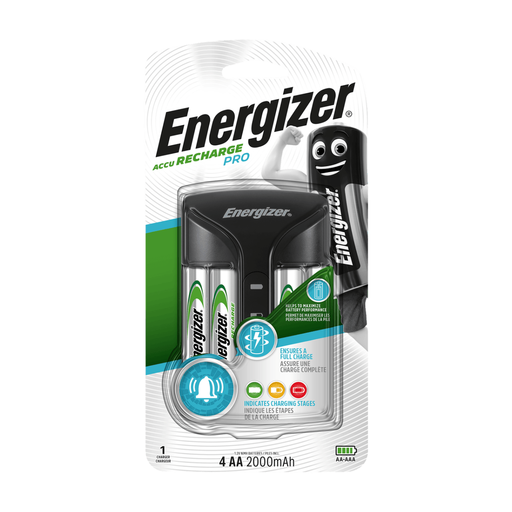 No image available
A bundle to consider when you can prepare a set before travel; check that its cells suit the lantern and that its charging arrangement fits the number you need.
Includes four 2000 mAh rechargeable AA batteries and a UK charger.
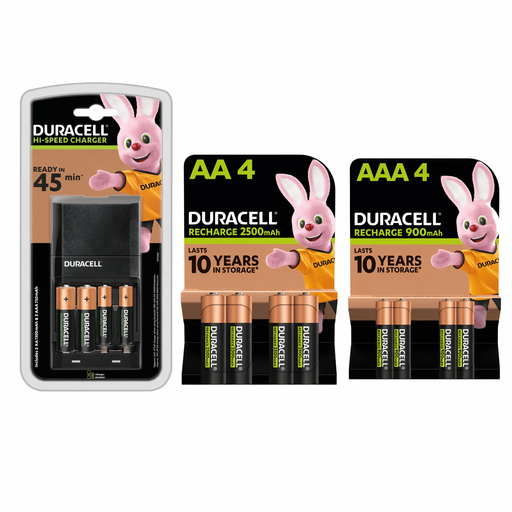 No image available
Consider this kit for a pre-departure top-up, but check the charge level promised under the stated conditions and whether the included AA count covers your lantern.
The bundle is identified as a 45 Minute Charger with AA and AAA batteries; confirm its exact contents before buying.
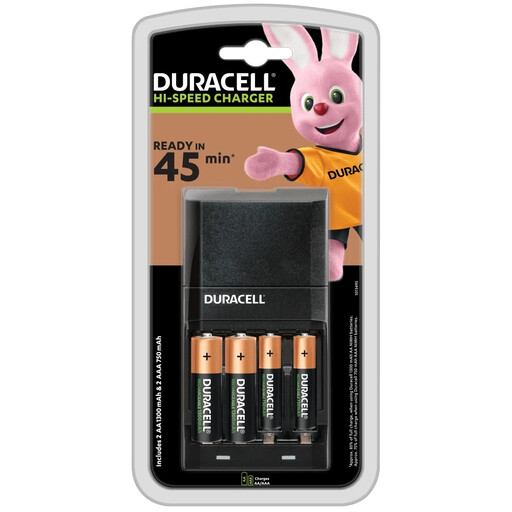 No image available
This bundle may suit a quick top-up if the lantern accepts its rechargeable AA cells. Check the charger's batch capacity before relying on it to prepare a larger set.
The bundle includes two AA and two AAA NiMH cells. Duracell's 45-minute CEF27 figure means approximately 85% charge for two 1300 mAh AA NiMH cells, not a guaranteed full charge.
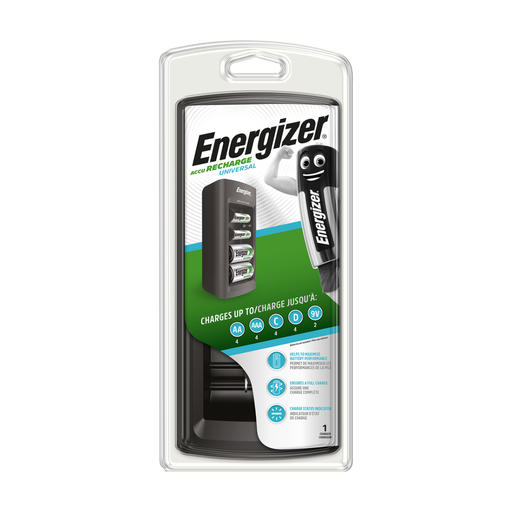 No image available
For planned lantern preparation, check its AA charging capacity, supported cell chemistry and plug type against the cells and setup you intend to use. If the lantern takes an odd number of cells, confirm whether the charger can charge that number.
No: use only the rechargeable battery types specified for your charger. Energizer warns that charging other types in its NiMH chargers can cause leakage, rupture or explosion; do not charge disposable, unidentified or damaged cells.
Yes, if the exact charger supports individual-cell charging. Panasonic specifies one-to-four-cell charging for compatible eneloop or eneloop pro AA/AAA cells in its BQ-CC55; other chargers may require two or four cells.
No. Duracell's CEF27 figure is approximately 85% charge in 45 minutes for two 1300 mAh AA NiMH cells. Check the stated conditions for your cells and allow more time if you need a fully prepared lantern set.
Follow your charger's instructions and use it in a suitable dry indoor location. Energizer's instructions call for dry-location use; follow polarity markings and do not use damaged equipment.
Take them to a suitable battery collection point. GOV.UK says most waste batteries can be taken to a local supermarket or another large shop that sells more than 32 kg of batteries a year.