Shared-desk radio users
When different people bring AA cells with different remaining charge levels, independently controlled slots and a status indicator for each cell make it easier to manage the charging routine.


For a shared desk, consider a NiMH AA charger with independently controlled slots and a separate status indicator for each cell. Those features matter when people add cells at different times or with different remaining charge levels. Choose faster charging when turnaround matters, or more slots when several sets regularly need preparing; in either case, check that the radio accepts the rechargeable cells you plan to use.
When different people bring AA cells with different remaining charge levels, independently controlled slots and a status indicator for each cell make it easier to manage the charging routine.
If cells need to be ready before a shift or event, a charger with a stated charging time may help you plan, provided its instructions cover the batteries and the conditions in which you will use it.
For a desk that regularly prepares several sets of rechargeable cells, an individually monitored eight-slot charger may reduce the need for repeated charging cycles.
Check the radio and battery chemistry before comparing slot controls, charging time or capacity.
| Concern | What to check | Who this matters to |
|---|---|---|
| Battery compatibility | Match the charger’s stated chemistry to the rechargeable AA cells, and check the radio’s battery instructions before switching cells. | If I’m switching from disposable AA batteries, I need to know that both the charger and radio suit the rechargeable cells. Roughly 42% of consumers put battery compatibility first. |
| Independent slots and status | Look for explicit independent charging control and a separate indicator for each slot; check what the indicators actually show. | When several people use the desk, I want to tell which cells are still charging without treating them as one batch. Around 33% of consumers make individual cell management their primary concern. |
| Turnaround and capacity | Compare stated charging times under the specified battery conditions, then count how many cells need charging at once. | If the next radio set must be ready soon, or several sets are routinely queued, waiting time and available slots shape my choice. About 25% of consumers prioritise turnaround or capacity. |
AA describes a size, not whether a battery is rechargeable. Energizer warns that attempting to recharge non-rechargeable cells increases the risk of leakage or rupture.
Read each cell’s label and use it only with a charger that explicitly supports its rechargeable chemistry. Check the radio’s battery requirements separately.
A short stated charging time is useful only if the charger can be used as its instructions require. Energizer’s charger instructions specify indoor, dry use and warn that cells may become hot while charging.
Check the instructions and choose a location where the charger can be kept dry and used safely; do not select a rapid model solely on its advertised time.
More slots help when several sets regularly need preparing, but slot count alone does not make charging one radio’s cells easier to manage.
Count the cells that need charging simultaneously. For a smaller routine, prioritise suitable slot controls and clear status; consider eight slots when the desk routinely handles multiple sets.
Used rechargeable cells need an appropriate collection route rather than being mixed into the desk’s ordinary waste.
GOV.UK says most waste batteries can be taken to a local supermarket or another large shop that sells batteries. Check where the nearest battery collection point is before clearing out old cells.
Its NiMH AA/AAA charger range includes models for users who want independent slots and visible charging progress.
Its AA/AAA NiMH charger options include models aimed at shorter charging turnaround.
Its multi-slot options are relevant when a shared desk regularly manages several sets of rechargeable cells.
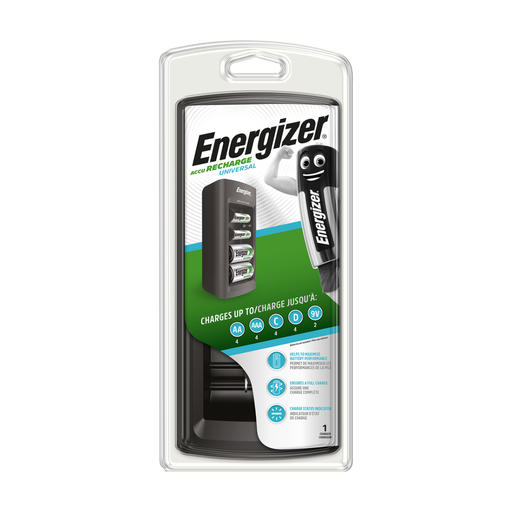
This charger is relevant to preparing rechargeable NiMH AA cells for a radio. If independent management of cells is important at your shared desk, check its slot controls and indicators before choosing it.
 No image available
A charger to consider for preparing rechargeable NiMH AA cells at a shared desk. Check whether it controls and indicates each slot separately if people will add cells at different times, and confirm that the radio accepts the cells you intend to use.
No: use an AA charger only with rechargeable cells of a chemistry it explicitly supports. Energizer warns that attempting to recharge non-rechargeable batteries increases the risk of leakage or rupture.
Yes. Check the exact radio’s manual or battery-compartment guidance before buying rechargeable cells; the charger’s ability to charge NiMH AA batteries does not establish that they suit the radio.
Individual slots are useful when people bring different numbers of cells or add them at different times. Panasonic states that its BQ-CC55 independently charges one to four compatible AA/AAA cells; check the exact model for separate status indicators as well.
They can if the location meets the particular charger’s instructions. Energizer’s instructions for its charger specify indoor, dry use and warn that batteries may become hot, so check the model’s directions and choose the charging location accordingly.
Use a suitable battery collection point. GOV.UK says most waste batteries can be taken to a local supermarket or another large shop that sells batteries; check that a collection point is available before taking them there.