Households preparing a torch in advance
You keep a torch for power cuts or home tasks and can recharge its AA cells before you need them, rather than relying on a last-minute top-up.


Choose a charger by the number of rechargeable AA cells your torch needs and whether you want to charge a single spare: individually controlled slots suit one-at-a-time charging, while two-or-four-cell models suit planned batches. Check what a quoted charging time measures before paying for speed, and confirm that your torch accepts rechargeable NiMH AA cells.
You keep a torch for power cuts or home tasks and can recharge its AA cells before you need them, rather than relying on a last-minute top-up.
You sometimes have one AA cell to recharge, or also use AAA rechargeables, and want to check whether a charger controls its slots individually.
You may find the torch’s cells flat shortly before use and need to distinguish a partial-charge claim from a full-charge time.
Check your torch’s required cell count and whether its instructions allow rechargeable NiMH AA cells; then decide whether single-cell flexibility, charging time or planned batch charging matters most.
| Concern | What to check | Who this matters to |
|---|---|---|
| Single-cell flexibility | Check whether slots charge cells independently and which AA/AAA combinations the model accepts. | If my torch uses an odd number of cells, I want to recharge one spare without waiting for a pair. Around 40% of consumers put single-cell flexibility first. |
| Charging time | Check the stated cell capacity, number of cells and whether the quoted time reaches a partial or full charge. | When I need the torch soon, I want to know how much charge its cells will have after the advertised wait. Faster readiness is the primary concern for around 30% of consumers. |
| Planned batch charging | Confirm the supported cell count and allow for the model’s stated charging window. | I can prepare a pair or set of cells well before using the torch, so a simpler charger may meet my needs. Around 20% of consumers prioritise planned batch charging. |
| Compatibility and charging location | Check the cells’ chemistry against the charger instructions and choose an uncovered, hard, flat, heat-resistant surface away from flammables. | Before leaving cells to charge on my kitchen counter, I want to avoid a battery mismatch and choose a suitable place for the charger. Around 10% of consumers make these checks their primary concern. |
AA describes the cell’s size, not its chemistry. Energizer warns that charging unsupported rechargeable or non-rechargeable batteries can cause leakage, rupture or explosion.
Read the cell label and charger instructions. Put only compatible rechargeable NiMH cells in a NiMH charger; never put disposable AA cells in it.
Duracell’s 45-minute claim for the Hi-Speed Advanced Charger CEF27 means approximately 85% charge with its 1300 mAh AA NiMH cells, not a full charge for every AA rechargeable.
Compare the specified cells, capacity and charge level before deciding whether a rapid model meets your deadline.
A covered charger or one placed near flammable materials creates an avoidable charging hazard.
Follow the manufacturer’s instructions. Greater Manchester Fire and Rescue Service advises using a hard, flat, heat-resistant surface away from flammables and not leaving a charging battery unattended.
Used rechargeable AA cells need an appropriate battery collection route rather than a household rubbish bin.
UK government guidance identifies collection points at many supermarkets and suitable retailers, as well as battery recycling facilities.
The BQ-CC55 is a route to consider when charging individual AA spares or a mix of AA and AAA rechargeable cells.
The UK Base and Pro models offer two-or-four-cell AA/AAA NiMH charging for households preparing cells in batches.
The Hi-Speed Advanced Charger CEF27 is worth examining when a time-sensitive top-up matters more than preparing cells well in advance.
These charger and battery options are relevant to preparing AA cells for a household torch. Before choosing a kit, check that your torch accepts rechargeable NiMH AA cells and that the charger’s cell-count and power requirements suit how you will use it.
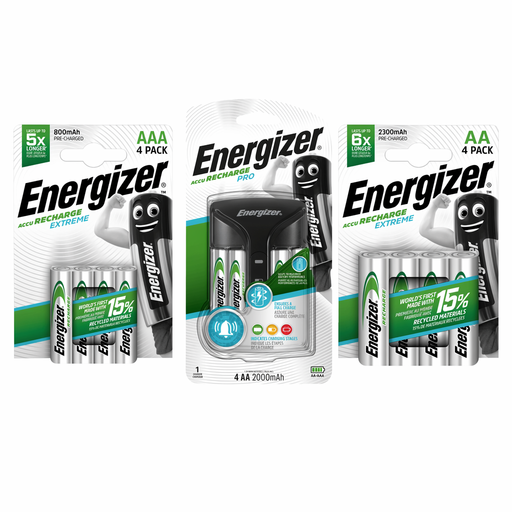 No image available
Consider this kit if you want a charger and rechargeable cells together for preparing torch batteries. The named bundle includes a Pro Charger and Extreme AA and AAA batteries; confirm the included quantities, cell chemistry and charging arrangement on the product page.
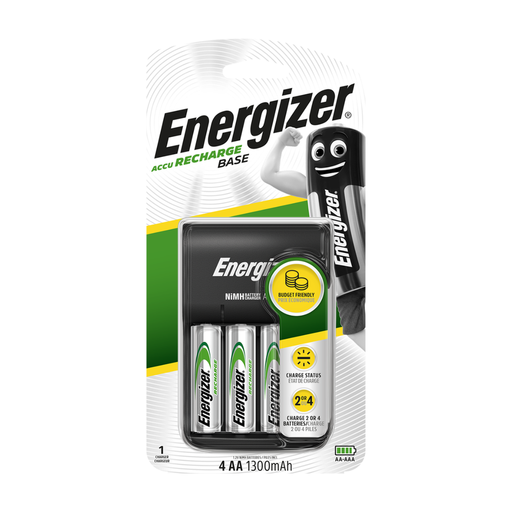 No image available
Consider this USB-powered kit if you want four rechargeable AA cells to prepare alongside a charger. Check that you have a compatible USB power source, whether an adapter is included and whether the charger accepts a single cell if you rotate spares individually.
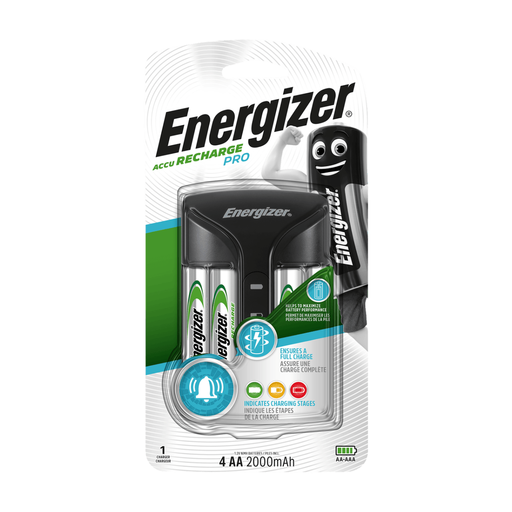 No image available
Consider this UK charger bundle if you normally prepare a set of AA cells ahead of using the torch. It names four rechargeable 2000 mAh AA batteries; check the charger’s supported cell counts if you also need to top up one spare at a time.
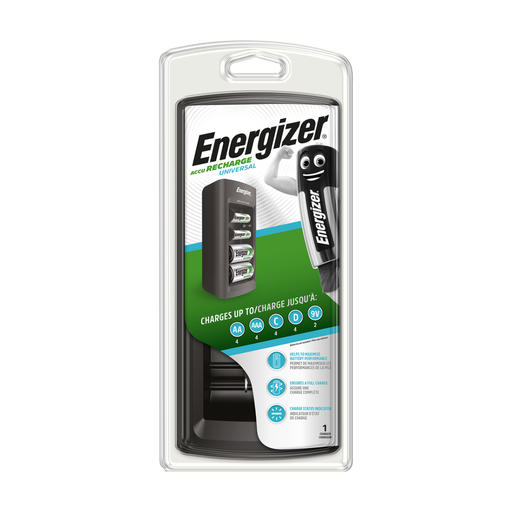 No image available
Consider this charger if you want to check one model against several rechargeable battery sizes as well as your torch’s AA cells. Confirm its supported chemistries, how many AA cells it charges at once, whether it accepts a single cell and whether batteries are included.
No. AA identifies a size, not a rechargeable chemistry. Use only cells supported by the charger instructions; Energizer warns that charging unsupported rechargeable or non-rechargeable batteries can cause leakage, rupture or explosion.
Single-cell charging is useful if your torch takes an odd number of AAs or you rotate one spare. Panasonic says its eneloop BQ-CC55 individually charges one to four compatible AA/AAA cells; if you always recharge pairs or sets of four, check whether a two-or-four-cell model meets your needs.
Yes, if the surface is hard, flat and heat-resistant and the charger is uncovered and away from flammable materials. Follow its instructions and remain available while it charges; Greater Manchester Fire and Rescue Service advises against leaving a charging battery unattended.
No. Duracell UK’s CEF27 claim is approximately 85% charge in 45 minutes with Duracell 1300 mAh AA NiMH cells. Check the specified capacity, cell count and charge level before comparing that time with another charger’s claim.
Take them to an appropriate battery collection point rather than putting them in household rubbish. UK government guidance identifies collection at many supermarkets and suitable retailers, alongside battery recycling facilities.