Planned-session recorder users
If meetings, interviews or notes are recorded at known times, you can prepare a compatible AA set in advance. A visible charge-complete indication helps you check it before leaving.


Check your recorder’s manual for its required battery type and AA-cell count before choosing a charger for rechargeable NiMH cells. For a set prepared ahead of time, prioritise compatible charging and a clear completion indicator; stated charge times matter more for short-notice recording, while test functions are most relevant when you manage several rechargeable sets.
If meetings, interviews or notes are recorded at known times, you can prepare a compatible AA set in advance. A visible charge-complete indication helps you check it before leaving.
When a recording may come up with little warning, compare the stated charging time for the cells you use and look for an indication that charging has finished. Treat the stated time as a planning estimate, not a deadline.
If you rotate several AA or AAA sets across devices, individual monitoring may help you manage cells separately. A capacity-test function becomes more relevant when you need information about the condition of older cells.
Start with the recorder’s permitted battery chemistry and cell count. Then choose the charging time, slot flexibility and battery-maintenance functions that fit how you prepare for recordings.
| Concern | What to check | Who this matters to |
|---|---|---|
| Cell compatibility | Confirm that the charger supports rechargeable AA NiMH cells and that your recorder’s manual permits those cells. Check the required cell count and any battery-type setting. | I want to know that the cells I prepare are permitted in my recorder, rather than choosing by AA size alone. Around 44% of consumers put compatibility and safe cell handling first. |
| Ready time | Compare the stated time for your cell count and capacity, and check whether the charger shows when charging is complete. | With a recording approaching, I need enough time to charge a set and check that it is ready. For around 33% of consumers, turnaround is the primary concern. |
| Managing several sets | Look for individual-slot monitoring; consider a capacity-test programme if you need to assess older cells. | When I rotate several rechargeable sets, I want to keep track of cell condition instead of relying only on a completed charge. Battery-set maintenance comes first for around 23% of consumers. |
AA describes the cell’s size, not whether it can be recharged or whether your recorder accepts rechargeable NiMH cells.
Check the charger’s permitted chemistry and the recorder manual’s battery requirements. Do not put disposable AA cells in a NiMH charger unless that charger’s instructions explicitly permit it.
Manufacturer charging times depend on the specified cells and conditions; battery condition and temperature can change how long charging takes.
Allow time before an important recording and check the charger’s completion indication rather than relying on the quoted time alone.
Discharge, refresh and capacity-test programmes serve a different need from simply charging cells before a session.
If you do not maintain several sets or need to assess older cells, focus on compatibility, suitable slot operation and a clear completion indication.
A product listing alone does not establish current availability or that the pictured bundle and plug match what you need.
Check live availability, the exact model, included cells and supplied plug before relying on an order for a scheduled recording.
The eneloop range includes rechargeable AA and AAA cells and chargers for different charging routines.
Energizer offers AA and AAA NiMH charger kits, including models supplied with rechargeable cells.
Ansmann’s AA and AAA NiMH chargers range from straightforward charging models to equipment with battery-maintenance programmes.
These options relate to preparing rechargeable AA cells for a voice recorder: one is a USB charger bundled with four cells, while the other is a charger to consider if you already have suitable cells. Check your recorder’s battery requirements before choosing either.
 No image available
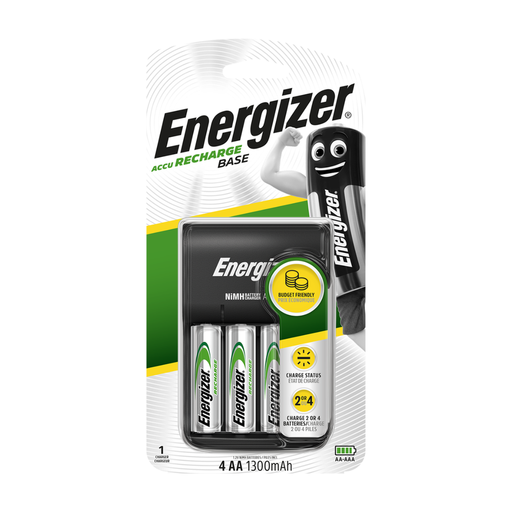
Consider this bundle if you need a charger and an AA set for planned recording sessions, provided the cells meet your recorder’s requirements.
The product title specifies a USB charger and four 1300 mAh AA rechargeable batteries. If turnaround or charging a single cell matters, confirm the charge time and slot behaviour for this exact model.
 No image available
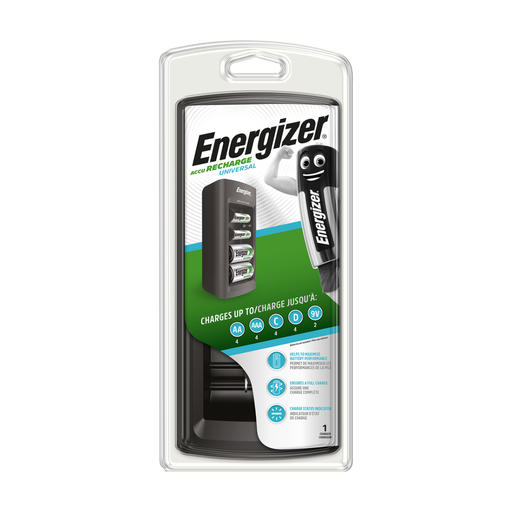
Consider this charger if you already have rechargeable AA cells and your recorder permits their use.
Before ordering, confirm the supported cell chemistry, supplied plug and charging arrangement for the number of cells you use. If a session has a tight timetable, check the stated time for your cells rather than applying another charger’s estimate.
Do not charge ordinary alkaline AA batteries in a NiMH charger unless its instructions explicitly permit that chemistry. Follow the charger manufacturer’s supported-battery instructions; Panasonic says its BQ-CC55 identifies a dry battery as an error and shuts off the affected slot.
Yes, if your charger supports charging a single cell: Panasonic specifies individual charging for the BQ-CC55, and Rapid Electronics lists the Ansmann Powerline 4 Smart for one to four AA or AAA cells. Check the recorder manual for its installed-cell requirements before preparing a set.
Charge with enough margin to check the completion indicator before you need the recorder; a maker’s quoted time is an estimate for specified cells. Panasonic gives approximately 90 minutes for two AA eneloop cells in its BQ-CC55 guidance, while Energizer quotes approximately four hours for two or four AA or AAA NiMH cells with its Pro Charger. Neither figure should be applied to a different charger or cell arrangement.
Take spent rechargeable batteries to an appropriate battery collection point rather than putting them in general waste. UK guidance from the Office for Product Safety and Standards and the Department for Environment, Food & Rural Affairs says distributors and retailers supplying more than 32 kg of batteries a year must provide a take-back service.